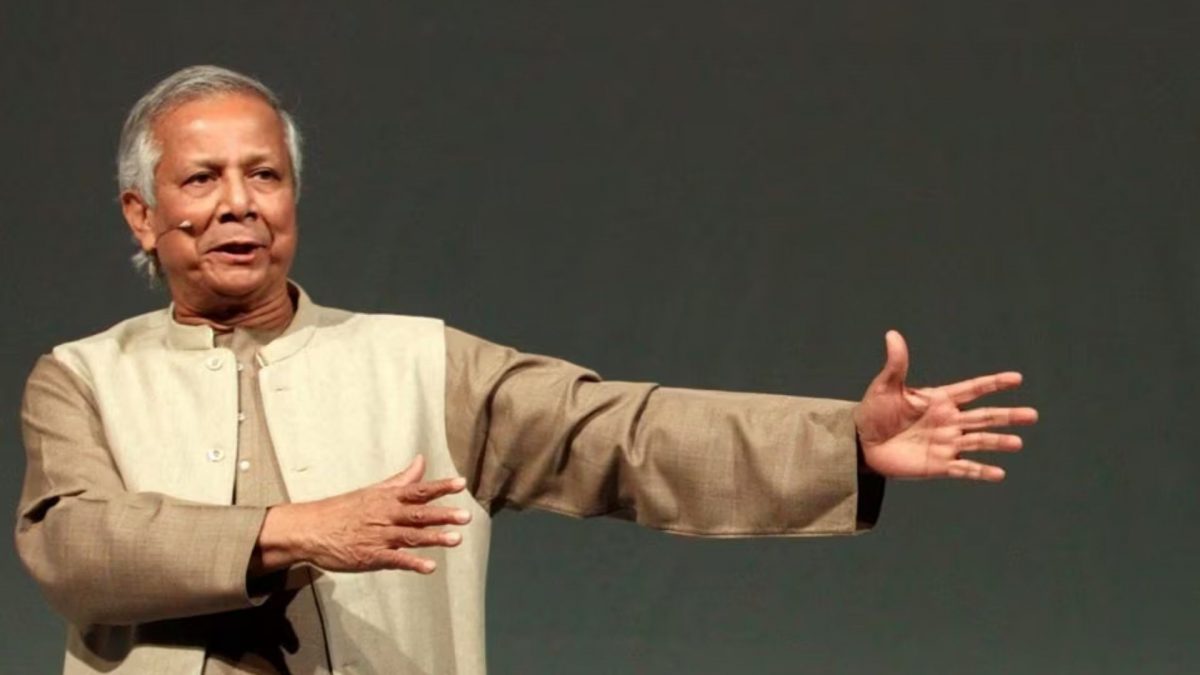
 "Muhammad Yunus, Bangladesh interim government’s chief adviser. Source: Reuters.")
Muhammad Yunus, the chief adviser of Bangladesh’s interim government, convened a meeting of all political parties over ties with India amid Iskcon row. The all-party meeting, however, had a conspicuous absentee in Awami League, the party of former Prime Minister Sheikh Hasina — now exiled and sheltering in India.
It was the first such large political meeting convened by Yunus since he took over the reins of the country’s government in August, following a mass agitation and the ouster of Hasina. During the political huddle, Yunus sought suggestions to counter what was described as “aggression against the nation”.
The meeting was called in the wake of the security breach at the Assistant High Commission of Bangladesh in Agartala, the capital of Indian state Tripura. During the December 2 vandalism, protesters removed the Bangladesh flag and attempted to damage property. The Indian police arrested seven persons in connection with the incident and suspended three police-persons. A police officer faced disciplinary action.
While Yunus’s focus during the meeting was on addressing India concerns, the political parties urged him to hold early elections — a task he was entrusted with when the agitators picked him to head the interim government after the fall of the Hasina rule.
3 big agendas of Yunus meet
During the meeting, Yunus sought political leaders’ input on three critical issues:
1 - alleged propaganda against Bangladesh in India and other parts of the world
2 - an attack on the Bangladesh mission in Agartala
3 - accusations of minority persecution within Bangladesh
‘Cancel all agreement between Bangladesh-India’
Briefing media after the meeting, adviser of law affairs Asif Nazrul said, “The meeting condemned India’s attempts to establish cultural hegemony over Bangladesh and its economic harassment of our country. It also condemned India’s attempts to interfere in Bangladesh’s internal affairs. The parties urged the government to reveal all agreements that were concluded with India in the last 15 years and cancel all those agreements that are harmful for Bangladesh."
Nazrul, one of the leading spokespersons of Bangladesh interim government, said that the meeting chaired by Yunus did not include ‘fascist parties’ Awami League and its allies such as the Jatiyo Party of the late General Hossein Mohammed Ershad.
Impact Shorts
More Shorts“Apart from the fascist Awami League government and their allies, all political parties of Bangladesh participated in the meeting. There were differences of opinions among us but we were united in our approach to safeguard independence, sovereignty and honour of Bangladesh,” a report by The Hindu quoted Nazrul as saying.
‘Big countries not liking Bangladesh’s freedom’
According to a report by The Times of India, Yunus, without directly naming India, spoke about the escalating tensions with the neighbouring country. He claimed that there has been a coordinated “campaign” by “big countries” to undermine the legitimacy of the uprising that brought his administration to power.
He further alleged that “big countries” are involved in spreading misinformation about the new government.
“Many are not liking our freedom, the (new) independence, desperate efforts are being made to upset it,” Yunus told political parties.
Yunus also urged the political parties to come together and take a collective action to counter the narrative saying that the July-August uprising in Bangladesh, which led to the ouster of Sheikh Hasina, as destabilising event.
“The quarters who did not like the uprising are trying to depict it domestically and internationally as something dangerous,” he said.
“We have to tell the entire world that we are one. We achieved this together. This has now become a matter of our existence,” Yunus further said.
Yunus govt claims ‘Hindutva forces’ fostering hatred towards Bangladesh’
The Yunus-led government accused India’s “governing elite” of attempting to create an “internal political issue” out of everything that was happening beyond the border of the two neighbouring countries.
“If this happens, it will be detrimental to India’s domestic politics. Anti-Bangladesh and anti-Muslim politics won’t serve India’s national interest or contribute to its unity,” a report by ToI quoted information adviser Nahid Islam as saying.
Nahid, one of the student activists who helmed the uprising against ousted PM Hasina before joining the interim govt, urged India to “cease false propaganda” against Bangladesh and uphold “harmony”.
“Bangladesh shares historical and cultural ties with West Bengal, Tripura and Assam; they are our stakeholders. During the uprising in Bangladesh, students from Kolkata and Delhi stood in solidarity with us and protested Hasina’s atrocities,” he said.
He further claimed that “Hindutva forces” didn’t want democratic relations and harmony between India and Bangladesh.
“They perceive the Bangladesh uprising and the political awakening of its students as a threat. As a result, they are fostering hatred towards Bangladesh,” Nahid said.
With inputs from agencies.