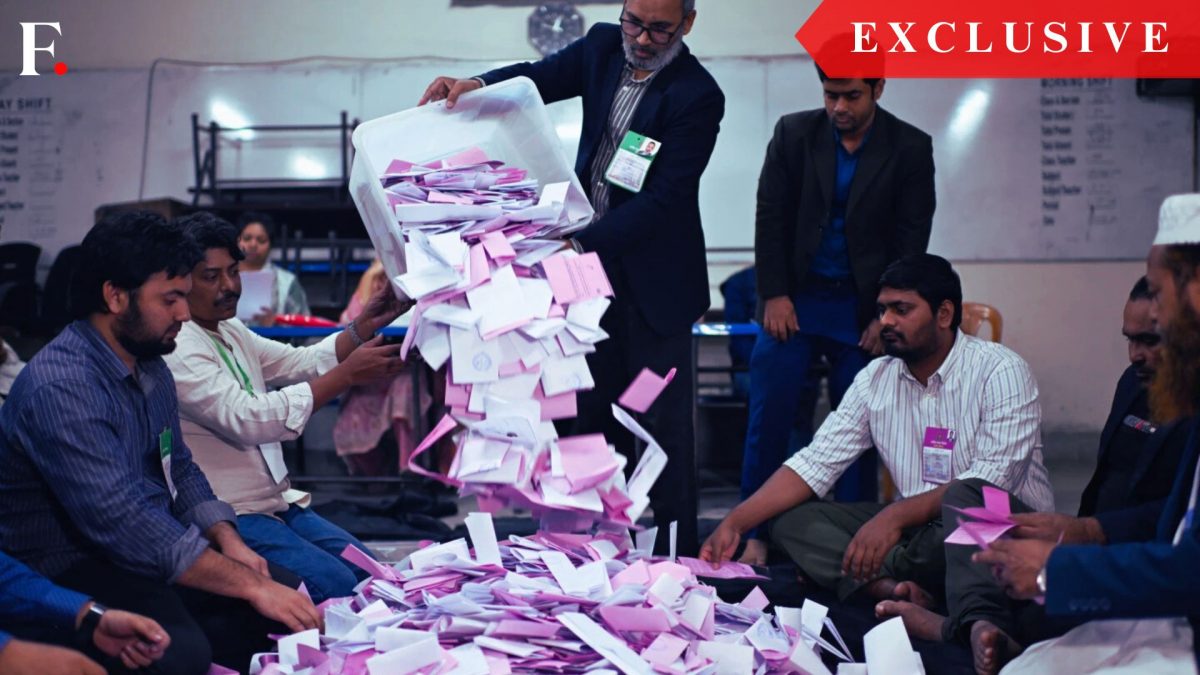
 "Polling officials begin the counting of votes cast for the national parliamentary election in Dhaka, Bangladesh, Thursday, Feb. 12, 2026. AP")
On February 12, Bangladesh chose a new government, with the Bangladesh Nationalist Party (BNP) chairman Tarique Rahman becoming the country’s prime minister. The 13th national parliamentary election was watched closely since they came one and a half years after a public uprising overthrew the government of former Prime Minister Sheikh Hasina.
While Rahman’s BNP witnessed a landslide victory, many questioned the integrity of the polls. One of Bangladesh’s most prominent political parties, Hasina’s Awami League (AL), was barred from contesting in the polls by the interim government led by Nobel laureate Muhammad Yunus, who took charge after the fall of the Hasina government. The polls were also happening in an extremely turbulent time, when minorities within the country had been severely persecuted.
The run-up to the national election and the post-election violence have kept Bangladesh politically on edge, with observers and commentators known for their neutral or critical view of the establishment fear persecution. Against this backdrop, a rights activist and top court lawyer in Bangladesh spoke with Firstpost on the condition of anonymity, assessing the country’s parliamentary election. During the interview, she shared her take on the polls, the transitional period led by Nobel Peace Prize winner Muhammad Yunus and what the future of the country looks like under Tarique Rahman.
‘We can’t call it a democratic transition’
When asked about her take on the election outcome, the Bangladeshi rights lawyer emphasised that the election process was a regime reset and can not be called a democratic transition. “The way things have unfolded since August 5 and the entire process of the election indicate that it was merely a regime reset. We can not call it a democratic transition since the largest political party of Bangladesh, namely Awami League, was not allowed to participate in the election,” she told Firstpost.
When asked if Bangladesh witnessed a change in the governing system, she noted that it is simply a change of government. “I don’t think we can name it a change of governing system yet. It’s just a change of government, a puppet government planted by national and international players,” she said.
The rising Jamaat
This year, Bangladesh’s Islamist party, Jamaat-e-Islami, recorded its best performance in national elections. Due to its radical nature, the party was banned from contesting polls until last year, when the country’s court lifted the ban.
When asked about the rise of Jamaat and whether the two-party system has collapsed in Bangladesh, the Bangladeshi lawyer explained that the “rise of Jamaat does not mean the fall of two major political parties in Bangladesh”.
Quick Reads
View All“The previous election results showed that Awami League and BNP respectively had at least 30 per cent of voters, whereas Jamat had only 4 per cent of voters. In the recent election, AL was not allowed to contest, and according to many people, the election was engineered. The true percentage of Jamaat voters could not be identified. Also, nearly 50 per cent of voters did not go to vote. This indicates BNP and AL still have an appeal to the masses,” the Bangladeshi lawyer explained.
“We can certainly say people of Bangladesh are against extremism and religious fanaticism. Election result indicates this, though many politicians and political analysts are claiming that the election was engineered to empower Jamaat.”
“History shows that Bangladesh has seen violence and conspiracies in politics since its birth. The process of Islamisation began after the brutal murder of Bangabandhu, and after the ouster of Sheikh Hasina, the same process has started,” she said.
Yunus ran a ‘puppet government’
Following the overthrow of the Hasina government, the group of agitators chose its Nobel laureate, Muhammad Yunus, to lead the interim government. Many criticised Yunus for his government’s inability to take hold of the law and order situation in the country and for taking one and a half years to conduct polls.
“It was a puppet government which did nothing for democracy, economy or maintenance of law and order of the country. Seemingly, it made sure the National Citizen Party (NCP) got functional, Jamat became powerful, and AL remained out of politics. Meanwhile, the advisors made their fortune, made unrealistic deals and destroyed the social structure. Thus, it can be characterised as a chameleon government,” the Bangladeshi rights lawyer told Firstpost.
“They created obstacles in the path of democracy. They allowed the culture of mobocracy to diminish freedom of speech. They weakened all the institutions. It would be difficult for Bangladesh to ensure substantive democracy,” she said.
When asked if the Yunus government created a precedent for unelected authority, she insisted that his regime was a learning experience for the people of Bangladesh. “One incident or exception can not be an example for politics. Rather, people of Bangladesh, especially youths, learned from this incident, and I hope they will be vigilant in future if a group of agenda-oriented people try to do the same,” she said.
“The Yunus government wanted to create a fearful atmosphere so that people remain silent abt their inefficiency or agendas. Clearly, their agenda was to promote Islamists and undermine democracy and socio- plotical structure so that Bangladesh becomes a weak state. A weak state with a puppet government can serve the purpose of many international players. For this, they had to accommodate radical elements and promote Islamist’s. In this process, minorities, women, AL activists and progressive people were persecuted.”
“The court has already declared a verdict relating to the caretaker government. Now we have to wait and see what the new government brings to the table. Limits of power are desirable for accountability; otherwise, that creates more obstacles for democracy,” the lawyer said.
What the new government brings to the table?
When asked what her expectations are from the Rahman government, the Bangladeshi lawyer laid out the key tasks at hand. “Political stability is a must for Bangladesh, but that does not mean the rule of law should not prevail. It is the duty of the government as well as the political parties to ensure justice is delivered to the people who lost their dear ones during the August violence, deliver justice for those police officers who were brutally killed, and ensure punishment for the mobocracy,” she told Firstpost.
“A truth commission should be formed to find out the truth behind all these. The commission also should find out why radicals and criminals alike were freed right after August, and whether the allegations of corruption against the Yunus government are true.”
When asked about her expectations for Rahman leading the country, she insisted that he should be given some time. " We have to allow some time to comment on this. But to me, he is already compromising with the Islamists," she said.
“He introduced a prayer session on the Shahid Minar; he is hanging Islamic scripture on the wall while he is on TV. He is doing all these to show people he is not less of a Muslim. Why is it necessary? Is he fearful of the Islamists’ rise? If so, then how will democracy flourish? How women’s rights and minority rights shall prevail,” she exclaimed.
What lies ahead for India and Bangladesh?
The rights lawyer emphasised that India and Bangladesh are not just neighbours, but they “share history and culture”. “It has been proven many times that India is an ally of Bangladesh. But certain political parties under the influence of national and international players use anti - Indian rhetoric for political gain,” she said.
She emphasised that sour ties between India and Bangladesh would be detrimental to the wider region. “In the long run, this should not prevail because we need a peaceful South Asia as well as a prosperous Bangladesh,” she said.
She also maintained that Rahaman himself understands the gravity of the situation. “There is widespread rumour that Tarique came back after he got a green signal from India. Even if this is not true, I am sure now Tarique understands India is important for our own stability and growth,” she said.
“If we have to compete with India, that should be in a constructive way - we have focus on our economy, IT sector, education, democratic institutions, diplomatic skills, etc., rather than using anti-Indian rhetoric to amuse a certain group of people. Therefore, holding onto the Yunus view will give us big zeros but no progress,” she said.