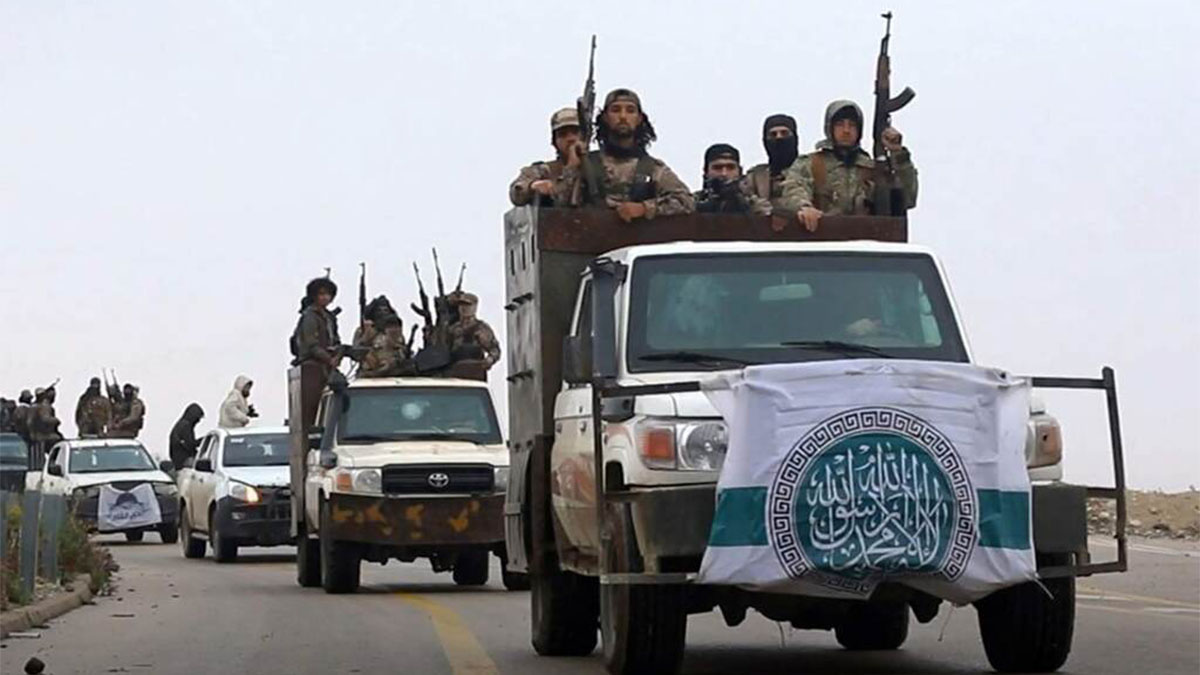
 "(File) Members of Hayat Tahrir al-Sham, or HTS, AP")
In a dramatic turn of events, the Syrian government led by Bashar al-Assad collapsed with the Hayat Tahrir al-Sham (HTS), once an Al Qaeda affiliate, taking control of the country. This sudden shift in the Syrian situation has forced nations to reassess their position vis-a-vis Damascus. The fall of Assad’s regime has prompted the Biden administration to make careful decisions about its foreign policy in the region, particularly regarding HTS, which has been designated a terrorist group since 2012.
The US response
In light of the sudden shift in power, the Biden administration has signalled that it might recognise and support a new Syrian government, provided it meets several conditions. These include renouncing terrorism, securing chemical weapons and ensuring the protection of minority rights. Secretary of State Antony Blinken emphasised that the US would engage with groups in Syria without explicitly naming them to facilitate a smooth transition from Assad’s regime. Despite HTS’s terrorist designation, the US has left the door open for potential dialogue with the group, indicating flexibility in the face of rapidly changing circumstances. According to an Associated Press report, Blinken’s statement noted that the US would support an inclusive, transparent government transition but highlighted that Syrians themselves must decide their future, free from foreign interference.
HTS: From terrorists to potential partners?
HTS’s ascent has been marked by its controversial history and violent tactics, but its evolving stance has raised questions about its future role in Syrian governance. The group has historically been associated with Al Qaeda and responsible for many brutal attacks. However, in recent years, HTS has distanced itself from its extremist past. According to the BBC, its leader, Abu Mohammed al-Jolani, now goes by the name Ahmed al-Sharaa and has publicly advocated for religious tolerance and the protection of Syria’s minority groups. This shift in rhetoric has garnered attention from the international community, especially from the UN and the US.
The US State Department has signalled that it will review HTS’s designation if the group takes concrete steps to mend its ways that led to its terrorist label. This move is significant, as it opens the possibility of removing sanctions and providing the group with access to international aid. According to US officials, HTS could earn broader support if it forms an inclusive government that represents Syria’s diverse religious and ethnic communities, which would also enable greater humanitarian assistance and the return of refugees, a Reuters report said.
Impact Shorts
More ShortsGlobal reactions: Changing alliances
While HTS’s shift may signal a potential thaw in its relations with the West, other global players have varied responses. Israel, which has conducted military strikes against Syrian military targets, including those related to chemical weapons, is watching the evolving situation closely. The White House has reaffirmed its support for Israel’s right to defend itself but has been careful not to commit to a clear stance on the legitimacy of the post-Assad Syrian leadership. Israel’s seizure of a buffer zone in the Golan Heights following Assad’s fall highlioghts its concerns about regional stability, particularly regarding Iran’s influence in Syria.
Iran, a key ally of Assad’s regime, has also adapted its approach following his ouster. Tehran has initiated direct communication with the new rebel leadership, reflecting its desire to maintain influence in Syria despite the loss of its longstanding ally. Iranian officials have expressed concerns about the possibility of a hostile, post-Assad Syria that could sever its vital connections to Hezbollah and disrupt its access to the Mediterranean. However, Iran has shown a willingness to engage diplomatically with the new leadership in a bid to preserve its regional influence, the Reuters said.
The UK stance
In the United Kingdom, the situation is similarly fluid. The UK government, which has long designated HTS as a terrorist organisation, has been forced to reconsider its stance. Cabinet Minister Pat McFadden acknowledged that the government is reviewing whether to maintain HTS’s designation, particularly as the group’s leadership has shown signs of moderation. McFadden emphasised that the UK would need to make a decision quickly, given the pace of events on the ground in Syria. According to the BBC, the UK’s approach to HTS will likely depend on whether the group’s actions align with its stated commitments to protect minorities and uphold citizens’ rights.
Russia’s position
For Russia, the fall of Assad’s regime represents a loss of a crucial ally in the region. Russia has invested heavily in Syria, both militarily and diplomatically and its military bases in Syria are of strategic importance. Following Assad’s ouster, Russia is scrambling to negotiate with the victorious rebel factions, including HTS, to ensure its continued access to these bases. The Kremlin has made it clear that it seeks to preserve its influence in Syria and prevent a shift toward a pro-Western government. Russian officials are closely monitoring the situation and are prepared to engage with the new leadership to safeguard their interests in the region.
Moscow has long condemned any group that threatened Assad’s authority framing Syria’s conflict in terms of national sovereignty. The Russian government had unwavering support for Assad, committing military resources to defend his regime. Russia strongly denounced HTS’s rise to power viewing it as a destabilising force in the region. For Russia, which has been a staunch ally of Syrian President Bashar al-Assad throughout the civil war, the rise of HTS is nothing short of a challenge.
India’s cautious approach
India’s response to HTS’s rise has been measured and cautious. As a nation with strategic interests in West Asia, New Delhi’s position on HTS is focussed on ensuring stability and combating terrorism. India has long maintained that it supports Syria’s sovereignty and territorial integrity emphasising the importance of a political solution that includes all Syrian factions—except those that are irredeemably tied to terrorism.
The Ministry of External Affairs issued statements urging caution in dealing with HTS, noting that while the group has undergone changes in its leadership and tactics, its past as a jihadist organisation cannot be ignored.
An uncertain road ahead
As the situation in Syria continues to unfold, the world watches closely to see whether HTS can transition from a terrorist organisation to a legitimate governing entity. The international community remains divided on how to engage with the group, with some countries, such as the US and the UK, taking a cautious approach, while others, like Iran, are more eager to establish relations. The key to Syria’s future lies in the formation of a government that is inclusive, respects minority rights and ensures stability within the country. However, as the US, UK, Russia and Iran continue to manoeuver through these complex dynamics, the question remains: Can Syria’s new rulers overcome their violent past and build a stable, peaceful future?
The collapse of Assad’s regime and the rise of HTS as Syria’s new rulers represent a historic shift in West Asia. While global powers are divided on how to approach this change, the possibility of a reformed HTS gaining international legitimacy cannot be ruled out. As the international community maintains a hawk eye on Syria, it is clear that the future of Syria will depend on the ability of its new rulers to break from their violent past and foster a unifying government by ironing out differences among the country’s diverse communities.