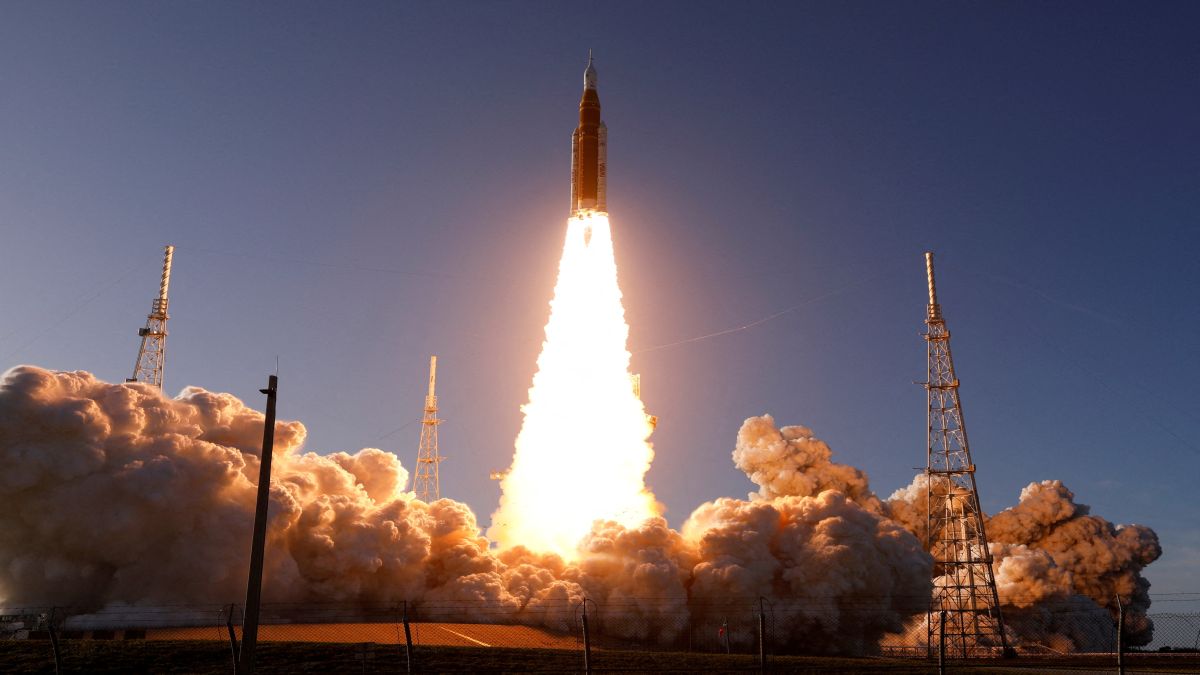
 "Artemis II is officially heading to the moon after leaving Earth's orbit")
Artemis II is now officially heading to the moon after firing its thrusters and leaving Earth’s orbit at 7:49 pm (local time). This marked the beginning of an epic four-day journey that would take the crew where only 24 humans have gone before.
It is pertinent to note that the Orion capsule flawlessly executed the nearly six-minute manoeuvre, which is known as the translunar ejection burn. The whole process took place on Thursday night, just over a day after the historic mission was launched from Florida’s Cape Canaveral.
After the launch, Artemis II has been slowly circling the Earth in a large elliptical orbit since the launch, but the injection burn accelerated the capsule to about 22,000 mph and broke it free from orbit, launching it into the empty 250,000-mile region between the Earth and moon known as the cislunar space.
An historic mission
The mission comprises a four-person crew - Cmdr. Reid Wiseman, specialists Christina Koch and Jeremy Hansen, and pilot Victor Glover, who will now buckle down for a four-day journey into deep space before arriving at the moon on Monday evening, if everything goes to plan.
It is important to note that the Artemis II will be flying by Isaac Newton’s first law of motion — an object in motion stays in motion. For the duration of the trip, the thrusters will be firing only for a series of minor adjustments to ensure its trajectory is correct.
These correction burns will be vitally important, since even the smallest trajectory error could send the crew smashing into the moon or soaring off into endless space. By Sunday, Day 5 of the mission, the capsule will have slowed down due to the drag of Earth’s gravity, but it will enter the lunar sphere of gravitational influence and will begin to accelerate towards the moon.
Quick Reads
View AllDay 6 will bring about the highly anticipated lunar flyby, when the crew will come within 4,000 miles of the moon and see its far side in sunlight for the first time with human eyes. However, exactly what time the flyby will begin is subject to change, and it would be around 4:30 pm (local time) based on the current flight plan.
According to Nasa, Artemis II will make its closest approach to the lunar surface around 8 pm (local time) on Monday, when the moon will appear out the capsule window to be about the size of a basketball held at arm’s length. This will be the closest any human has been to the moon since Apollo 17 left it behind in 1972.
Live looks at the flyby may be limited — and will cut out entirely for upwards of 50 minutes — as the moon blocks Artemis II’s communications with the Earth. Hence, the mission is being watched closely.


 "Iran Israel War Live News: Kuwait's desalination plant, oil refinery hit by drones as Iran vows 'crushing attacks' on infra")
 "Iran drafts a ‘hit list’ of Gulf bridges for retaliatory strikes after US destroyed its largest")
 "One year of Liberation Day tariffs: US trade deficit rose, manufacturing boom never arrived")
 "Head-on | From stone age to scorched earth: Trump’s presidential legacy")
 "Iran Israel War Live News: Kuwait's desalination plant, oil refinery hit by drones as Iran vows 'crushing attacks' on infra")
 "Iran drafts a ‘hit list’ of Gulf bridges for retaliatory strikes after US destroyed its largest")
 "One year of Liberation Day tariffs: US trade deficit rose, manufacturing boom never arrived")
 "Head-on | From stone age to scorched earth: Trump’s presidential legacy")