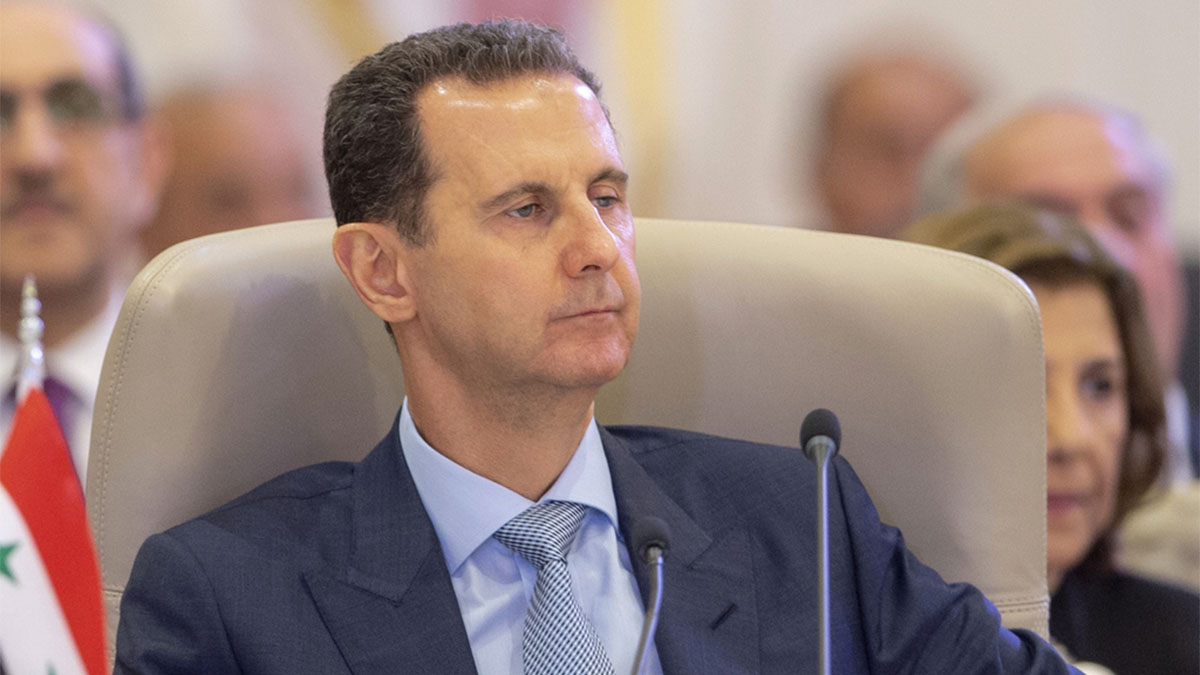
 "(File) Syrian President Bashar al-Assad. AP")
Bashar al-Assad’s leadership of Syria marks a clear shift from his father Hafez al-Assad’s reign. While Hafez was known for his clever political tactics, patience and ability to keep Syria stable, Bashar’s rule has been marked by growing internal conflicts and Syria becoming less important in the region.
Hafez al-Assad’s strategic diplomacy and stability
Hafez al-Assad led Syria from 1970 until his death in 2000 building a regime known for careful planning and strict political control. During his time in power, Syria played a key role in Middle Eastern politics, maintaining relationships with the US, Russia and various Arab nations. Hafez was skilled at using Syria’s role in the Arab-Israeli conflict to strengthen its position in the region. Even though he couldn’t regain the Golan Heights or change the Arab-Israeli peace process significantly, he ensured Syria remained involved in important diplomatic talks.
His regime kept Syria stable by combining authoritarian rule with strong control over both the military and civilian areas, preventing major opposition. However, by the time of his death, Syria’s influence had started to fade and the economy had slowed down, weakening the unity within the country. Hafez’s time in power is often seen as a period of strategic stability though it came with a lack of freedom and no democratic reforms.
Bashar al-Assad’s inherited struggles
Bashar al-Assad, who took over from his father in 2000, inherited a country facing many problems. Syria’s economy was struggling with high unemployment, poor infrastructure and growing frustration over the lack of political reforms. Early in his presidency, Bashar promised to bring political and economic changes, but these efforts failed. According to Brookings, despite initial promises of reform, his government didn’t address Syria’s economic problems. Instead, it stayed as authoritarian as under his father, focussing on maintaining power through military force rather than improving political stability.
Bashar’s failure to introduce meaningful reforms, combined with worsening economic conditions, set the stage for the 2011 uprising, a turning point in Syria’s history. Rather than addressing the demands for change, Bashar chose to crush opposition with violence, which sparked the civil war that has devastated Syria for over a decade.
Impact Shorts
More ShortsEscalation of violence and regional isolation
The 2011 uprising against Bashar al-Assad’s government was met with harsh repression, marking the start of the Syrian Civil War. There is a clear difference between Hafez and Bashar in how they handled opposition. While Hafez kept a tight grip on power with calculated violence, Bashar escalated the use of military force, resulting in large numbers of civilian casualties and global condemnation. The regime’s reliance on military solutions only worsened Syria’s division, weakening the political unity Hafez had worked to maintain.
Bashar’s violent crackdown also strained Syria’s relations with the rest of the world. While Hafez was able to keep diplomatic ties with both the West and Russia, Bashar’s Syria became more isolated. Support for his regime dropped and Western powers imposed sanctions. Meanwhile, foreign fighters and rebel groups trying to overthrow him only added to the chaos. The civil war turned into a battleground for international powers with Russia and Iran emerging as the main supporters of Bashar’s regime.
Rebel surge: A turning point
The Syrian Civil War started to change in late 2023. In early December, the rebel group Hayat Tahrir al-Sham (HTS), once linked to Al Qaeda, launched a successful attack in northern Syria, capturing Aleppo, the country’s second-largest city. This was a major turning point for Bashar’s government, which seemed vulnerable for the first time in years. As reported by The Economist, the rebels advanced quickly, taking important locations like Hama and Aleppo, exposing serious weaknesses within Bashar al-Assad’s military.
The HTS, along with the Syrian National Army (SNA), which was better equipped and trained than earlier rebel groups, caught the regime by surprise. Many Syrian soldiers abandoned their posts, leaving behind military equipment like tanks and artillery, which the rebels seized. The collapse of the military showed Bashar’s failure to keep his forces loyal and effective. With his allies, Russia and Iran, facing their own challenges, Bashar’s position became more vulnerable.
Weakened support of Russia and Iran
Syria’s international support has also changed. Russia and Iran, once crucial to Bashar’s survival, are now less able to help due to their own problems. Russia’s involvement in Ukraine has reduced its ability to assist Syria effectively while Iran is focused on conflicts in West Asia. According to Slate, the weakening of these powers’ support has made Bashar more isolated and vulnerable.
Iran, for example, is dealing with its own economic troubles and military setbacks, especially after Hezbollah’s reduced power following recent conflicts with Israel. This has weakened Iran’s ability to support Bashar’s regime, further damaging Syria’s military efforts.
Deteriorating situation in Syria
Despite these challenges, Bashar still controls key areas, including the capital, Damascus and parts of the Mediterranean coast. However, ongoing fighting between rebel groups like HTS and the Syrian Democratic Forces (SDF) makes stability harder to achieve. The SDF, a Kurdish militia backed by the US, has clashed with other rebel groups, particularly the SNA, which is supported by Turkey. This division deepens Syria’s fragmentation making it harder to find a solution to the conflict.
The future of Syria remains uncertain. Bashar’s regime might survive, but it has been severely weakened by his failure to unite the country as his father did. The harshness of his response to dissent combined with Syria’s economic collapse and growing isolation has led many to argue that Bashar’s leadership is a sharp contrast to his father’s calculated stability and diplomacy.
Collapse of a dynasty
Bashar’s inability to maintain the political unity and stability his father Hafez had secured has left Syria in a constant state of conflict and division. The rise of rebel forces, along with the decline in support from Russia and Iran, suggests a grim future for Bashar’s regime. As Syria continues to spiral into chaos, it is clear that Bashar’s rule will be remembered as a major departure from his father’s legacy of calculated control and strategic diplomacy. The fate of Syria, once shaped by stability and careful diplomacy, is now uncertain, with no clear solution in sight.