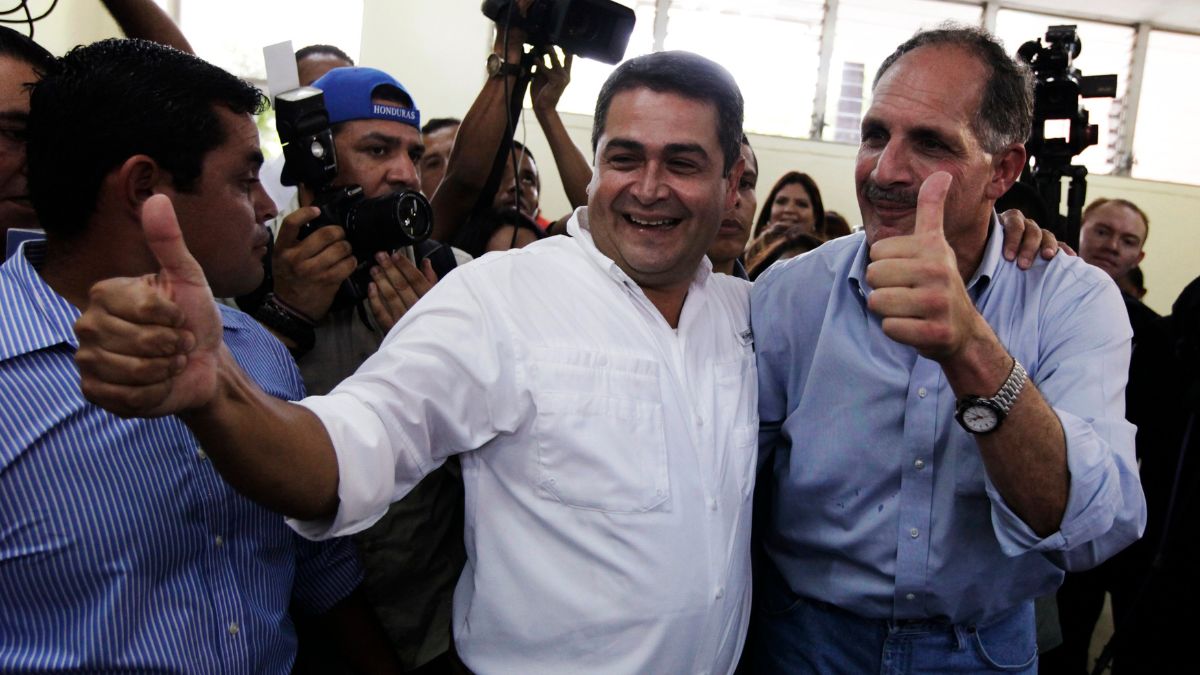
 "Juan Hernandez (left) and Nasry Tito Asfura of the National Party of Honduras gesture after Asufra cast his vote in Tegucigalpa on November 24, 2013. (Photo: Jorge Cabrera/Reuters)")
With votes from about 34 per cent of polling places counted in Honduras’ presidential contest, preliminary and partial results released late Sunday showed conservative candidates Nasry Asfura and Salvador Nasralla leading and the governing party trailing, only days after US President Donald Trump intervened in a close race by endorsing a candidate and announcing that he would pardon a former president.
The National Electoral Council said that Nasry ‘Tito’ Asfura of the National Party had 40.63 per cent of votes in early counting, while Salvador Nasralla, of the conservative Liberal Party, had about 38.78 per cent. Rixi Moncada of the democratic socialist LIBRE or Liberty and Re-foundation party trailed with 19.59 per cent.
Asfura, the 67-year-old former mayor of Honduras’ capital Tegucigalpa, ran as a pragmatic politician, pointing to his popular infrastructure projects.
Just days before the vote, US President Donald Trump endorsed him, saying he would fight “narco-communists” with the United States and was the only
Honduran candidate his administration would work with.
Nasralla, a 72-year-old sportscaster, has campaigned with various parties over the years and even joined the ticket of current President Xiomara Castro four years ago. But he continued to cast himself as an outsider and his central campaign issue has remained rooting out corruption.
Asfura had 530,073 votes, Nasralla 506,316, and Moncada 255,972.
Trump has intervened to support the National Party
Trump shocked Hondurans on Friday by announcing that he would pardon former National Party President Juan Orlando Hernández, who was one year into a 45-year sentence in a US prison for helping drug traffickers move cocaine to the United States.
Many Hondurans said it would not affect their votes.
Trump lashed out at Nasralla and Moncada just days before the vote, warning they could lead Honduras down the same path as Venezuela.
Quick Reads
View AllSome voters echoed Trump’s warnings that Moncada could lead Honduras to become another Venezuela, because Castro has maintained a cordial relationship with Venezuela President Nicolás Maduro, while simultaneously working with the Trump administration on security and immigration issues.
It’s not clear if candidates will accept the official results
The final stages of the presidential campaign were dominated by the three leading candidates trading accusations of election fixing, leading Honduran and international observers to warn that they could be undermining the process’ credibility.
Moncada, current President Castro’s handpicked successor, said in the days leading up to the election that she would not accept the preliminary tallies because she believed there was a plot to manipulate them.
Moncada called on her supporters shortly before preliminary results were announced to remain ready to fight until they have 100 per cent of the results. She said she would not comment on the electoral council’s preliminary results until Monday.
Meanwhile, there was concern among the opposition that the governing LIBRE would use the levers of government to give Moncada an advantage in the contest.
Voters worried about jobs and crime
Concerns about security and employment were top of mind for many voters.
The homicide and unemployment rates have both improved during the past four years under Castro even as the International Monetary Fund applauded her administration’s fiscal responsibility, but Honduras still has Central America’s highest homicide rate and Hondurans complain about a lack of job opportunities.
Castro’s supporters point to the situation she inherited from ex-President Hernández, whom her government extradited to the United States to face drug trafficking charges after he left office.
Hondurans also elected a new Congress on Sunday, as well as voting for hundreds of local positions.
(This is an agency story. Except for the headline, the story has not been edited by Firstpost staff.)