by Captain Cor Blokzijl There are various reasons why an aircraft could disappear so completely: - Hijack - Cataclysmic event leading to aircraft falling out of the sky - Serious malfunction ending in crash 1. Hijack: I would consider this very unlikely because should they have gone anywhere towards the mainland, the air defense radar system will pick up the plane. These are real radar and not an air traffic control (ATC) radar which is a radar producing signals on a TV screen produced by the aircraft itself. Should they fly elsewhere or below the radar, it’s hardly possible that a 200 x 209 feet aircraft goes unnoticed. Of course nothing is impossible nowadays, but it must have been a very sophisticated terrorist group. Wouldn’t they have claimed to do so to achieve maximum publicity? 2. Falling out of the sky: This can have two reasons: a) mechanical b) bomb explosion. As you know the air pressure inside an aircraft is much higher (about around an equivalent altitude of 2000 mtr) than outside (around 11-12000 mtr) all depending on the temperature. Therefore a) & b) will cause a so called explosive decompression, which would have shattered the aircraft in either many big and small pieces, but most likely in thousands of small pieces. [caption id=“attachment_1429285” align=“alignleft” width=“380”]
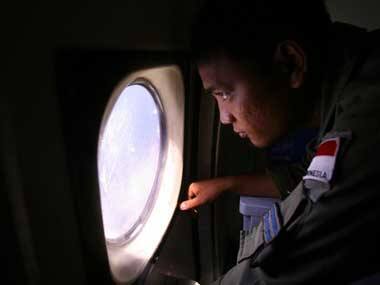 Search and rescue operations have been unsuccessful so far. AP[/caption] 3. Serious malfunction (or like AF 447 pilot induced error). This means that the crew could be so busy that they could have no time for an emergency call. Even that I doubt when we know how experienced the cockpit crew is. The emergency signal on their so called transponder (identifies aircraft on the ATC radar) is relatively early on the emergency checklist and one sees in training that pilots tend to do this instinctively. In such case the aircraft might hit the water in one piece (like AF 447). Unfortunately when the speed of the object is greater than 80 km/hr, water is harder than concrete, albeit the pieces of the aircraft will be bigger than in case 2. One should not forget that the first piece of debris of AF 447 was found on day 5 of the Search and Rescue (SAR) operation. I am not a pathologist but if my memory is correct, bodies or larger body parts do not come up before day 6-8 and let’s not forget that those waters are infested with sharks. As far as the SAR operation is concerned, from an aircraft the sight on a person in the water (even with a life-vest) is max 0.5 NM (nautical miles) when the sea is relatively calm. As soon as the sea is a bit choppy the distance reduces, as does the radar picture of an object in the water. With the current and the wind, in short time objects might be out of the search area which is only based on the last know position. Do not forget that an aircraft at 35,000 ft in case 3 can still cover 60-100 NM depending if they have engine power or not. Many people ask, with the AF 447 crash in memory, why did Malaysian Airlines not receive the technical data from the aircraft. This could have two reasons. Having a continuous stream of technical data from an aircraft is expensive. Therefore often airlines program the computer which the data send in such a way that these are send when approaching the airport of destination (and these are fully downloaded after each landing) or in case of emergency. I do not know what MAS has chosen to do with the data. Also it is well known that there are several so called black spots on the earth where reception of signals is limited at the best, and the area between Malaysia and Vietnam is one of these. What is remarkable is the fact that the satellites from the world wide emergency system have not picked up any of the Emergency Locator Beacon systems of the aircraft, but again we don’t know the force of decompression and/or impact. Captain Cor Blokzijl, is a senior pilot with over 20,000 hours of flying. He started his career with 16 years in the Royal Netherlands Navy in various roles, including Search and Rescue, flight instruction, long-range maritime patrol and carrier-operations. He later worked for UNDP/ICAO and has served in several airlines world-wide including as the Vice-President Flight Operations in Air Deccan from 2006-till the take over by KingFisher.
A pilot explains why the Malaysia Airlines flight is still missing
FP Archives
• March 12, 2014, 12:14:06 IST
A former pilot explains possible outcomes of the Malaysia Airlines flight still being untraced and why it is still missing.
Advertisement
 "A pilot explains why the Malaysia Airlines flight is still missing")