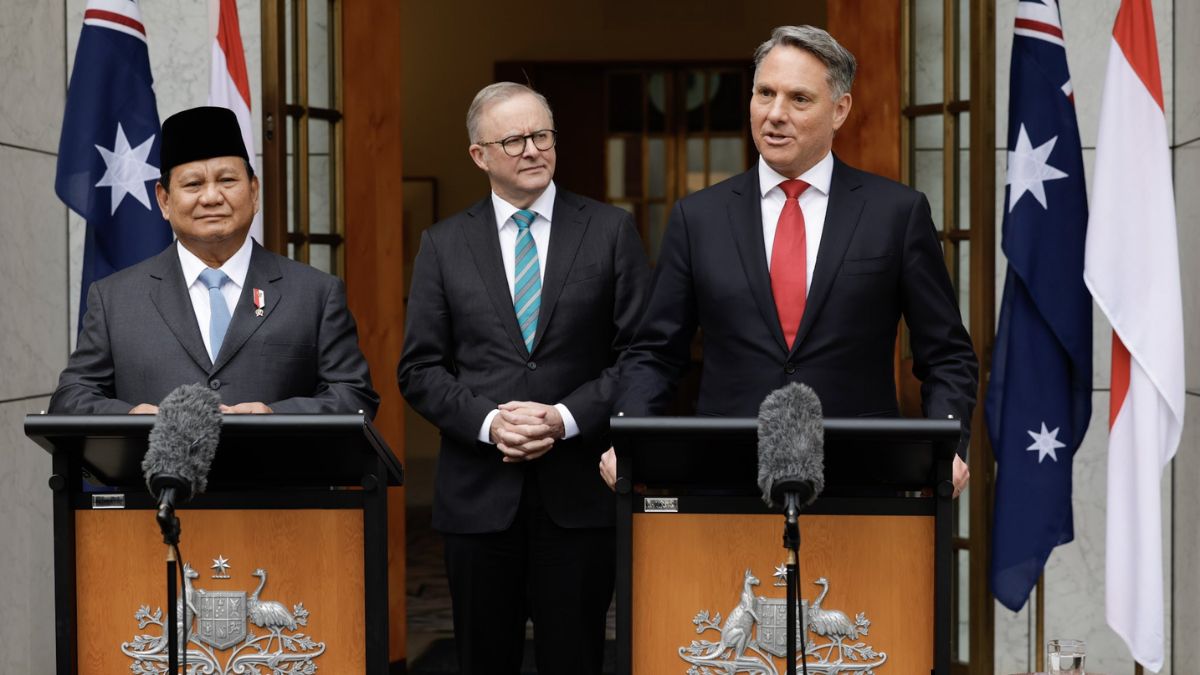
 "Australian and Indonesian leaders announcing the defence deal (Photo: X/Richard Marles)")
Australia and Indonesia have concluded a new defence cooperation agreement that the leaders have dubbed as a historic moment in the bilateral relationship.
As neighbours that share the world’s longest maritime borders, Australia and Indonesia have long-standing relations and security cooperation. Indonesia has always been one of the first ports of call for new Australian premiers.
Highlighting the relationship at a press briefing in which the agreement was announced, Indonesia’s President-elect Prabowo Subianto said that there was “no more important relationship than the one between our two great nations”. The agreement would allow more joint military exercises and visits between the two countries.
Australian Prime Minister Anthony Albanese dubbed the deal as a “historic treaty”. He said the deal would “bolster our strong defence cooperation by deepening dialogue, strengthening interoperability and enhancing practical arrangements”.
While the agreement was announced, it would be finalised in the upcoming days when Australian Defence Minister Richard Marles will travel to Indonesia to sign the agreement. The two countries had said last year that they were negotiating a new pact to replace their existing defence cooperation agreement.
Here are the five things to know about the Australia-Indonesia security agreement
1. More drills, more interoperability
The new security agreement would not just allow for more joint military exercises between Australian and Indonesian military but it would also for much more interoperability.
Impact Shorts
More Shorts“What this agreement will do is provide for much greater interoperability between our defense forces, it will provide for much more exercises between our defense forces, it will see us working together the global commons to support the rules-based order and, importantly, it will allow us to operate from each other’s countries,” said Australian Defence Minister Marles.
Nothing else is known about the deal. Albanese, Marles, or Subianto did not take questions from the press after the briefing.
2. The China factor
Even as neither Indonesia or Australia have named China, it is a fact that the deal has come at a time when Australia and partners are concerned about the aggressive activities and hegemonic designs of China in the Indo-Pacific region.
China has not been aggressive in the waters around its shores, it has also reached out to island nations in the Indo-Pacific. The Australian outreach to China should also be seen as part of efforts of contain China in the region.
Australia sees the Indo-Pacific reason as its turf and is working with like-minded partners like the United States and India to curb Chinese influence and disturbances in the region.
In his remarks, Albanese said the deal was not vital to the two countries but to also “the stability of the region that we share”.
3. But is the deal practical?
Even though Australia and Indonesia have reached the deal, there are questions about the practicality of the deal.
The questions take a front-row as Indonesia does not share the same concerns regarding China as Australia or its partners.
Indonesia has also stated that it would not be part of any alliance.
Euan Graham, an analyst at the Australian Strategic Policy Institute think tank, further questioned the deal’s strategic value to Australia and highlighted that Indonesia has made clear that it would remain non-aligned under. He told AP that this meant that Indonesia would be part of countries that don’t want to be officially aligned with or against any major power bloc such as the United States.
“The issue is that Indonesia doesn’t share the same threat perception as Australia towards China,” said Graham.
4. Latest Australian defence pact
In the recent years, Australia has been engaged in numerous security-related talks and agreements.
The most notable of these agreements is the AUKUS with the United Kingdom and the United States. It is geared towards Australia receiving nuclear-powered submarines for the Royal Australian Navy. The second part of the AUKUS is focussed on enhancing joint capabilities and interoperability in the areas of cybersecurity, artificial intelligence, quantum technologies, and additional undersea capabilities.
While it is not a new treaty, another agreement has become important as the region faces a common threat from China. There exists a Five Power Defence Arrangements (FPDA) with the Malaysia, New Zealand, Singapore, and the UK and commits members to consult in the case of an attack on Malaysia or Singapore.
There is also the Quadrilateral Security Dialogue with the United States, Japan, and India. While it is not a security alliance, the increasing focus on the security and stability of the Middle East gives it a strong security dimension. Moreover, last years, the four nations held military drills together in Australia.
5. Human rights concerns
There are concerns that the Indonesian government may use the deal to the political advantage of the regime.
Indonesia is a Muslim-majority country and there are strong Islamist undercurrents in the country. There are also human rights concerns regarding rules around the Islamic headscarf hijab and the queer community in the country. The Human Rights Watch (HRW) said the Australian government should use the platform provided by the deal to urge Indonesia to “fulfil the human rights-related commitments that previous Indonesian administrations had made but failed to meet”.
“These [human rights concerns] include some difficult issues such as the mandatory hijab rules, the crackdown on LGBT people, and the government’s unwillingness to allow foreign journalists and United Nations officials to visit West Papua,” said HRW’s Australia Director Daniela Gavshon, as per The Guardian.
The HRW maintains that up to 100,000 Papuans have been displaced since 2018 when violence between the Indonesian forces and the militants escalated in the region, according to the newspaper.
The HRW has flagged reports of extrajudicial killings and enforced disappearances in the region.