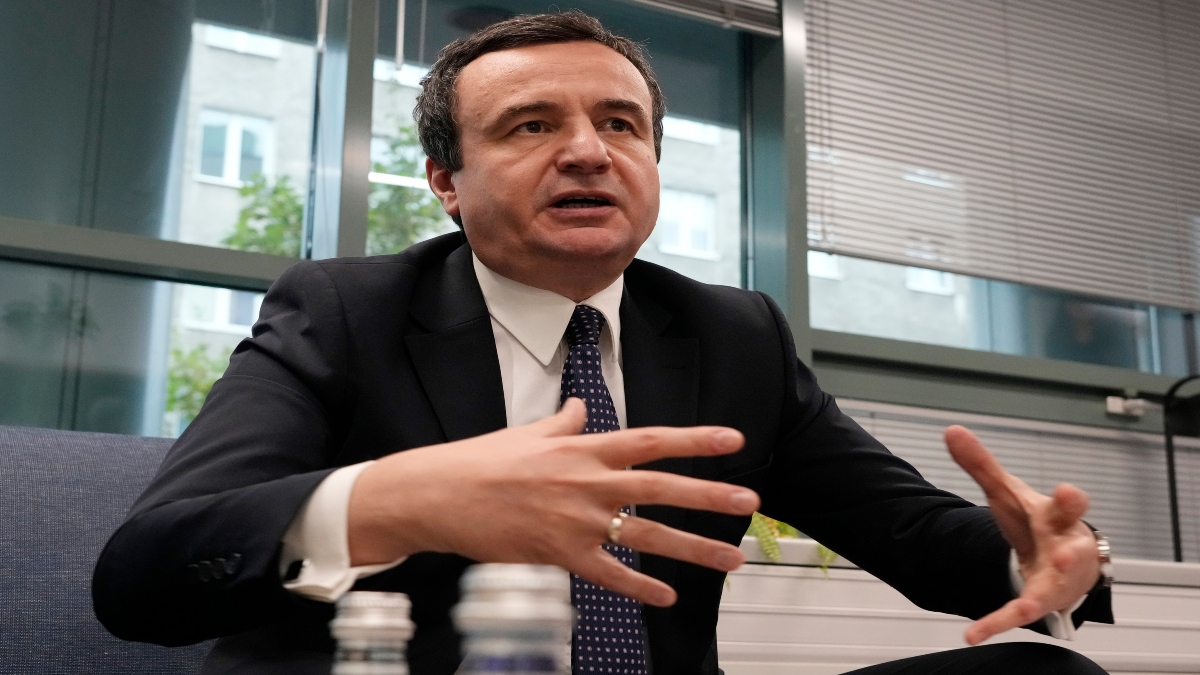
 "Kosovo Prime Minister Albin Kurti in Warsaw on October 3. AP File")
Kosovo’s government announced on Monday that it would lift a ban on the entry of Serbian products at one border crossing, 16 months after halting imports to prevent potential hidden shipments of weapons for Serb separatists.
This decision aligns with efforts by Western partners to foster reconciliation and cooperation between the two neighboring Balkan nations.
Tensions escalated in May 2023 when Kosovo police seized municipal buildings in Serb-majority areas of northern Kosovo, where residents had rejected ethnic Albanian mayors elected in a vote boycotted by Serbs.
Kosovo Prime Minister Albin Kurti stated that the Merdare border crossing would reopen with enhanced monitoring of goods by customs agents stationed just 300 meters from the border. He added that the remaining five border crossings would open once they are equipped with new scanners.
The other five border crossings would open once they can be equipped with new scanners, he said.
Kosovo has cited the seizure of four large caches of weapons that Kurti says could have been brought through the border disguised as trade, as well as the movements of troops by Serbia near the border, as reasons for its move in June 2023 to curb cross-border trade.
“These were steps of security, never commercial ones,” Kurti told journalists Monday.
Local media in Kosovo have reported that Germany warned Kosovo that unless it reestablished trade it could be excluded from the Central European Free Trade Agreement and the Berlin Process, aimed at boosting cooperation among six western Balkan nations and the European Union.
Impact Shorts
More ShortsKosovo was a Serbian province until Nato’s 78-day bombing campaign in 1999 ended a war between Serbian government forces and ethnic Albanian separatists in Kosovo, which left about 13,000 dead, mainly ethnic Albanians, and pushed Serbian forces out. Kosovo proclaimed independence in 2008, which Serbia doesn’t recognise.
The European Union and the United States are pressing both sides to implement agreements that Serbian President Aleksandar Vucic and Kurti reached in February and March last year. They include a commitment by Kosovo to establish an Association of the Serb-Majority Municipalities. Serbia is also expected to deliver on the de-facto recognition of Kosovo, which Belgrade still considers its province.
The NATO-led international peacekeepers known as KFOR have increased their presence in Kosovo after last year’s tense moments.
With inputs from agencies