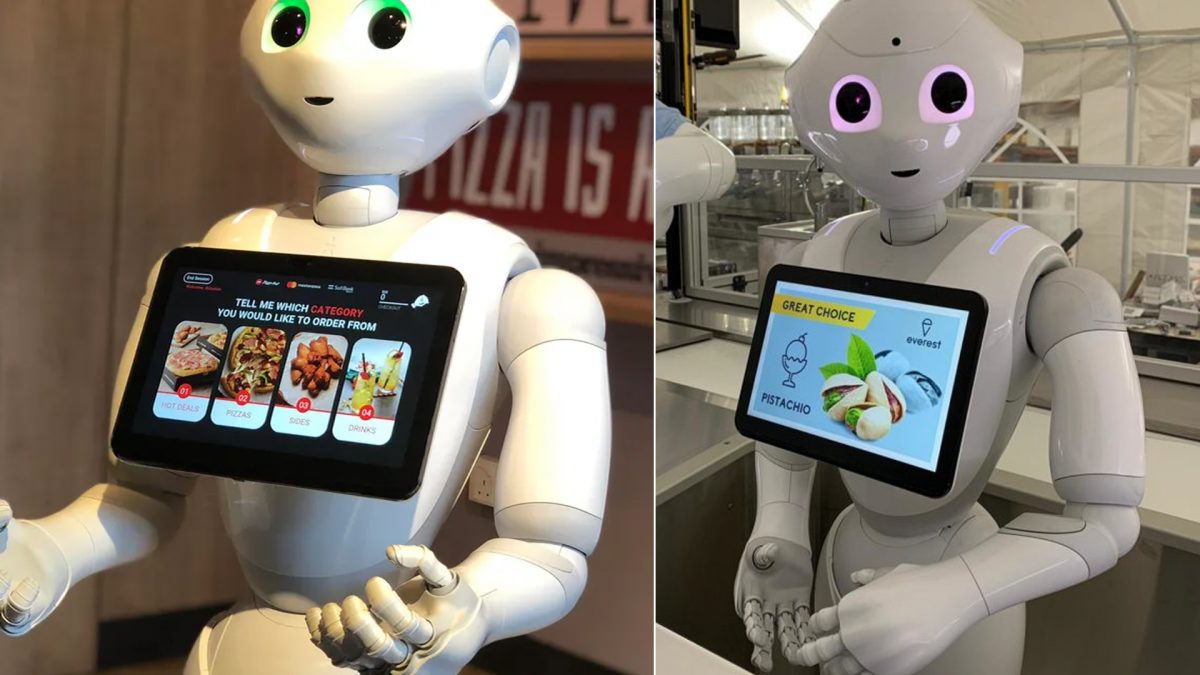
 "Robots and AI bots are a great way to collect data and process the data quickly. Image Credit: Reuters")
In the bustling world of fast-food drive-thrus in the US and the UK, a new star is emerging: Wendy’s FreshAI. Videos of customers interacting with this AI bot have gone viral, showcasing its astonishing speed, accuracy, and polite demeanour.
While still in its early stages and often requiring human assistance, FreshAI exemplifies a larger trend in retail: the embrace of artificial intelligence to replace human workers.
But why the rush to automate? At first glance, it may seem like a straightforward cost-cutting measure, with AI stepping in for human labour. However, there’s a deeper force propelling this wave of restructuring — data.
Unlike retail employees, who primarily contribute their personal experiences and expertise, AI bots excel at data collection. Every customer interaction is seamlessly recorded and stored in a database, providing invaluable insights into consumer behaviour. This data harvest encompasses not only the dialogue exchanged but also various demographic details, thanks to advancements in video and audio recording technology.
Moreover, AI bots don’t just collect data; they use it to enhance customer interactions in real time. By analyzing vast amounts of past data, bots can tailor their responses to individual customers, creating dynamic touchpoints that influence perceptions and decisions. This continuous feedback loop, fueled by data, allows businesses to refine their strategies and maximize profits.
The allure of AI lies in its ability to transform businesses into equations that can be constantly optimized. By leveraging AI-driven insights, retailers can implement minute adjustments, such as tweaking interaction timings, to boost profitability. This data-driven agility creates an uncanny sense of anticipation for customers, reminiscent of the personalized experiences offered by tech giants like Google and Amazon.
Impact Shorts
More ShortsHowever, as AI reshapes the retail landscape, concerns about job displacement arise. Jobs that involve high data volumes or rely heavily on data-driven decision-making are particularly susceptible to automation. Roles like fast-food drive-thru workers, dealing with high-volume traffic, may soon be targeted as AI seeks to streamline data loops and maximise efficiency.
In contrast, jobs that are less data-intensive and rely more on human touchpoints may be safer for the time being. Nevertheless, the relentless march of AI-driven automation poses challenges for workers across the retail sector, underscoring the need for proactive adaptation and re-skilling efforts.
In the age of retail AI, the key to survival lies in navigating the evolving relationship between humans and machines, leveraging technology to enhance customer experiences while ensuring a sustainable future for the workforce.
(With inputs from agencies)