

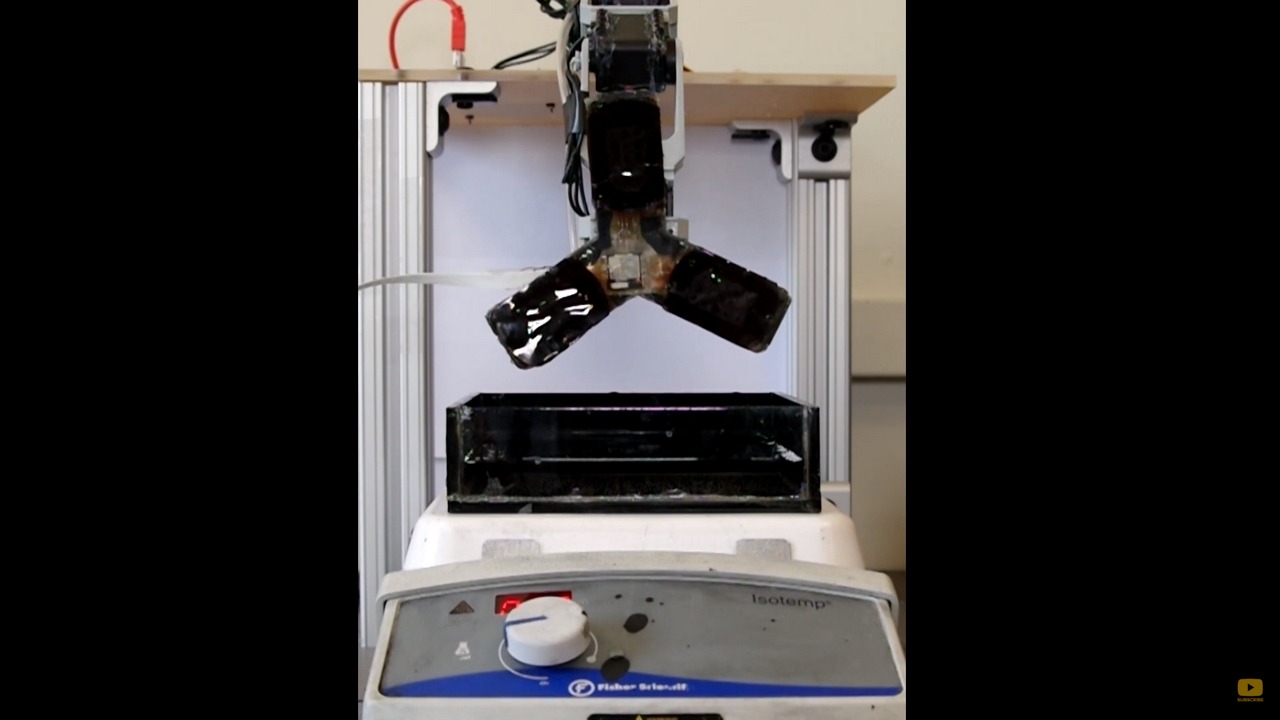
 "Scientists have developed a robotic arm that can taste for chemicals using bacteria")
Scientists have developed a robotic gripping arm that uses engineered bacteria to “taste” for specific chemicals, an advance that may pave the way for biohybrid machines that can sense and interact with the environment around them. The gripper, developed by researchers at the University of California, Davis and Carnegie Mellon University in the US, is a proof-of-concept for biologically-based soft robotics. “Our long-term vision is about building a synthetic microbiota for soft robots that can help with repair, energy generation or biosensing of the environment,” said Cheemeng Tan, assistant professor at UC Davis. Soft robotics uses lightweight, flexible and soft materials to create machines that match the versatility of living things, and soft robot designs often draw inspiration from nature. Adding actual living cells to soft robots brings scientists another step closer to creating biological-mechanical hybrid machines. “By combining our work in flexible electronics and robotic skin with synthetic biology, we are closer to future breakthroughs like soft biohybrid robots that can adapt their abilities to sense, feel and move in response to changes in their environmental conditions,” said Carmel Majidi, an associate professor at CMU. [caption id=“attachment_6897661” align=“alignnone” width=“1280”] Robotic arm that can taste chemicals. Image credit: Youtube/UC Davis[/caption] The new device uses a biosensing module based on E coli bacteria engineered to respond to the chemical IPTG by producing a fluorescent protein. The bacterial cells reside in wells with a flexible, porous membrane that allows chemicals to enter but keeps the cells inside. This biosensing module is built into the surface of a flexible gripper on a robotic arm, so the gripper can “taste” the environment through its fingers. When IPTG crosses the membrane into the chamber, the cells fluoresce and electronic circuits inside the module detect the light. The electrical signal travels to the gripper’s control unit, which can decide whether to pick something up or release it. As a test, the gripper was able to check a laboratory water bath for IPTG then decide whether or not to place an object in the bath. So far, this biohybrid bot can only taste one thing and it is difficult to design systems that can detect changing concentrations, Tan said. Another challenge is to maintain a stable population of microbes in, or on, a robot — comparable to the microbiome or ecosystem of bacteria and fungi that live in or on our own bodies and carry out many useful functions for us. Biohybrid systems potentially offer more flexibility than conventional robotics, he said. Bacteria could be engineered for different functions on the robot: detecting chemicals, making polymers for repairs or generating energy, for example.
Soft robotics uses lightweight, flexible and soft materials to create machines that match the versatility of living things.
Advertisement
End of Article

 "Israel targets top Hamas leaders in Doha; Qatar, Iran condemn strike as violation of sovereignty")
 "Nepal: Oli to continue until new PM is sworn in, nation on edge as all branches of govt torched")
 "Who is CP Radhakrishnan, India's next vice-president?")
 "Israel informed US ahead of strikes on Hamas leaders in Doha, says White House")
 "Israel targets top Hamas leaders in Doha; Qatar, Iran condemn strike as violation of sovereignty")
 "Nepal: Oli to continue until new PM is sworn in, nation on edge as all branches of govt torched")
 "Who is CP Radhakrishnan, India's next vice-president?")
 "Israel informed US ahead of strikes on Hamas leaders in Doha, says White House")



