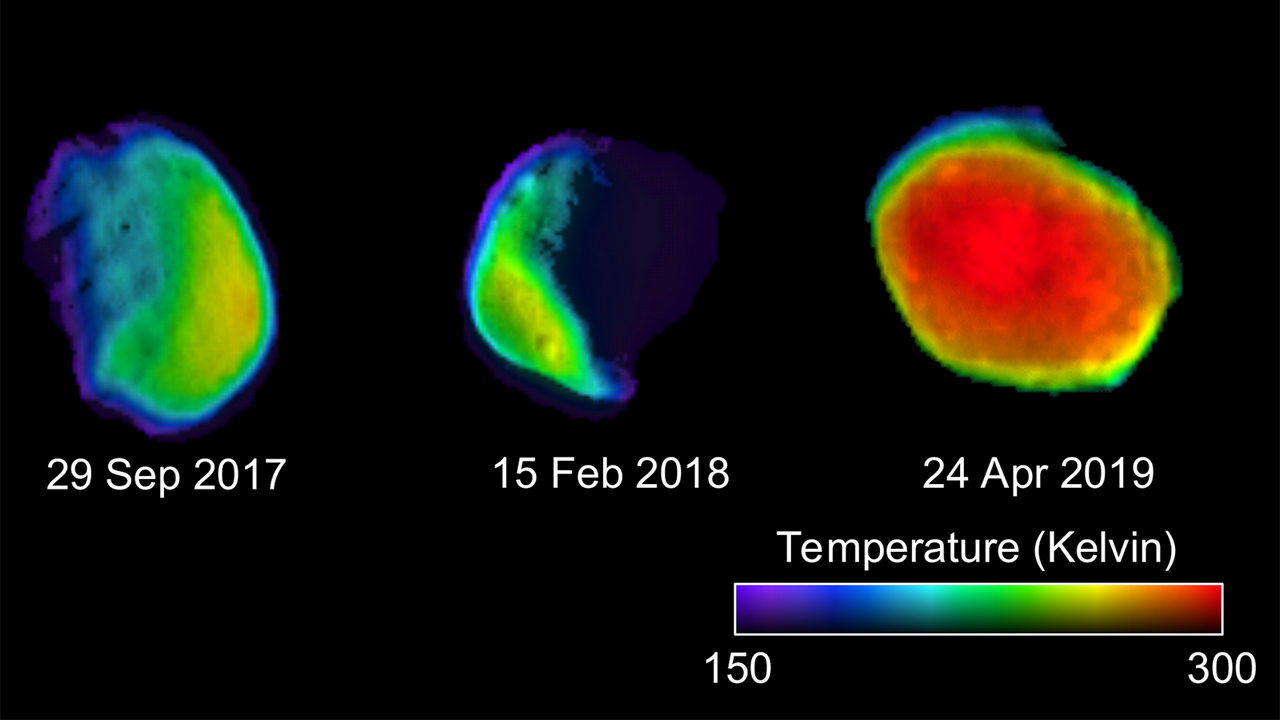
 "NASA's Odyssey spacecraft captures candy coloured image of Mars' moon Phobos")
NASA’s spacecraft Odyssey has been orbiting Mars since 2001 and gone a long way in helping us understand the Red Planet. On 24 April 2019, the Odyssey panned to glance at
Phobos
, with the Sun behind it and a full Phobos in front of it. The images that came from this sighting are incredible. Phobos is the larger of Mars’ two moons, Phobos and Deimos. Odyssey used an onboard infrared camera — the Thermal Emission Imaging System (
THEMIS
) — to capture images. THEMIS can detect the temperature of the moon’s core. As seen in the images, the centre, of the moon, is the hottest and is gets cooler towards the outer regions.
NASA
compared the heat-vision images to a Jawbreakers candy because of the heat variation that can be seen in the image. [caption id=“attachment_6642861” align=“alignnone” width=“1280”]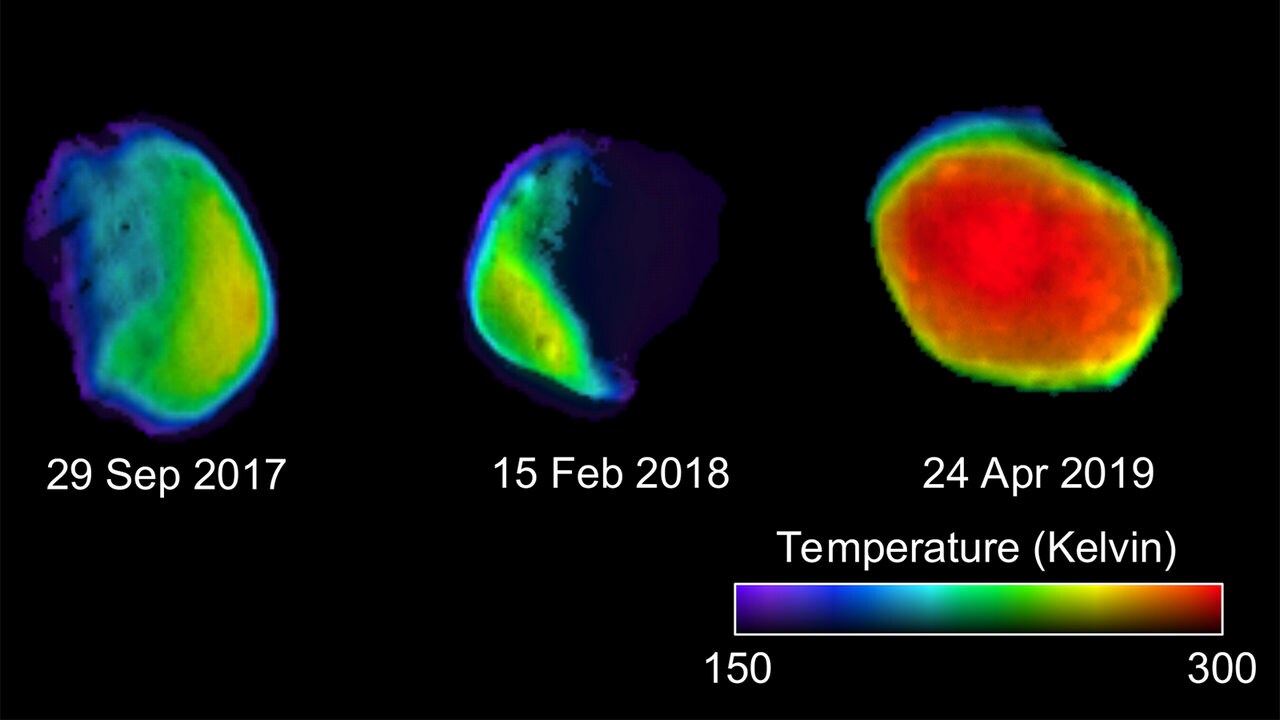 These three views of the Martian moon Phobos were taken by NASA’s 2001 Mars Odyssey orbiter using its infrared camera, THEMIS. Each color represents a different temperature range. Credit: NASA/JPL[/caption] In 2017, Odyssey had captured images of the half-moon, both in the infrared and visible spectrum to understand what the surface of Phobos was like. But the latest full moon photographs are the best yet for studying the composition of the moon. Half-moon views are better for looking at textures, according to
a press release
. “With the half-moon views, we could see how rough or smooth the surface is and how it’s layered. Now we’re gathering data on what minerals are in it, including metals,” Joshua Bandfield, Co-investigator and senior research scientist at the Space Sciences Institute in Colorado,
said
. Iron and nickel are two such metals that appear to be abundant on Phobos’s surface.
These three views of the Martian moon Phobos were taken by NASA’s 2001 Mars Odyssey orbiter using its infrared camera, THEMIS. Each color represents a different temperature range. Credit: NASA/JPL[/caption] In 2017, Odyssey had captured images of the half-moon, both in the infrared and visible spectrum to understand what the surface of Phobos was like. But the latest full moon photographs are the best yet for studying the composition of the moon. Half-moon views are better for looking at textures, according to
a press release
. “With the half-moon views, we could see how rough or smooth the surface is and how it’s layered. Now we’re gathering data on what minerals are in it, including metals,” Joshua Bandfield, Co-investigator and senior research scientist at the Space Sciences Institute in Colorado,
said
. Iron and nickel are two such metals that appear to be abundant on Phobos’s surface.
Phobos’s Origins
The
origin of Phobos
has been a source of mystery to scientists. Many believe that it is an asteroid that taken into the role of being a Martian moon by force. The theory says that Phobos was captured by the gravity of Mars while it was on a trajectory cutting through our solar system. Even Mars’ second moon, Deimos, is thought to be an asteroid it acquired in a similar fashion.  The other theory is that the moon was once a part of Mars, and broke off after another asteroid hit the planet. “These recent observations won’t definitively explain Phobos’ origin”, Bandfield says, but they will give scientists a better understanding of the moon.
Future of Phobos missions
There have been talks about using Phobos as a pitstop for future missions to Mars. These whispers were confirmed by Hoppy Price, chief engineer for NASA’s robotic Mars Exploration Program, in a previous interview with Inverse . With all the images that Odyssey has been capturing over the years, the landing sites, possible obstacles and surfaces can be mapped out and studied. Japan’s Aerospace Exploration Agency (JAXA) has a sample return mission planned to Phobos in 2024, which could go a long way in understanding Phobos better.