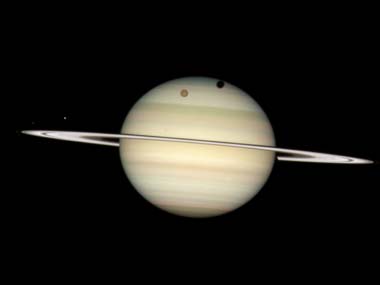
 "Oxygen detected on Saturn's moon Dione'")
**Washington:**Planetary scientists claimto have for the first time detected presence of oxygen in theatmosphere of Saturn’s moon, Dione.
An international team, led by Los Alamos NationalLaboratory, says it has discovered molecular oxygen ions inthe upper-most atmosphere of Dione, one of the 62 known moonsorbiting Saturn, thanks to NASA’s Cassini spacecraft, the_Geophysical Research Letters_journal reported.
[caption id=“attachment_232854” align=“alignleft” width=“380” caption=“The concentration ofoxygen in Dione’s atmosphere is roughly similar to what youwould find in Earth’s atmosphere at an altitude of 300 miles.Reuters”]
 [/caption]
Dione - discovered in 1684 by astronomer GiovanniCassini (after whom the spacecraft was named) - orbits Saturnat roughly the same distance as our own moon orbits Earth. Thetiny moon is a mere 700 miles wide and appears to be a thick,pockmarked layer of water ice surrounding a smaller rock core.
As it orbits Saturn every 2.7 days, Dione is bombarded bycharged particles (ions) emanating from Saturn’s very strongmagnetosphere. These ions slam into the surface of Dione,displacing molecular oxygen ions into Dione’s thin atmospherethrough a process called sputtering.
Molecular oxygen ions are then stripped from Dione’sexosphere by Saturn’s strong magnetosphere, says the team.A sensor aboard the Cassini spacecraft called the CassiniPlasma Spectrometer detected the oxygen ions in Dione’s wakeduring a flyby of the moon in 2010. Now, the team confirmedthe presence of oxygen in the ringed planet’s moon.
Team leader Robert Tokar said: “The concentration ofoxygen in Dione’s atmosphere is roughly similar to what youwould find in Earth’s atmosphere at an altitude of 300 miles.
“It’s not enough to sustain life, but - together withsimilar observations of other moons around Saturn and Jupiter -these are definitive examples of a process by which a lotof oxygen can be produced in icy celestial bodies that arebombarded by charged particles or photons from the Sun orwhatever light source happens to be nearby.”
PTI