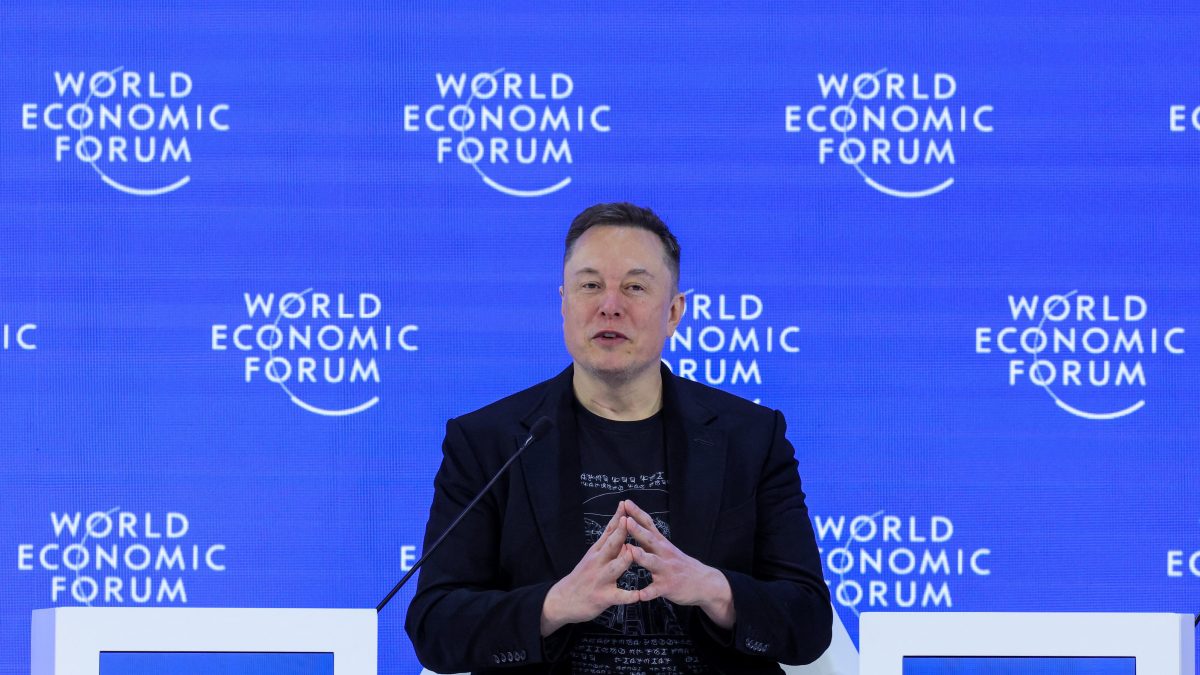
 "Elon Musk warns AI could become smarter than humans in the next 5 years")
Elon Musk has once again sounded the alarm over the rapid rise of artificial intelligence, predicting that AI could surpass human intelligence entirely within the next few years, a development he believes will reshape how people live, work and even define purpose.
Speaking at the World Economic Forum in Davos during a conversation with BlackRock CEO Larry Fink, the Tesla and SpaceX chief said AI is evolving faster than most experts anticipated. “AI could be smarter than any individual human this year,” Musk said, adding that “within five years, it may be smarter than all of humanity combined.”
From robots to driverless cars: Musk’s AI vision
Musk was not just talking about AI at work, but he linked this accelerating intelligence to the rapid development of humanoid robots, which he said could dramatically transform the global economy. Tesla’s Optimus robots, he revealed, are already carrying out basic tasks in company factories, with more complex functions expected soon.
“If things go well, we expect to sell humanoid robots to the public by the end of next year,” Musk said, stressing that safety and control would be paramount before any mass rollout.
On autonomous vehicles, Musk claimed Tesla’s Full Self-Driving (FSD) software has reached a point where insurers are offering “significant discounts” to drivers using it.
The company is now seeking regulatory approval to expand supervised self-driving across Europe, potentially as soon as next month, followed by China.
“If regulated and supervised, it will be widespread,” Musk said, reaffirming his long-standing vision of a world where driverless cars dominate roads and drastically reduce accidents.
Just after this comment, Tesla officially began operating its Robotaxi service in Austin, with no human safety driver inside.
In a post on X, Musk confirmed the milestone, writing, “Just started Tesla Robotaxi drives in Austin with no safety monitor in the car. Congrats to the @Tesla_AI team!” The announcement marks Tesla’s first public rollout of completely driverless rides, allowing passengers to travel with no one behind the wheel.
Quick Reads
View AllJust started Tesla Robotaxi drives in Austin with no safety monitor in the car.
— Elon Musk (@elonmusk) January 22, 2026
Congrats to the @Tesla_AI team!
If you’re interested in solving real-world AI, which is likely to lead to AGI imo, join Tesla AI. Solving real-world AI for Optimus will be 100X harder than cars. https://t.co/OnP8gredWD
Powering the AI future and beyond Earth
While Musk was characteristically upbeat about AI’s potential, he cautioned that the biggest obstacle to its growth might not be computing power, but energy. “AI chips are being produced faster than we can power them,” he said, warning that electricity generation is failing to scale at the pace of AI infrastructure, especially in the United States.
He described solar power as the most viable solution to meet the immense energy demands of future AI systems, noting that China is far ahead in large-scale solar deployment. “Policy barriers and tariffs are slowing down progress elsewhere,” he added, urging governments to accelerate renewable energy adoption.
Looking further ahead, Musk painted a striking picture of where the AI industry might go next, into space. He suggested that orbit could become the most efficient environment for running advanced AI systems. “The lowest-cost place to put AI will be space,” he said. “Solar panels in orbit produce more energy, and the vacuum of space provides natural cooling for data centres.”
Musk predicted that solar-powered AI infrastructure in orbit could become a reality within the next few years, creating a future where human intelligence and machine intelligence evolve far beyond Earth itself.
On SpaceX’s ambitions, Musk said the company is close to achieving full rocket reusability with its Starship vehicle, which he believes could reduce the cost of access to space “by a factor of 100.”
Asked what continues to drive him after decades of technological breakthroughs, Musk simply replied, “Curiosity and the desire to understand reality.” And when pressed on whether he would go to Mars himself, he smiled, “Yes, just not on impact.”

 "How Davos, and Trump, turned Canada’s banker PM Carney into a global political star")
 "India launches 'Responsible Nations Index' to rank countries beyond GDP and power")
 "Musk is back in US politics in time for 2026 midterm polls")
 "Bangladesh T20 World Cup Participation LIVE Updates: Bangladesh approach ICC with fresh demand as drama deepens")
 "How Davos, and Trump, turned Canada’s banker PM Carney into a global political star")
 "India launches 'Responsible Nations Index' to rank countries beyond GDP and power")
 "Musk is back in US politics in time for 2026 midterm polls")
 "Bangladesh T20 World Cup Participation LIVE Updates: Bangladesh approach ICC with fresh demand as drama deepens")