R Kaushik in Sydney Martin Crowe has called him a beautiful player. Mahendra Singh Dhoni has said his was a talent wasted at No. 6 in the One-Day International set-up. But no one in Indian cricket has polarised opinion more than Rohit Sharma. When Rohit is at his subliminal best, sliding back in his crease to direct the ball with strong, supple wrists through the covers or dancing down the track and easing it long distances into the stands with minimum of effort, he is a sight for the gods. He has that aura about him when in full cry, all lazy elegance and fluid motion, almost balletic. The bat seems no more than an extension of his supple but powerful forearms, a weapon used not to bludgeon the bowling to death but to bleed them gently with a nick here, a cut there, a slice elsewhere. So why does he polarise opinion? Why does he exasperate and frustrate? Why do the adjectives and the expletives come with such alternate regularity? Why indeed? They used to say of David Gower that even when was dismissed, he looked elegant and graceful. Rohit could so easily fall into that minority category. The oohs and aahs give way to grrs when he gives his hand away. Because he is by nature unhurried, it doesnt come naturally to him to show remorse. And, lets get this straight, he doesnt need to show remorse. Its enough that he feels it. Rohit Sharma isn’t indifferent to failure, but because he doesn’t reveal his anguish or his agony, he is an easy option to bracket in the he doesn’t care section. [caption id=“attachment_2167117” align=“alignleft” width=“380”]
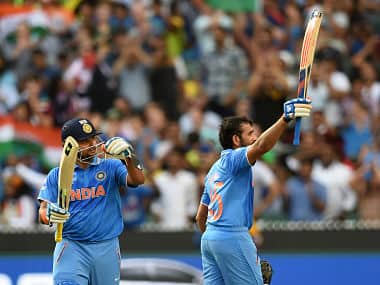 Rohit Sharma has come into his own as opener. AP[/caption] That being said, Rohit will also be the first to concede that he has played several daft strokes, that he has thrown his hand away far too often for a batsman of his calibre and pedigree. This is the man who began his Test career with back-to-back hundreds. This is the same man who has two double hundreds in ODI cricket, including a gargantuan 264 that still looks a little out of reach despite the pyrotechnics of the Martin Guptills and the Chris Gayles. There is no doubting his class. The genesis of the frustration that Rohits followers experience lies in the inconsistency with which that class outs in international cricket. In a couple of months time, Rohit will have completed eight years in international cricket. He is 27 and has the wealth of 134 ODI appearances under his belt. His initiation into Test cricket got delayed due to one reason or the other; by now, he should have played infinitely more than 10 Test matches. But he is now a fairly regular, if not always settled, member of the Test side, expected to form the batting core group over the next several years alongside M Vijay, Shikhar Dhawan, KL Rahul, Cheteshwar Pujara, Virat Kohli and Ajinkya Rahane. Despite falling off the perch somewhat, he still averages more than 41 in Test matches, a number that is bound to go up considering India have plenty of games lined up in the subcontinent over the next year or so. At one stage, a little over two years back, Rohit had been left far behind by Kohli, whose ODI debut came one year after the Mumbaikars. Kohli had done enough to earn the elevation to No. 3, and was taking bowling apart in different parts of the world while Rohit was still chugging along at a stately pace, only occasionally doing justice to his ability. Time and patience were running out when, perhaps in a last throw of the dice, Dhoni pulled another of his rabbits out of the hat, pushing Rohit up the order to open the batting in January 2013, against England. Rohit had opened earlier, in January 2011 in South Africa, with less than flattering results. He made 23, 1 and 5 in three games before returning to the middle order, but in his second coming as an opener, he has flourished like never before. Since marking his return to the top of the batting tree in Mohali with a match-winning 83, Rohit has been in pretty awe-inspiring form. In 48 games, he has amassed 2208 runs at 53.85, with five hundreds and 13 fifties. He has been dismissed for single-digit scores 10 times, but that is an occupational hazard for an opening batsman, especially now with one new ball at each end. During this run as opener, he has smacked two double centuries, has forged an excellent association with Dhawan, and totally justified his elevation. In his first 86 games before this 26-month phase as opener, Rohit had made only 1978 runs at 30.43. His only two hundreds during that phase came when he batted at No. 4 in a triangular series in Zimbabwe in 2010, back-to-back centuries with most of the big boys missing from the Suresh Raina-led side. And contrary to what Dhoni might have said of him being wasted at No. 6, he had batted only 10 times out of 81 at No. 6. There were 26 knocks at No. 4 and 23 at No. 5; his promotion as opener was perhaps the eventual acknowledgement that he wasnt pulling his weight in the middle order, but that he was too good a player to be put out to pasture, so why not give him a run of sorts at Nos. 1 and 2. He would get enough time to play himself in, and he was capable enough to catch up with the scoring rate in the middle to end phases of his innings. Almost the whole of Rohit’s ODI career has come under Dhoni, who like the rest of his colleagues just can’t fathom how the rest of the world could ever question Rohit’s presence in the side. “If I have to go back four years, it won’t be a realistic comparison (of Rohit the batsman then and now), the reason being he was not opening for us at that point of time. We felt he was a bit of waste of talent if he was batting at 6 for us because more often than not, he was not getting enough chances to bat,” Dhoni pointed out. “We couldn’t really give him enough opportunities. That’s one of the reasons why, if you see the first 40 games, you may think he has not done enough. But out of those 40, there were quite a few times when he went in to bat in the last four overs or five overs, and it’s difficult. That was the time we decided we’ll try to make him an opener, and he accepted that. He did open for us in the World T20, and from that point, we thought it will be good to have him as an opener because he cuts and pulls well, and he’s a natural stroke-player which helps.” Rohit needed the century against Bangladesh more for his own confidence than that of his mates. His only scores of substance previously in this World Cup had come against UAE (57*) and Ireland (64). Last Wednesdays 137 in the quarterfinal, his third hundred in his last 10 innings and his second in three digs at the MCG, now means each one of the fixed top three has made a century, that each of Dhawan, Rohit and Kohli goes into the semifinal against Australia in a positive, confident frame of mind. Thats exactly the kind of mental space Dhoni would have wanted his top order to be at this stage of the tournament. The article was first published on the
Wisden India
website.
Rohit Sharma has come into his own as opener. AP[/caption] That being said, Rohit will also be the first to concede that he has played several daft strokes, that he has thrown his hand away far too often for a batsman of his calibre and pedigree. This is the man who began his Test career with back-to-back hundreds. This is the same man who has two double hundreds in ODI cricket, including a gargantuan 264 that still looks a little out of reach despite the pyrotechnics of the Martin Guptills and the Chris Gayles. There is no doubting his class. The genesis of the frustration that Rohits followers experience lies in the inconsistency with which that class outs in international cricket. In a couple of months time, Rohit will have completed eight years in international cricket. He is 27 and has the wealth of 134 ODI appearances under his belt. His initiation into Test cricket got delayed due to one reason or the other; by now, he should have played infinitely more than 10 Test matches. But he is now a fairly regular, if not always settled, member of the Test side, expected to form the batting core group over the next several years alongside M Vijay, Shikhar Dhawan, KL Rahul, Cheteshwar Pujara, Virat Kohli and Ajinkya Rahane. Despite falling off the perch somewhat, he still averages more than 41 in Test matches, a number that is bound to go up considering India have plenty of games lined up in the subcontinent over the next year or so. At one stage, a little over two years back, Rohit had been left far behind by Kohli, whose ODI debut came one year after the Mumbaikars. Kohli had done enough to earn the elevation to No. 3, and was taking bowling apart in different parts of the world while Rohit was still chugging along at a stately pace, only occasionally doing justice to his ability. Time and patience were running out when, perhaps in a last throw of the dice, Dhoni pulled another of his rabbits out of the hat, pushing Rohit up the order to open the batting in January 2013, against England. Rohit had opened earlier, in January 2011 in South Africa, with less than flattering results. He made 23, 1 and 5 in three games before returning to the middle order, but in his second coming as an opener, he has flourished like never before. Since marking his return to the top of the batting tree in Mohali with a match-winning 83, Rohit has been in pretty awe-inspiring form. In 48 games, he has amassed 2208 runs at 53.85, with five hundreds and 13 fifties. He has been dismissed for single-digit scores 10 times, but that is an occupational hazard for an opening batsman, especially now with one new ball at each end. During this run as opener, he has smacked two double centuries, has forged an excellent association with Dhawan, and totally justified his elevation. In his first 86 games before this 26-month phase as opener, Rohit had made only 1978 runs at 30.43. His only two hundreds during that phase came when he batted at No. 4 in a triangular series in Zimbabwe in 2010, back-to-back centuries with most of the big boys missing from the Suresh Raina-led side. And contrary to what Dhoni might have said of him being wasted at No. 6, he had batted only 10 times out of 81 at No. 6. There were 26 knocks at No. 4 and 23 at No. 5; his promotion as opener was perhaps the eventual acknowledgement that he wasnt pulling his weight in the middle order, but that he was too good a player to be put out to pasture, so why not give him a run of sorts at Nos. 1 and 2. He would get enough time to play himself in, and he was capable enough to catch up with the scoring rate in the middle to end phases of his innings. Almost the whole of Rohit’s ODI career has come under Dhoni, who like the rest of his colleagues just can’t fathom how the rest of the world could ever question Rohit’s presence in the side. “If I have to go back four years, it won’t be a realistic comparison (of Rohit the batsman then and now), the reason being he was not opening for us at that point of time. We felt he was a bit of waste of talent if he was batting at 6 for us because more often than not, he was not getting enough chances to bat,” Dhoni pointed out. “We couldn’t really give him enough opportunities. That’s one of the reasons why, if you see the first 40 games, you may think he has not done enough. But out of those 40, there were quite a few times when he went in to bat in the last four overs or five overs, and it’s difficult. That was the time we decided we’ll try to make him an opener, and he accepted that. He did open for us in the World T20, and from that point, we thought it will be good to have him as an opener because he cuts and pulls well, and he’s a natural stroke-player which helps.” Rohit needed the century against Bangladesh more for his own confidence than that of his mates. His only scores of substance previously in this World Cup had come against UAE (57*) and Ireland (64). Last Wednesdays 137 in the quarterfinal, his third hundred in his last 10 innings and his second in three digs at the MCG, now means each one of the fixed top three has made a century, that each of Dhawan, Rohit and Kohli goes into the semifinal against Australia in a positive, confident frame of mind. Thats exactly the kind of mental space Dhoni would have wanted his top order to be at this stage of the tournament. The article was first published on the
Wisden India
website.
World Cup 2015: Just in time, Rohit Sharma finds his comfort zone
FP Archives
• March 22, 2015, 11:03:03 IST
Almost the whole of Rohit’s ODI career has come under Dhoni, who like the rest of his colleagues just can’t fathom how the rest of the world could ever question Rohit’s presence in the side.
Advertisement
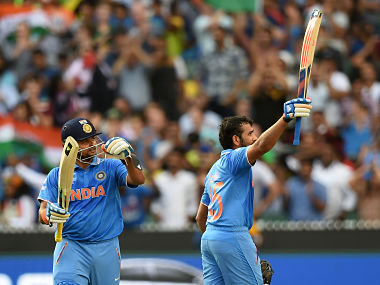 "World Cup 2015: Just in time, Rohit Sharma finds his comfort zone")