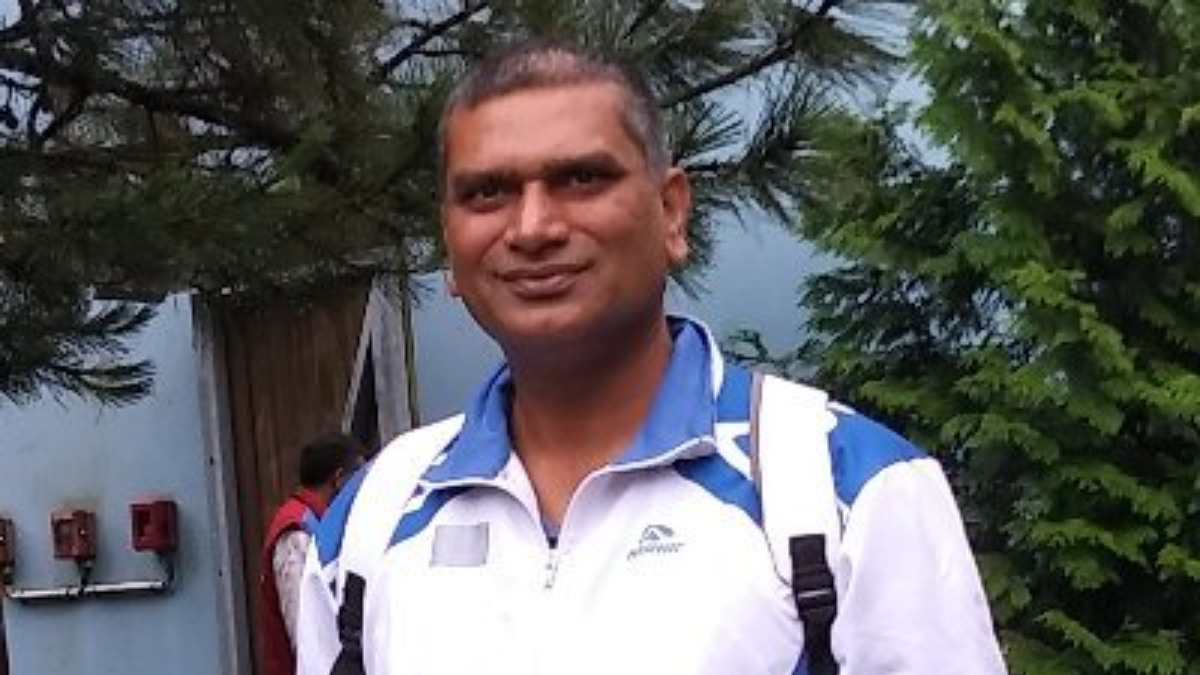
 "Veteran javelin coach Naval Singh, a recipient of the prestigious Dronacharya Award, has coached Paralympic gold medallists Sumit Antil and Navdeep Singh. Image credit: X/@Navaldrona")
Two-time Olympic medallist, Neeraj Chopra, has of course put India firmly on the global javelin map, but India is yet to earn the tag of a global javelin powerhouse.
Is that a realistic dream though? Yes, says veteran Indian javelin coach, Naval Singh, currently in charge of the very talented Sachin Yadav who has already touched the 90m mark in practice and is tipped to do the same in competition.
According to Singh, India can in fact achieve that target in the next five years, because there is a lot of untapped raw talent in the country. Figuring out how to bring that talent into camps and academies and then honing those raw skills is what is needed right now.
According to Singh, a very simple model can be devised which will not only shape many future javelin champions, but also provide meaningful employment to many talented coaches, who are struggling to make ends meet.
Though there is still a very long way to go, India has evolved over the last few decades into a more sports-friendly country. As a society we have learnt to look beyond our cricketers and recognise and celebrate some of our other champions – from non-cricketing sports. What we haven’t really done though is give most of the coaches, who work relentlessly behind the scenes, their due credit.
No athlete can succeed without the right kind of guidance and coaching. Raw talent alone is not enough for an athlete to succeed at the highest levels. And behind every successful athlete there is usually more than one extremely passionate coach. The trouble is these men and women live almost their entire lives in the shadows and on the sidelines.
Games
View AllSports journalists who interact with coaches in India on a regular basis know the reality. It’s not the same across the board, in every sport of course, but it is a common story. When it comes to athletics in the country, the major stakeholders – the Athletics Federation of India, along with the Sports Authority of India and the Sports Ministry are doing a great job of shaping the future of Indian athletics, which has grown by leaps and bounds over the last 10-15 years. Incentive for the coaches though is still an area that can be looked into.
In an exclusive interview, Singh talks about why he feels sports coaching is a thankless job in India, the respect he gets abroad which is missing at home, his model to turn India into a global javelin powerhouse and more.
This is Part 2 of the interview.
Firstpost: Most people don’t really find out or are even curious about what a coach goes through. As someone who has been coaching for such a long time, tell us about how tough and often thankless a job this can be…
Naval Singh: To excel in any line of work, you need to be completely passionate about it. Paagalpan zaroori hai. Now, while you are completely wrapped up in it, what your children and your family is going through - no one is interested in that, no one asks. Coaching in India is an extremely thankless job. Regardless of what you manage to do, in terms of shaping an athlete who might go on to do great things, the coach’s job is a thankless one.
The athlete that you have groomed can also abandon you at any given point in time. And you can’t do anything about that. There are many athletes, I don’t want to take any names, but I coached them, taught them how to throw the javelin and they went on to notch up world records. Today, some of them abuse me behind my back. I say I am ready to face the abuses also, but make me a ‘crorepati’, give me a lot of money in return. But that too is missing.
But you have to carry on doing your job, because you have children to feed and raise. And the children in turn don’t understand. They see their father leaving the house at 2 am, working 12 hours, 16 hours a day, and for what? Has any Prime Minister or Chief Minister ever patted any coach’s back? Has anyone ever encouraged a coach? This is the reality.
FP: Do you think the global athletics governing bodies, not just the Indian ones, should take a bigger interest in promoting the good work being done by the coaches behind the scenes?
NS: Outside India things are very different. In foreign countries (mostly the global athletics powerhouses) the coach’s word is final. In India, the athlete’s word carries a lot of weight. I have travelled the world, I have met and worked with world champions, world record holders, Olympic champions.
Coaches from countries like Finland and Germany (traditional javelin powerhouses) treat me with a lot of respect and have a lot of regard for me. I have experienced the same thing in London as well. No one here, in India, has ever shown me that respect. But I feel that whatever God has given me, it is my duty to pass that on. Jo Naseeb mein hoga, dekha jayega. Daal-roti chal rahi hain a? Kami to Nahin hain? (whatever is destined for me is what I will receive. I have enough to eat, there is no shortage of anything. What else do I need?). My parents have left me property. There are so many people who don’t have their own homes. That is the one satisfaction that I have. There is no other satisfaction apart from this.
FP: Talk to me a little bit about the exposure trips abroad. These usually go a long way in preparing athletes to tackle foreign conditions. Who decides how many foreign exposure trips there will be in say a year? Does this depend on the competition calendar and the exposure requirement alone, or something else also?
NS: The Chief coach and the Federation decide this. A full group sits down and discusses this and it’s all done in an organised manner. It doesn’t matter what an individual thinks or says. Like if I say that a certain athlete needs a foreign exposure trip or that same athlete also says the same thing, it doesn’t matter. It’s a collective decision which is based on multiple inputs. The Athletics Federation of India (AFI) is doing a great job of keeping everything organised and we go by what they decide.
FP: As things stand in Indian javelin, who are the athletes that one needs to keep an eye out for in the future? Neeraj is of course already very well established, Sachin is coming up the ranks nicely. Who else should we look out for?
NS: The one name I can think of is that of Yash Vir (Singh). He can do very well in the future (Yash Vir beat Asian Games silver medallist Kishore Jena in April this year to win the men’s title at the Indian Open Athletics meet in Chennai). He is very talented and can do very well. He has javelin in his genes. I don’t go to junior competitions, so I am not sure who else is coming up the ranks. I keep hearing from other people about some athletes who are competing in the juniors. People send me videos and ask me about technical aspects of someone’s game. Coaches get in touch with me to ask about what more can be done to train a particular athlete, but I can’t recall the names of these athletes right now. I watch the videos and give my feedback and coaching tips.
FP: Apart from the challenges that you have talked about so far, in this interview, that are plaguing Indian athletics in general and Indian javelin in particular, are there any other obstacles that you can think of? Is there any request that you would want to make to the AFI, SAI, the Sports Ministry etc. to make things smoother, especially for the coaches, going ahead?
NS: India has so many different sports. I am an athletics coach and I am talking about my issues. Tomorrow some hockey coach, kabaddi coach or weightlifting coach etc will talk about their issues. The problems don’t end. India is a country of over 140 crore people (approximately 1.48 billion currently). The countries we compete against often have populations of 50 lakh to 1 crore (Finland’s approximate current population is 5.62 million currently or just over 56 lakh. Germany’s approximate current population stands at 84 million or just over 8 crore).
We need sport-specific sponsors who are willing to come onboard and look after those particular sports, like the state of Odisha sponsored the Indian men’s and women’s national hockey teams. We need the same thing for Indian javelin. All the stakeholders should come together and meet to decide who are the people who should be put in charge of Indian javelin – those who are the real hard workers.
FP: What is the model you think will work? What would your suggestion be?
NS: There are so many good coaches out there who don’t have jobs. They are having to run their houses on Rs 20,000 a month. These coaches should be brought in, paid about a lakh each, every month, and put in charge of 10 youngsters each at a centre to coach. We should have javelin coaching and excellence centres in at least 10 different cities. Each centre should have two to three coaches, a physiotherapist and about 20 trainees. So, you have 200 young javelin throwers – and for that you need at least 20 dedicated coaches. That is when you will start seeing real results.
You spoke earlier about a 10-year period. I am saying that if we follow this model, India can become a javelin powerhouse in five years’ time. But who is going to fix the system? We have so much raw javelin talent in our country, including in the girls’ category. We have so many young girls in our villages who are very tall, over six feet tall and strong.
Also Read | India can become global javelin powerhouse, what we need is exclusive sponsorship: Naval Singh
Someone once told me about this young girl, who – you will not believe this – was carrying things on her head which weighed over 50 kilos. She was carrying cow dung, wood, sacks of wheat. Girls like her, who have such a natural affinity to carry heavy weights can be trained to throw the javelin and become good athletes. There is no dearth of raw talent. But will people allow their daughters to pursue sport and be trained by others? We don’t have the mindset.
FP: When you look back at your entire career – both as a player and then as a coach, despite the thankless nature of your job, you must feel proud of what you have managed to achieve, whether it’s acknowledged by others or not…
NS: It does feel good for a while, but then when the wife scolds me, that feeling disappears (laughs). When the wife asks questions like, ‘Why are you doing this? What have you got from this except criticism and negativity?’ then that momentary happiness turns into sadness. When an athlete I have trained wins a medal, I celebrate with a few friends, dance a little and that’s it. The next day all of it is forgotten. The fact that that medal was the result of years of hard work – all of that is forgotten.
You see, the family really suffers and the person who is in the centre of it all can break. In today’s day and age everything is about just money. Everyone wants to just earn some more money, by whatever means necessary. The way I look at it is – I have been given the opportunity to help others, I will do that and leave everything else to God. Neki kar, dariya mein daal (Do good deeds and don’t expect anything in return).
Prepare one athlete, then move on to the second, then the third and so on and so forth. More often than not, the athletes you have trained from scratch will forget you. I have heard unspeakable things directed towards me by people who I showed how to hold a javelin. But what can you do? This is what coaching is.
Akaash is a former Sports Editor and primetime sports news anchor. He is also a features writer, a VO artist and a stage actor