The process of natural selection abandons the unadapted and those who survive are the best adapted and best equipped to do so— that’s evolution theorist Charles Darwin explaining GenNext of species deviating from the genetic rule of the thumb. Genuine fast bowlers— the type that the late 70s and 80s generations grew up worshipping — in cricket have become a near-extinct species, and there’s something ominously Darwinian about it. We still have a clutch of speed demons across continents chugging in to hurl thunderbolts at batsmen. But they don’t inspire the same awe and fear among batsmen and that adrenalin rush in spectators. That raw, boxing ring feel to the contest between the bat and the ball has evaporated over the years. Wind back to 1981, the third Test and between the West Indies and England at Bridgetown. Michael Holding — the Whispering Death— running in to hurl blinders at Geoff Boycott, among the greatest batsmen in the world then. It was raw aggression let loose on the unsuspecting batsman. After five balls of incredible pace, fury, bounce and movement, Boycott, for the first time in his life, must have loved to see the sixth one carrying one of the stumps half-way to the boundary. Those six balls from Holding are still considered the best first over from a fast bowler. [caption id=“attachment_28284” align=“alignleft” width=“380” caption=“Geoff Boycott of England faces Dennis Lillee of Australia during the Third Ashes Test match. Adrian Murrell/Getty Images “]
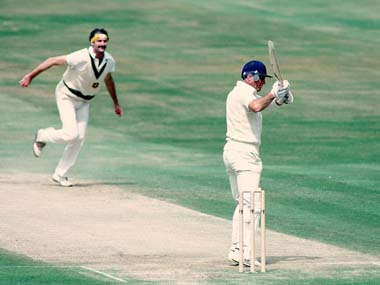 [/caption] Imagine the quartet of Holding, Andy Roberts, Collin Croft and Joel Garner operating in tandem with a frenzied crowd seeking blood on the pitch. Think of the sheer majesty in Imran Khan running down to bowl a delivery; and the joy of watching Dennis Lillee and Jeff Thomson working as a pair to make batsmen scamper for cover. It was as much about bowling fast as about having a personal signature to it. A batsman’s greatness was defined and redefined after his encounters with the bowling greats. Legends were born out of those great contests on the cricket pitch. This is the story of another era. Fast bowling got its glam quotient from the raw passion the bowlers managed to generate in the spectators. The long gap between Test series allowed space for popular imagination and myths to grow and cricket stars inevitably ended up as larger-than-life figures. It was a beautiful, fulfilling exercise for the lay follower of the game. It gave cricket most its essence and meaning back then. How everything has changed! While cricket’s basic DNA structure remains largely unchanged, the environment around it has undergone massive changes in the last few decades. The biggest loss in the process has been the awe and glamour around bowling fast. Shoaib Akhtar revived that old feeling for a brief period. We may have people bowling fairly close to his speed but that X factor is conspicuous by its absence. Also, there’s a growing tendency among bowlers to apply the brakes after the initial rush of blood their careers. The changed environment has thrown up circumstances where compromises become the key to survival. Unfortunately, the art of pure fast bowling is not amenable to negotiations and practical give and take. That brings us back to the curious question of evolution, adaptation and compromises. Cricket has turned into an unfair game, particularly for the fast bowlers. It has evolved into a batsman’s game over the years. It no more has patience for that luxuriant run up from close to the boundary line. Even the number of bouncers has been limited. To make matters worse, most pitches across the world have gone flat, either by design or default. Nobody has talked about the evolution of the cricket bat yet— that has been the biggest game-changer. The best equipped to survive in these circumstances are those who adapt. It is normal for bowlers to sacrifice speed for longevity and natural flair for financial security. If it has to be choice between speed and accuracy for the bowlers the latter becomes an easy choice. But that’s not easy to accept. Fast bowling is often associated with masculinity and the male ego; it’s about passion too. But the thought is so old school. The new age bowlers would let that pass. Evolution calls for pragmatic responses. But pragmatism is so stupid sometimes.
Is fast bowling as we once knew it, extinct?
Akshaya Mishra
• June 25, 2011, 16:32:43 IST
Cricket’s evolution has reduced fast bowling from high art to reckless passion without a meaning. It’s sad but that’s how natural selection works.
Advertisement
 "Is fast bowling as we once knew it, extinct?")
End of Article