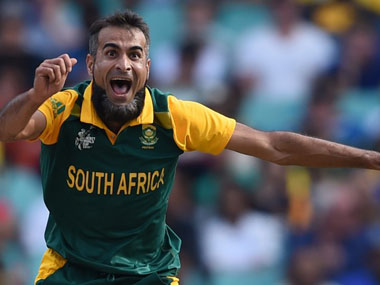
It’s the World Cup, its Australia, and an Imran is taking centrestage again. Only this time round, no one really expected him to; no one expected him to do it for South Africa; no one really expected him to run through a Sri Lanka side on an SCG wicket that in the eyes of Michael Hussey looked “brilliant for batting”. At the start of the match, everyone seemed to be speaking about how the Sri Lankans would attack the South African spinners. For a change, this South African team had no pace bowling allrounders – not even a Wayne Parnell or Vernon Philander. [caption id=“attachment_2160765” align=“alignleft” width=“380”]
 Imran Tahir. AFP[/caption] They went in with just four regular bowlers – hoping that Duminy and maybe AB de Villiers would fill in for the rest. Imran Tahir and JP Duminy are good spinners but teams from the subcontinent don’t really worry about them and the Lankans were no exception. So the plan at the start, it seems would have been to attack the spinners. And when Angelo Mathews won the toss and elected to bat first, De Villiers grimaced a little. He would have liked to bat first two on a ground that had seen South Africa score over 400 (against West Indies) and Australia make 370+ (against Sri Lanka). And then there was the added pressure of history; a pressure one undoubtedly feels more while chasing. Sri Lanka’s batting led by Kumar Sangakkara and Tillakaratne Dilshan has been in fine form and the wicket promised to not make things difficult for them. But the South African attack had different ideas. It started off with the pacemen. Kyle Abbot and Dale Steyn were accurate and fast. Kushal Perera was sent back in the second over, Dilshan in the 5th over. Just 6 runs came off the first 5 overs. By the 10th over, Sri Lanka had reached 35-2 (their slowest start in the tournament) and Sangakkara (2 off 23 balls) seemed to be playing the waiting game. South Africa’s attack had a clear weakness and the left-hander had the gifts to exploit that chink in the armour. Then, after sticking with pace for the first 14 overs, de Villiers finally turned to spin. The ball was first throw to JP Duminy and then to Tahir. It was spin from both ends, Thirimanne was looking good and Sangakkara had played himself in. This was the point where everyone expected Sri Lanka to make a break for it. Instead, in the 20th over – Tahir got Thirimanne – the only batsman who looked at ease with the two-paced pitch, the stage and the South African attack. It was a simple leg-break from round the wicket - a length delivery, just outside off-stump. The ball seemed to stop a little off the pitch and it bobbed straight back to the bowler off the high part of the bat. That was enough to send Tahir on one of his joyous celebration runs around the ground. Next in was Mahela Jayawardene. One of the greatest batsmen to come out of Sri Lanka. He was playing in his final World Cup; in potentially his final game. But Tahir wasn’t about to have mercy. Leg-spin, googly, flipper, quicker through the air, flight – he brought it all to the table. It left Mahela struggling to pick him. The wicket it seemed was only a matter of time. And it was a beautiful set-up. In the last four deliveries of the previous over, Tahir had tossed it up and even reviewed a massive appeal for LBW which the right-hander just about survived. Then, for the first ball in his new over, he went with a flipper. It was quick and fooled Mahela completely, it was almost a double touch as it came off the bat and gently looped to short mid-wicket. In four matches, Tahir has claimed Mahela’s wicket four time – 35 balls, 12 runs, 4 dismissals. It was not the way we would have liked to see a great career end but here it was. The leg-spinner was off on another one of his runs. He also sent back Thisara Perera and Lasith Malina to end up with figures of 8.2-0-26-4. When we first think of Tahir, our minds usually go back to his first Test match in Australia in 2012. He was hammered for 180 runs off 23 overs in the first innings and then in the second innings, more carnage followed – 14 overs, 80 runs. 260 runs for no wickets. But there is a big difference between Tahir the Test bowler and the one who turns up in ODIs. With the red ball he averages 46.39. With the white ball, he averages 19.94. If you look at just the World Cups, he has been even more deadly. In 12 World Cup matches, he has taken 29 wickets at an average of 14.93 – which is the best by anyone who has taken at least 20 wickets. Well ahead of the likes of Geoff Allot, Michael Holding, Shane Bond, Brett Lee, Glenn McGrath, Tim Southee, Richard Hadlee and Imran Khan. Then again, you might be tempted to dismiss him as a World Cup wonder. But since January 2013, he has the second best bowling average (56 wickets at 22.25) among spinners in the world. Only Saeed Ajmal (71 wickets at 20.56) was better. And he does all of this at a very good economy rate of 4.35. This makes him a bonafide weapon that teams perhaps will need to start playing more attention to now. At the end of the match, Mathews couldn’t quite put his finger on what went wrong. “133 is not too much on this track. No demons in this track. We didn’t bat well. Maybe the nerves. Easily the worst performance we have done in the World Cup,” said Mathews. “We all know that SA have a great bowling attack. But we just didn’t bat well. Unfortunately, that is the way it goes.” Sangakkara playing in his last ODI match was perhaps closer to the mark: “The disappointing thing was losing seven wikts to spin when SA have pace-dominated attack.” But Tahir has proven over the years that he is a solid performer. Sri Lanka underestimated him and paid the price. He is wicket-taker in the middle over that South Africa missed and somehow he has managed to help them break the knockout jinx. After the game, Tahir – a much travelled Pakistan-born player who has represented 27 teams around the world – spoke about how grateful he was to South Africa. “I really can’t complain. I’ve got everything from SA – so I feel I need to pay them back,” he said. “If you look at our team, there are some good and great players. But we all want to play together, we are hoping for a couple of good games. This is the dream.” And if that dream does come true, we could see a Tahir celebration that would refuse to end. Maybe then, we will all join him with a run of our own.
Imran Tahir shows South Africa are not just about de Villiers and fast bowlers
Ashish Magotra
• March 19, 2015, 08:11:02 IST
Tahir has proven over the years that he is a solid performer. Sri Lanka underestimated him and paid the price.
Advertisement
 "Imran Tahir shows South Africa are not just about de Villiers and fast bowlers")
End of Article