 "How dancing Colombia became the World Cup's favourite team")
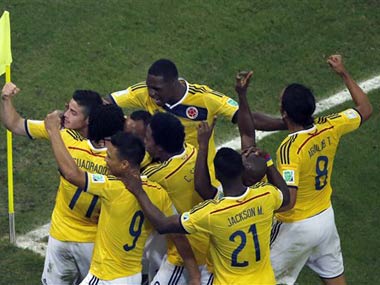
Cameroon’s Roger Milla lit up the 1990 World Cup with his hip-shaking dancing celebrations near the corner flag every time he scored. In 2002, it was Senegals’s Papa Bouba Diop who removed his shirt and led a dance after scoring against France . Fast forward 12 years and we have the Colombian team who are pulling off dance celebrations as enjoyable as the goals they score. The combination of striking football striking rhythm has gained them the world’s admiration. Here are three reasons Colombia has gone from rank outsiders to the world’s favourite team: [caption id=“attachment_1594019” align=“alignleft” width=“380”]
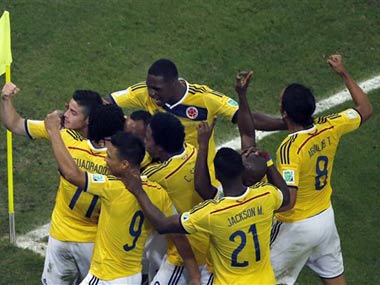 Colombia have gone from being rank outsiders to the darlings of World Cup 2014. AP[/caption] James Rodriguez: Call him James as in King James or Haamezz with a Spanish twang as in Jalapeno — this guy has been sensational for his country. With five goals in four games — two of them nothing less than spectacular — the 22-year-old has ensured that the spotlight is firmly on him now despite the credentials of Neymar and Lionel Messi. In the absence of Rademel Falcao, Rodriguez has become the focus of Colombia’s attacking moves. He’s a threat from distance (14 total shots - 8 from outside area, 6 from inside, 88 percent shot accuracy), dribbles, pulls of some brilliant passes and is the fulcrum of a talented, young, attacking Colombia. Rodriguez’ super solo goal against Japan
Rodriguez’ goal against Uruguay in the Last 16 They are a team, not a one man army: Portugal depended on Cristiano Ronaldo, England on Wayne Rooney and Spain on Andres Iniesta — they’re all out. Argentina depends on Lionel Messi and Brazil on the brilliance of Neymar. But Colombia are a proper team which executes perfect transitions from defence into attack. 10 out of the 11 goals they have scored have been assisted by a teammate (Cuadrado leads the World Cup assists chart with four) and have come from five different scorers. Their defending mainly depends on throwing bodies in the way of shots. They have made the most number of blocks (22) and even their goals are very well worked (watch below) and quick with an average passing streak of just 3.75. This is a team which knows each other, there is no one superstar and the dressing room ethos comes out in their dance moves and attacking moves — both of which they execute perfectly. This is a team which is having fun: When you anticipate the goal celebrations as much as the goal itself, you know you are watching a team that is playing with freedom and just enjoying themselves. When Pablo Armero scored their first 2014 World Cup goal (vs Greece) and broke off into a classic put-your-hands-in-the-air celebration, little did we know that was just the beginning. But it did, and when Teofilo Gutierrez added a second, another set of moves was shown with style: After seeing off Greece with ease, Colombia laid dancing on the back-burner in a serious contest against Ivory Coast which they won 2-1. With qualification assured, it was time to show the world a new celebration. As soon as Juan Cuadrado converted a spot-kick in the 17th minute, it was time for a move right out of Michael Jackson’s Thriller. James Rodriguez scored the fourth goal in their 4-1 win and ran across the touchline before leading the team to a fine step — learn this one, it’s going to be handy for a clubbing night.
Colombia next take on Brazil in a mouth-watering tie — it’s Neymar vs Rodriguez, Oscar vs Cuadrado — a battle of two South American teams, one struggling under the expectations of a nation and the other enjoying every minute of the World Cup. If Colombia can beat the hosts and pre-tournament favourites, it could herald a new era for a country that sadly has been known more for their drugs than anything else.
If there is one place Pulasta Dhar wanted to live, it would be next to the microphone. He writes about, plays and breathes football. With stints at BBC, Hallam FM, iSport, Radio Mirchi, The Post and having seen the World Cup in South Africa, the Manchester United fan and coffee addict is a Mass Media graduate and has completed his MA in Broadcast Journalism from the University of Sheffield."