

 "How Greg Chappell used Anil Kumble's appointment to take further potshots at Indian cricket")
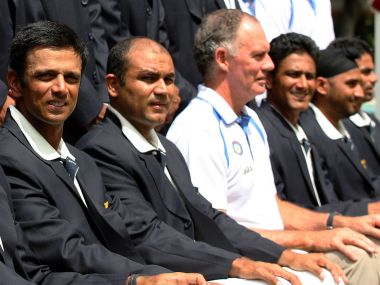
Calling Greg Chappell’s relationship with Indian cricket tumultuous would be something of an understatement. His constant conflict with various Indian cricketers, both during and after his tenure as coach, have been well-documented by the media. From his appointment as coach in 2005 to as recently as last week, when former captain Sourav Ganguly said that he hoped he didn’t repeat the Greg Chappell mistake while selecting the next India coach, the war of words between the former coach and senior Indian cricketers has been an ongoing story. [caption id=“attachment_2857026” align=“alignleft” width=“380”]  File photo of Greg Chappel with the Indian cricket team. Reuters[/caption] And just when we thought we’d now go a few days without revisiting the saga, Chappell has fired his latest salvo at Ganguly, with an article on Anil Kumble’s appointment as India coach. In the article for The Hindu, titled ‘Anil Kumble’s appointment is inspired’, he has praised the new coach for his selflessness, contrasting it with the supposedly self-centered approach of other player, barring Dravid. He (Kumble) was the heart to Rahul Dravid’s soul of the Indian teams in which they played with such distinction. If they had been blessed to have been surrounded by other selfless individuals whose only aim was to serve the team, the Indian teams in which they played would have been impossible to beat. This is a clear, if sly, indictment of not only Ganguly, with whom he seems to have a perennial ax to grind, but also Sachin Tendulkar, VVS Laxman, Virender Sehwag, Harbhajan Singh, Zaheer Khan and other senior players. Of course, it is no secret that Chappell and the said players have not been on the best of terms. Things took a turn for the worse around the release of Tendulkar’s autobiography in 2014, when players said not so flattering things about Chappell, after the batting great called the controversial former India coach a ‘ringmaster’. In his book Playing It My Way, Tendulkar wrote, “Chappell wanted to replace me with [Rahul] Dravid as India captain in 2007. Anjali (Tendulkar’s wife), who was sitting with me was equally shocked to hear him say that ’together, we could control Indian cricket for years’, and that he would help me in taking over the reins of the side,” he wrote. Chappell had denied the the claim back then and in response, several others players, including Gangulay, Harbhajan, Zaheer, Laxman backed Tendulkar and lashed out at Chappell and how he had handled the players. Further, in his article, Chappell alluded to the coach-captain equation in cricket, an aspect that was said to be the main bone of contention during his tenure in India. Kumble has been around long enough to know that the captain is the critical component of any cricket team and that the coach’s role is to support the captain to take the load off him to allow for personal preparation time in the lead up to games, but then take a back-seat once the game begins. The coach/captain’s role in cricket is very different from other sports where the coach is the obvious leader. The implication of this allusion is not lost on anyone who has followed Indian cricket in the last decade and has seen the role of India coach change. Even other than Chappell’s troubles with Ganguly, India has had its troubles with a head coach. Since the exit of Duncan Fletcher, India has had no formal coach till Kumble’s appointment last week. Ravi Shastri was the team director with a slew of support staff. With India employing split captaincy at the moment, with Virat Kohli in Tests and MS Dhoni in limited overs, Kumble’s role will be even more challenging. But probably the biggest problem with Chappell’s opinion piece is reiteration regarding the “selfish” nature of Indian cricketers. While the title of the piece suggests it’s about the appointment of Kumble as coach, it actually read more like a scathing critique of other players — who were incidentally instrumental in choosing the said coach — with Kumble’s appointment being used merely as a crutch to point other flaws in Indian cricket. He even brings up his own tenure at the helm in relation to Kumble’s appointment.
Indian cricket has never reached the heights that it should because it has relied too much on natural ability and flair rather than diligent preparation. Too often in the past, Indian teams have tried to take short-cuts rather than work hard so any success has been fleeting. It was something that I was appointed to change, but it needed key players, not least of all the captain, to buy-in and lead by example. Sadly, this didn’t happen until Dravid was appointed and the next 12 months brought some consistent success because of the change at the top.
This has rarely happened in India’s cricket history.
Pataudi, Dravid and Kumble are the exceptions.
They tried to lead by example, but failed because they either didn’t have enough talent or didn’t get the support they needed from key individuals.
The operative phrases in this passage, of course, are ’not least of all the captain’, ‘short-cuts’, and ‘consistent success’, notwithstanding the 2007 World Cup exit, and ‘didn’t get the support from key individuals’. Each of them is like a bullet, specifically aimed at reiterating his age-old point that Indian cricketers were larger-than-life players who did not let his process succeed. This is not news, and definitely not something that should or would affect the new coaching staff years later.
Ironically, Chappell quotes Mahatma Gandhi at the start of the article: “Strength does not come from physical capacity. It comes from an indomitable will.” And then he goes on, with his own brand of indomitable will, making the same point that he has had for almost a decade now.
Impact Shorts
More ShortsThe level of expectation that has greeted Kumble’s appointment borders on unrealistic so, unless he gets the support of all of the key stakeholders, it may prove to be too much even for his indomitable spirit. We are almost as glad as he is to know Anil Kumble will be the next India coach.

 "Charlie Kirk, shot dead in Utah, once said gun deaths are 'worth it' to save Second Amendment")
 "From governance to tourism, how Gen-Z protests have damaged Nepal")
 "Did Russia deliberately send drones into Poland’s airspace?")
 "Netanyahu ‘killed any hope’ for Israeli hostages: Qatar PM after Doha strike")
 "Charlie Kirk, shot dead in Utah, once said gun deaths are 'worth it' to save Second Amendment")
 "From governance to tourism, how Gen-Z protests have damaged Nepal")
 "Did Russia deliberately send drones into Poland’s airspace?")
 "Netanyahu ‘killed any hope’ for Israeli hostages: Qatar PM after Doha strike")



](https://images.firstpost.com/wp-content/uploads/2016/06/Chappell-Kumble-Dravid-Reuters.jpg)