

 "Paris Olympics 2024: football - history, rules, defending champions")
It’s impossible to imagine the world’s biggest multi-sporting event not featuring the world’s most popular sport. Football has quite the rich history at the Olympics, having been part of the programme for over a century now and only missing out on a couple of editions under special circumstances.
And thanks to its popularity all over the world, football consistently draws big crowds and gets massive television — and more recently online — viewership regardless of which country or continent the Games are held in.
This time the Olympics are taking place in a nation that has reached the final of the last two FIFA World Cups. Parisians as well as the rest of France therefore will be hoping ‘Les Bleus’ are able to finish on top of the podium in a home Olympics, which will help bury the disappointment of their semi-final exit in Euro 2024.
What is football’s history at Olympics?
Football has been part of every edition of the Olympics except the inaugural one that took place in Athens in 1896, as well as in 1932. Football was still in its infancy at the time of the first modern Olympic Games taking place towards the end of the 19th century.
While in 1932, football was taken off the list of sports for the Los Angeles Games in order for the Olympics to not compete with the newly-established Football World Cup.
Women’s football would be added to the Olympic programme in Atlanta 1996.
Hungary and Great Britain are the most successful nations in men’s football at the Olympics with three gold medals each, the former having won more medals overall, while USA are the most successful women’s team at the Olympics with four gold medals.
What are the rules?
The sport of football involves two teams of 11 players each playing on a rectangular field with two goalposts at either end. A match is played over a duration of 90 minutes divided into two halves of 45 minutes each, excluding stoppage time for injuries and other delays.
A goal is scored when a player in Team 1 puts the ball past the goalkeeper guarding Team 2’s goalpost, and the objective of the game is to win by scoring as many goals as possible. While teams start with 11 players on the field, they can substitute players at any given point of the match, with a total of three substitutions allowed in a 90-minute match.
While a match will end in a draw if both teams fail to score or end with the same number of goals, another 30 minutes are added in ‘Extra Time’ for important fixtures where a result is mandatory, i.e. knockout fixtures in the FIFA World Cup, Olympics, Euro, Copa America and other tournaments. Teams can make an extra substitution during this phase. If deadlock isn’t broken in ‘Extra Time’ either, the match enters a penalty shootout to decide the winner.
While women’s football will have the exact same rules in the Olympics as in the FIFA World Cup and other event, the men’s game has an age cap wherein the squad has to be 23 years of age or below with only three over-age players allowed. The Olympics usually take place around the same time when football leagues around the world get underway, as a result of which national teams find it difficult to secure the services of top players.
The age rule for the men’s game was first introduced in Barcelona 1992, with the three over-age-player limit added four years later in Atlanta.
Who are the reigning champions?
Brazil won gold in the men’s event, defeating Spain 2-1 in the final with Mexico winning bronze after defeating hosts Japan 3-1 in the third-place playoff.
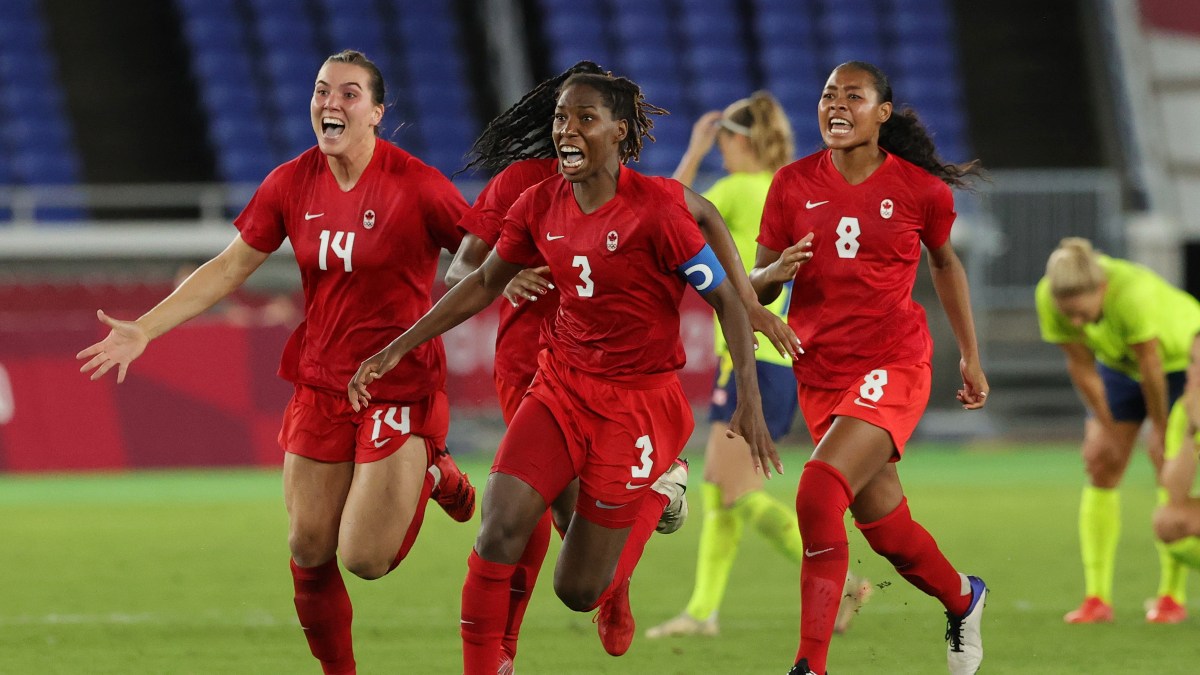
Canada won gold in the women’s event, defeating Sweden 3-2 on penalties after both teams finished with a gold medal each in the final. USA collected bronze after defeating Australia 4-3 in a high-scoring encounter.
Which countries have qualified?
Hosts France are among a handful of nations that have qualified for men’s as well as women’s football, and will be banking on home advantage to land a gold medal in both events. The other nations that have qualified for both categories of the sport are Japan, New Zealand, Spain and the United States.
A total of 16 teams will be participating in both men’s and women’s football, and will be divided into groups of four, with the top two teams then advancing to the quarter-finals, which will then be followed by the semi-finals and the gold and bronze medal matches.
While Canada will be defending the women’s gold medal that they had won in Tokyo, men’s gold medallists Brazil failed to qualify for the Paris Games. Teams such as Uzbekistan and Dominican Republic, meanwhile, have qualified for a global football tournament for the first time after qualifying for the men’s event.
Athletes to watch out for
Men’s football:
Bradley Barcola, France: One of France’s rising stars, Barcola joined Paris Saint-Germain last year as part of the club’s push for young, homegrown talent following the departures of icons like Lionel Messi and Neymar. Kylian Mbappe’s exit this year should provide more room for the forward to establish himself as one of PSG’s biggest talents. The Olympics is an opportunity to showcase his ability to a wider audience.
Kevin Paredes, United States: USA’s young player of the year in 2023 is gaining attention and has joined the likes of Vinicius Junior and Kevin De Bruyne by signing with Jay-Z’s Roc Nation sports agency. Capable of playing at left back or as a winger, the Wolfsburg player already has broken through to the United States’ senior national team.
Claudio Echeverri, Argentina: The 18-year-old Echeverri’s potential already has been spotted by Manchester City, and he will complete a move to the Premier League team ahead of next season. An attacking midfielder, he helped Argentina reach the semifinals of the U17 World Cup and could be one of the star players at the Olympics.
Women’s football:
Sophia Smith, United States: The former U.S. Soccer Player of the Year and NWSL MVP is heading into the Olympics in peak form. The 23-year-old forward plays for the Portland Thorns in the National Women’s Soccer League.
Aitana Bonmati, Spain: The reigning Ballon d’Or and FIFA Best Player of the Year winner led Spain to a World Cup title last summer. A fixture for Barcelona since 2016, the 26-year-old midfielder also helped lead the Spanish league team to the Champions League title in 2023.
Linda Caicedo, Colombia: One of the most dynamic young players in the game, Caicedo is just 19. Her story is even more compelling because she overcame cancer at 15. Caicedo scored in a 2-1 victory against Germany at the 2023 Women’s World Cup, a goal that was nominated for the FIFA Puskas Award for best goal.
Alexandra Popp, Germany: Popp scored four goals at last year’s Women’s World Cup, but Germany was surprisingly eliminated from the tournament after the group stage. The 33-year-old forward already has an Olympic gold medal from the 2016 Rio de Janeiro Games.
Barbra Banda, Zambia: Banda was a breakout star of the Tokyo Games, becoming the first player among men and women to have a hat trick in back-to-back games. The Orlando Pride in the NWSL paid a club-record transfer fee for the 24-year-old forward and it paid off: Banda scored 12 goals in her first 12 matches with the team.
When and where will football take place at Paris Olympics?
Football will take place at seven different venues across France, with Paris’ iconic Parc des Princes hosting the opening game on 24 July as well as the men’s and women’s gold medal matches on 9 and 10 August respectively. The other venues for the Olympics are Stade de Marseille (Marseille), Stade de Lyon (Lyon), Stade de Bordeaux (Bordeaux), Stade Geoffroy-Guichard (Saint-Étienne), Stade de Nice (Nice) and Stade de la Beaujoire (Nantes).
With AP inputs

 "Russian drones over Poland: Trump’s tepid reaction a wake-up call for Nato?")
 "As Russia pushes east, Ukraine faces mounting pressure to defend its heartland")
 "Why Mossad was not on board with Israel’s strike on Hamas in Qatar")
 "Turkey: Erdogan's police arrest opposition mayor Hasan Mutlu, dozens officials in corruption probe")
 "Russian drones over Poland: Trump’s tepid reaction a wake-up call for Nato?")
 "As Russia pushes east, Ukraine faces mounting pressure to defend its heartland")
 "Why Mossad was not on board with Israel’s strike on Hamas in Qatar")
 "Turkey: Erdogan's police arrest opposition mayor Hasan Mutlu, dozens officials in corruption probe")



