

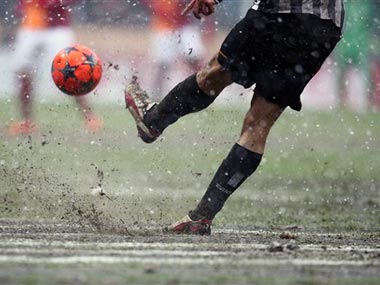
 "Dummies guide: How licensing works and why AIFF banned clubs from I-League")
When the All India Football Federation (AIFF) banned four clubs, including two-time champions Churchill Brothers, one thing was sure — this time, they meant business. But why did they do it? What were the exact criteria? Where did the clubs fail? Firstpost spoke to representatives/officials from the four banned clubs (Churchill Brothers, Rangdajied United, United SC and Mohd Sporting) and a source in the AIFF to compile this quick dummies guide. How does licensing work? The AIFF licensing system is heavily based on the AFC system and is divided into five major categories — sporting, infrastructure, personnel and administration, legal and financial. We have embedded a document at the bottom of the article where all these categories are explained in detail. There are categories within these broad divisions which are graded A, B and C. - Those requirements which are graded A are must-have’s for the club. If the club fails in any criteria which is graded A, the license will not be given. Example: Having at least two youth teams within the age range of 15 to 21, one youth team within the age range of 10 to 14 and one youth team below the age of 10 are all graded A. [caption id=“attachment_1548903” align=“alignleft” width=“380”]  The AIFF banned four clubs from the I-League for failing. AP[/caption] - If the club fails in any requirement graded B, then they will be penalised. Example: Each stand must provide sufficient toilet facilities for both sexes in accordance with the local authority regulations or the licensor’s requirements. These amenities must include washing facilities with at least cold water and a plentiful supply of towels and/or hand dryers. - Requirements graded C are those which are in best practice. Example: To implement a policy to ensure racial equality is upheld and educate its players, management and staff to ensure this goal is achieved. Why and in which categories did the clubs fail? “Forget about grade B or C, the clubs we banned have failed in multiple grade A criteria — so they were bound to be banned,” a top AIFF official told us. The official also told us that clubs did very poorly in the financial requirements. Here’s an example of a grade A requirement in the finance category: Regardless of the legal structure of the license applicant, annual financial statements based on the local legislation for incorporated companies shall be prepared and audited by independent auditors. The annual financial statements shall meet the minimum disclosure requirements and accounting principles defined by this regulations. Alternative 1: If the audited annual financial statements meet the minimum disclosure requirements and accounting principles defined by this regulations, then no further supplementary information has to be provided. Alternative 2: If the audited annual financial statements do not meet the minimum disclosure requirements and accounting principles defined by this regulations, then supplementary information must be prepared by the license applicant and assessed by the auditor. “These are things that almost every company in India follows, so there is no excuse to fail due to a lack of financial proof,” said the official. Rangdajied United also failed due to the non-submission of documents while lack of proper youth development (part of sporting category) was another area where all the clubs lost points. Finance, youth development and infrastructure are the three areas where clubs need to work most, the official told us. Is it possible for Indian clubs to follow such a stringent system? An argument against the licensing system is that there was too little time for clubs to manage setting up such a professional setup. In fact, Rangdajied United’s general secretary Karsingh Karbah admitted that ’the measures are surely good for Indian clubs’, but with football not being flush with money it would certainly be hard to pass with flying colours. “It’s not about money,” the AIFF official told us, adding: “It’s about structures and processes. Also, there was enough time for these clubs. The clubs knew since 2008 that this was coming — and we gave almost all of them exemptions at the start. If Pune and Bengaluru can do it, then why can’t the rest?”
Indian Club Licensing RegulationsFirstpost spoke to representatives/officials from the four banned clubs (Churchill Brothers, Rangdajied United, United SC and Mohd Sporting) and a source in the AIFF to compile this quick dummies guide.
Advertisement
End of Article
Written by Pulasta Dhar
If there is one place Pulasta Dhar wanted to live, it would be next to the microphone. He writes about, plays and breathes football. With stints at BBC, Hallam FM, iSport, Radio Mirchi, The Post and having seen the World Cup in South Africa, the Manchester United fan and coffee addict is a Mass Media graduate and has completed his MA in Broadcast Journalism from the University of Sheffield." see more


 "Russian drones over Poland: Trump’s tepid reaction a wake-up call for Nato?")
 "As Russia pushes east, Ukraine faces mounting pressure to defend its heartland")
 "Why Mossad was not on board with Israel’s strike on Hamas in Qatar")
 "Turkey: Erdogan's police arrest opposition mayor Hasan Mutlu, dozens officials in corruption probe")
 "Russian drones over Poland: Trump’s tepid reaction a wake-up call for Nato?")
 "As Russia pushes east, Ukraine faces mounting pressure to defend its heartland")
 "Why Mossad was not on board with Israel’s strike on Hamas in Qatar")
 "Turkey: Erdogan's police arrest opposition mayor Hasan Mutlu, dozens officials in corruption probe")



](https://images.firstpost.com/wp-content/uploads/2014/05/Football-gen-AP.jpg)