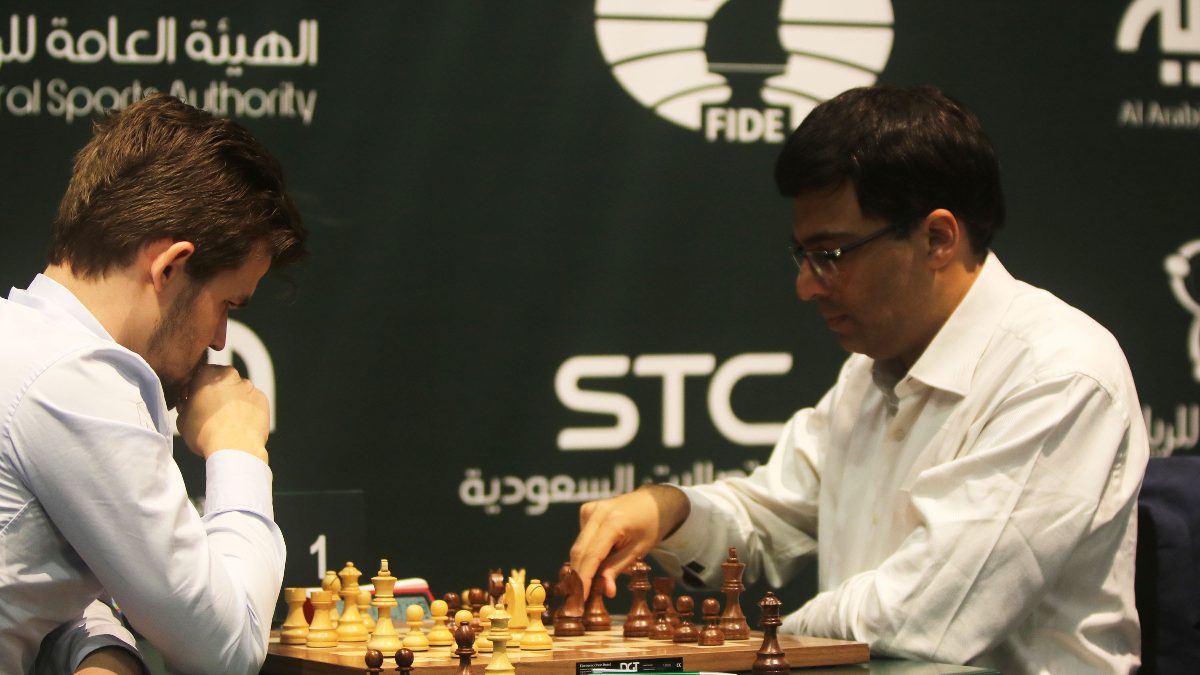
 "Magnus Carlsen beat Viswanathan Anand twice in World Chess Championship matches in 2013 and 2014. Image: PTI")
Five-time World Chess Champion Viswanathan Anand has reflected on his last two title clashes against Magnus Carlsen , the man who ended his long reign at the top. Speaking on YouTuber Prakhar Gupta’s podcast, Anand explained what went wrong for him in the 2013 and 2014 championships and why Carlsen became such a dominant force in the game.
Anand recalled that after the loss in the 2013 World Chess Championship, which took place in Chennai, India, he took the pressure off himself and played more for fun, which helped him win the Candidates Tournament in 2014 and earn another shot at Carlsen. However, Anand lost the rematch as Carlsen successfully defended his title in Sochi, Russia, in just 11 out of 12 games.
“I was in a chess crisis from roughly the end of 2010 until, well, after the match in 2013. I was really struggling with my game, and while I was working, I think I was unable to adapt to the new trends and developments. At the same time, I was working harder and harder in my old ways, trying to catch up, and it wasn’t working. This frustration climaxed in a pretty pathetic defeat in Chennai. But then I suddenly had this realisation… when I took a lot of pressure off myself and just tried to play for fun and experiment a bit more. I certainly won the Candidates in 2014 and played Magnus. I think I played much better this time… a lot of the games were at least two-way battles that could have gone either direction before they went in his favour. So that’s my story,” Anand said.
Anand on what makes Carlsen so special
When talking about Carlsen’s style and what makes him so special, Anand revealed that the Norwegian star limited himself to areas that most people ignored. Anand explained that Carlsen’s biggest strength was increasing his effort when others relaxed, forcing mistakes in situations that looked like draws.
“As for Magnus, he used to be quite a limited player, very, very good in that specific area. He limited himself to areas where no one else was really focusing, like the endgame and dry technical positions. He saw potential where others basically saw paint drying, and he was able to lure a lot of unsuspecting chess players to their doom over and over again. He was really cashing in those points before people learned the hard way to take those positions seriously and start working on them,” Anand said.
“Dry positions, where it seems you’re just on the way to making a draw… he understood that you still need to be precise. When people relax, they stop being precise; they go through the motions but aren’t paying attention anymore. So he (Carlsen) used to increase his effort there, force precision, and then the other players would make a mistake, unravel, panic, and lose these dry positions. He was cashing in during 2013-14, but here’s the thing… he bucked two great trends," he explained.
Anand said that Carlsen also became one of the best players in the opening stage and expanded his skills to all formats, especially faster games and online chess, which helped him improve further. Anand believes Carlsen’s dominance is a result of the fact that he can concentrate for long periods and work hard even when it doesn’t seem necessary for others.
“One trend was the broader trend I mentioned… why I think no country will dominate for a long time. Computers were supposed to level the playing field in terms of information, but Magnus showed that his unique ability, to increase his concentration at critical moments, to raise his effort when others were winding down, could be applied to many parts of the game. He was saying, ‘In any opening, I can find a little area to work in. I’ll apply this pressure, you’ll be inexact, and I’ll punish you.’ He was able to do that for a while. He’s been through a lot of trends, but later, he even became the best opening player in the world. For a good five or six years, he was the world’s leading opening expert. He may not have advertised it much, but he had caught up in openings with everyone. He was playing positions he earlier used to avoid… he kept expanding his game,” Anand added.
“Second, he kept expanding his comfort range. He started playing faster and faster time controls. He always liked blitz, but he began playing all this online internet chess, seemingly curious to see what he couldn’t get good at. I think that’s one reason he’s dominating now… because a lot of these faster formats are becoming more common. He continues to do extremely well in them to the point where, now that he seems slightly bored of classical chess, he focuses exclusively on faster play. But that’s a transition he worked on for a long time So he’s the big exception to the trend that says, ‘We all have the same information; it’s not easy to show an advantage.’ Magnus proved otherwise. And while others try to catch up, it turns out it’s not that easy to reduce his edge to a few simple steps. You have to change your whole attitude… concentrate for long periods without expecting immediate payoff, put in effort where others still don’t think it’s necessary. That’s what makes him different,” Anand said.
Carlsen went on to win three more titles before voluntarily relinquishing them in 2023. He announced in 2022 that he would not defend his title in the 2023 World Championship match. Carlsen stated he wasn’t motivated to play another match and that he found the preparation for classical chess matches exhausting.
As a result, 2022 Candidates winner Ian Nepomniachtchi played against Ding Liren, who had finished second in the tournament. Ding won the match after taking it into tiebreaks and delivering a decisive blow in the final rapid game to become the 17th World Champion. He eventually lost his title to India’s D Gukesh in 2024.