Politics springs surprises. Jitan Ram Manjhi, Bihar’s new chief minister designate, would vouch for it. He was inducted into the first cabinet of chief minister Nitish Kumar in November 2005 but he was dropped the same day, even before he could celebrate his big career achievement. The reason behind his unceremonious exit was his alleged involvement in the fake degree scam in the education department. He was exonerated from the charge later but the damage was done. Till three days ago, he was a thoroughly disappointed man. He had lost the Lok Sabha elections from the Gaya seat by a huge margin of around two lakh votes, finishing third in the contest. Now he is set to replace Nitish as the chief minister. [caption id=“attachment_1534369” align=“alignleft” width=“380”]
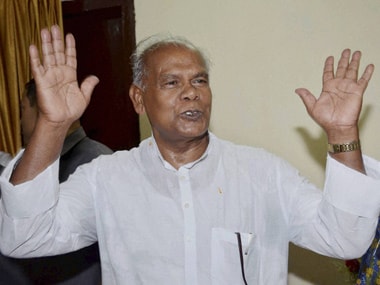 Jitan Ram Manjhi. PTI image[/caption] Why did Nitish settle for Manjhi as his successor? The reasons are many. The most important reason is that Nitish finds his position in the party, which has been under threat in recent times, safe with a low-profile, non-assertive, unambitious Dalit leader as chief minister. Had it been some powerful leader at the helm, say political observers, he would have found it difficult to rule the state by proxy. Manjhi is currently the SC/ST Welfare Minister in the government. “Nitish has appointed Manjhi just to take care of his ‘kharaon’ (a wooden slipper) as he wants to run the state by remote control. The next government will be quite like Sonia Gandhi running the Manmohan Singh government at the Centre or RJD leader Lalu Prasad remote-controlling the Rabri Devi government in Bihar,” commented senior BJP leader Sushil Kumar Modi who earlier served as Nitish’s deputy in the erstwhile NDA government. According to him, the Jitan Ram Manjhi government will be have no independence to act on its own. Secondly, Nitish wants to play the Mahadalit card to the hilt to increase and strengthen the vote base of his party, which put up a disastrous performance in the recent polls, as also to use them as a reply to Narendra Modi who played the “backward card” successfully. After the embarrassing defeat in the polls where his party was restricted to only two seats, Nitish apparently finds his leadership directly challenged even in his own den — his home district of Nalanda — where his yes-man and party candidate Kaushlendra Kumar scraped through, winning the polls by a little about 8,000 votes. In a way, victory of his candidate was only a “face-saver”, not a matter of pride which it used to be earlier. Similarly, the victory of another candidate Santosh Kushwaha—a former BJP lawmaker who joined the JD(U) on the poll eve after being denied ticket from his party — from eastern Bihar’s Purnia seat was more due to the sharp polarization of Muslim votes, than his party’s hold over voters. In fact, Purnia has been the stronghold of the BJP but it lost the polls only because the Muslims lent their support to the JD-U as the RJD-backed Congress candidate was not so strong. His pride wounded, Nitish wants to go the whole hog about the Mahadalit card - this socially backward group accounts for some 15 percent of the state’s total votes. A total of 21 castes fall under the Mahadalit category and Manjhi’s Musahar caste is one of them. The Nitish Kumar government had worked on this strategy in his first term in office itself but did not nurse this constituency much as he enjoyed the solid support of 14 percent upper caste for his party being in alliance with the BJP. He wants to make up for the loss of 14 percent of upper caste votes. By choosing an humble and down-to-earth person like Manjhi, whose total family assets remains at around Rs 50 lakh despite 34 years of active political service, Nitish has also served an open challenge to his detractors who were actively campaigning against him and trying to pull down his government with the alleged support from the BJP. Any attempt to bring down the government would only create sympathy for the Dalit chief minister. Manjhi began his career as a clerk in the telephone department after doing his graduation in 1967. As a boy he tended cows in the house of a farmer to eke out a livelihood. It was during this period that he learnt Hindi alphabets on his own, before finally enrolling himself in class four of government primary school. The study continued uninterrupted before he completed his graduation. He rise in politics, say observers, is due to his ability to read the direction of the political winds correctly. He began his political career by winning the assembly elections on a Congress ticket but when he found the party’s base going weak, he joined the RJD where he served as a minister. Finally, he joined the JD-U and became a minister until reaching this position.
Why Nitish chose to name Manjhi as his successor in Bihar
Manoj Kumar
• May 20, 2014, 18:53:04 IST
The most important reason is that Nitish finds his position in the party, which has been under threat in recent times, safe with a low-profile, non-assertive, unambitious Dalit leader as CM
Advertisement
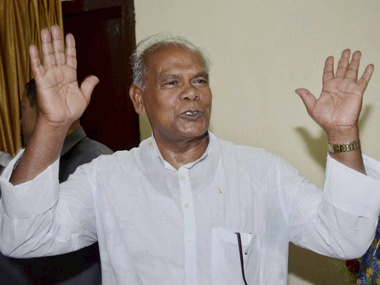 "Why Nitish chose to name Manjhi as his successor in Bihar")
End of Article