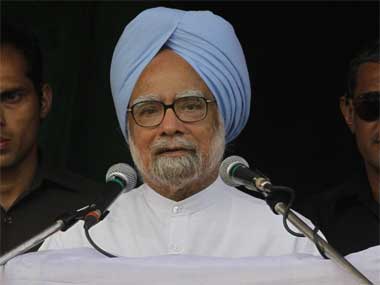
 "The loneliness of Manmohan Singh, a PM under siege")
The 18th century poet-saint Tyagaraja, in one of his soulful compositions ( Nagumomu Ganaleni ), points out that a king’s retinue would be failing in its duty if it did not offer good counsel to the ruler-in-chief.
It’s a pearl of wisdom that Prime Minister Manmohan Singh’s “counsellers” appear to have taken to heart.
In recent days, Singh has been at the receiving end of a torrent of well-meant criticism and advise from his professional peers and ‘friends’, which while couched in civilities, is nevertheless a searing criticism of a leader who has ceased to lead.
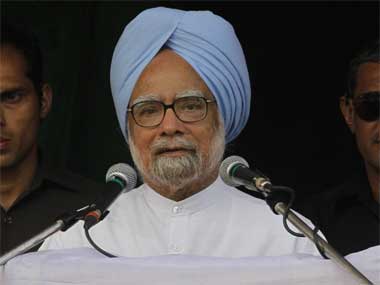
[caption id=“attachment_280544” align=“alignright” width=“380” caption=“A Prime Minister under siege.”]
 [/caption]
At a recent event in New Delhi, convened to release the second edition of a book that was originally published in 1998 to commemorate the first generation of economic reforms that Manmohan Singh presided over under PV Narasimha Rao’s prime ministership, Singh was bluntly reminded of his many failings.
Far from being a celebration of Singh’s work, this event, notes the Economist , “felt like an ambush.”
“Rather than waste time celebrating (Singh’s) work of two decades ago, everyone pushed on with far more urgent business: trying to get India’s prime minister to understand that, without a second round of economic reforms, and soon, India’s economic prospects will look far grimmer in the next few years than they have recently.”
That, they cautioned, would mean that Singh may not be remembered as the man who reformed India’s economy, but as the man who only got the job half done. His legacy, which must weigh on his mind in the autumn of his career, is in peril.
“The danger today,” noted ICRIER chief Isher Ahluwalia (who is Montek Singh’s Ahluwalia’s wife and a family friend of Manmohan Singh), “is that we seem to take faster growth for granted. But growth is currently under threat from a deteriorating macro-economic environment and a downturn in the investment climate. If growth slows down, we will lose instruments that enable us to bring about inclusion, provide social protection, and help eliminate hunger and malnutrition.”
Manmohan Singh’s honorary economic adviser Raghuram Rajan too was unsparing in his observations of where the fault lay. India’s star, he noted, “has dimmed in the last few months, as our governance is besmirched by corruption scandals and our macroeconomic health has deteriorated. Alarm bells should sound when domestic industry no longer wants to invest in India, even while eagerly investing abroad.”
The reason underlying the gloomy outlook, said Rajan, was that despite the success of the first generation of reforms, “some of the key next-generation reforms have been stymied.” These are the reforms that reduce rents and patronage, while increasing competition. But, he pointed out, if anything rent, patronage, or entitlement enhancing measures have sailed through.
Veteran journalist TN Ninan then identified the power dichotomy between Manmohan Singh and Sonia Gandhi as one of the underlying reasons why change wasn’t easy to come by. “We have copied the Communists, for whom the party is supreme and the government secondary.”
Second, he pointed out, “we have a prime ministerial system in Delhi, but a de facto presidential system in most of the states. So the prime minister at the Centre has to be consultative in all things, but presidential-style chief ministers in states can be as arbitrary and whimsical as they wish.”
Third, Ninan noted, “we have a coalition system at the Centre where the Cabinet acts like the American confederacy; each minister is an independent republic. So we have one policy under X environment minister, and quite the opposite under Y environment minister, and both are the policies of the same government.”
Finally, Ninan said, “our courts can and do dictate policy, breaching the walls that ensure a separation of powers. But when a former judge of the Supreme Court whom the government has foisted on the Press Council declares that 90 per cent of Indians are foolish, it does raise questions about the percentage of those on the Bench who are foolish.”
It isn’t just learned men of economic wisdom who are getting impatient with Manmohan Singh. According to some accounts, even Rahul Gandhi, he who has accomplished nothing of value till date, is believed to be “disgusted with Team Manmohan”, which he sees as a “lost cause”.
The Sunday Guardian reports , quoting unidentified aides of Rahul Gandhi, that he believes that it was the “poor performance and poorer optics” of Team Manmohan that was responsible for the Congress’ poor show in the recent round of Assembly elections. One of Rahul Gandhi’s key aides said: “A lot of effort was put in by Team Rahul to improve the functioning of the Congress organisation, but this proved useless against the steep decline in public support for Manmohan Singh and his ministers.”
The report further adds, citing sources, that “Team Rahul is getting very impatient” with the “infinite restraint and public support” shown by Congress president Sonia Gandhi to a government “that is visibly adrift”.
The language that Rahul aides invoke in their criticism of Manmohan Singh and his ministers paints a picture of a yuvraj who it itching for the throne. Perhaps this is the real ‘coup’ that may be in the works.
For Manmohan Singh, however, it’s getting awfully lonely at the top. The head-on criticism from his counsel of advisers may have been well-intentioned and therefore easier to absorb, but the sniping from the back-flanks by an uppity Prime Minister-in-waiting is far less benign. How much longer can Manmohan Singh bear such ritual humiliations?
Venky Vembu attained his first Fifteen Minutes of Fame in 1984, on the threshold of his career, when paparazzi pictures of him with Maneka Gandhi were splashed in the world media under the mischievous tag ‘International Affairs’. But that’s a story he’s saving up for his memoirs… Over 25 years, Venky worked in The Indian Express, Frontline newsmagazine, Outlook Money and DNA, before joining FirstPost ahead of its launch. Additionally, he has been published, at various times, in, among other publications, The Times of India, Hindustan Times, Outlook, and Outlook Traveller.