

 "Survey on Indian farmers: The MNREGA data Rahul Gandhi should see")
Last week, the Hindustan Times reported that a government report confirmed what the newspaper had reported previously, that delays in payment of wages under the Mahatma Gandhi National Rural Employment Guarantee Act had been one of the chief causes in the suicides of at least five rural labourers in Maharashtra. The five labourers, had ended their lives after not being paid their employment guarantee act wages went unpaid for three years. [caption id=“attachment_742469” align=“alignleft” width=“380”] 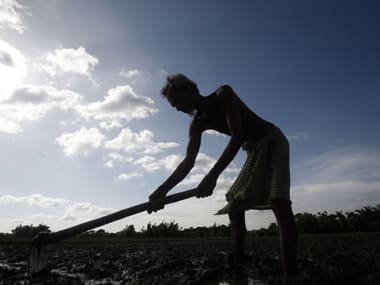 Representational image. Reuters.[/caption] HT’s investigative report published in December last year tracked seven families in rural Maharashtra and Jharkhand. In Buldhana’s Titvi village, Parvati Devi told the newspaper, “I will never go for MGNREGA work again. The scheme has killed my husband.” Her husband hanged himself in July last year. The family, landless labourers, worked for three years under the scheme, almost eight months a year, but got no wages. A loan followed, then difficulties in repaying, humiliation and finally, a desperate decision. The CSDS-Lokniti survey on the state of India’s farmers, a first of its kind initiative bears out Parvati Devi’s hatred of the UPA’s flagship scheme that Congress vice-president Rahul Gandhi never fails to mention, alongside his promise of “poori roti” through the food security law. The rights-based approach Rahul tries to peddle is noble in intention, but the survey finds that a mere 10 percent of poor and small farmers have got the benefit of the UPA’s farmer-related schemes. Specifically on MGNREGA, the survey found that 85 percent of farmers had heard about the scheme, but among those, more than half, 51 percent to be precise, said their household did not get work under the scheme. The MGNREGA scheme’s biggest beneficiaries are rural labourers, landless agricultural labourers, unskilled labourers looking for non-farm work during agricultural off -seasons, during other situations of crisis in the agriculture sector including drought, floods, crop destruction owing to other reasons and the small and marginal farmer looking for supplementary income. The other findings of the survey indicate that the beneficiary pond for MGNREGA is immense – the scheme could have on its own been a clincher for the UPA, had the scheme not been mired in allegations of non-payments, delayed payments, non-availability of work and corruption. The survey found approximately 70 percent of farmers reporting crop destruction in the last three years. While about 15 percent of interviewed farmers had heard about rural suicides in their areas, 49 percent associated these suicides with crop failure (35 percent because of credit/loans, 14 percent because of crop failure). As many as 67 percent of the women – a large target group under the Act – respondents admitting that income from agriculture is not sufficient to fulfill livelihood needs. And 61 percent interviewed farmers said they would gladly leave their farms if they got employment opportunities in the city. Of course, the most tell tale sign of the UPA’s failure to make MGNREGA count is the fact that 51 percent said their households did not get work under the law. That is not the only problem with an Act that has seen widespread irregularities, delays, suggestions to counter the delays, doubts over whether it is a viable source of livelihood, and admissions by Union ministers themselves that the social audits of MGNREGA works mandated under the law were largely ineffective. Last year, a CAG performance audit of the MGNREGA showed that the average number of days that the rural employment generation scheme delivered had declined from 54 days a year in 2009-10 to 43 days in 2011-12. Not only that, works worth over Rs 4,000 crore were incomplete even one to five years since launch. Also, Bihar, Maharashtra and Uttar Pradesh utilised only 20 per cent of the total funds released under the Scheme. The field reports, reviews, reports on the delays, delay compensation all make for enlightening reading on the MGNREGA’s website. You’ll see that while 29,35,112 households got at least 100 days of work in 2013-14 as promised by the Act, more than three times that number – 106,53,121 households – got less than 15 days of work in the same period. Certainly, Rahul Gandhi would do well to take a look at the numbers. But more than that, as the CSDS survey results show, it would serve the UPA well to review whether their schemes for the rural poor have impacted the state of the Indian farmer.
The scheme is mired in allegations of non-payments, delayed payments, non-availability of work and corruption.
Advertisement
End of Article

 "Russian drones over Poland: Trump’s tepid reaction a wake-up call for Nato?")
 "As Russia pushes east, Ukraine faces mounting pressure to defend its heartland")
 "Why Mossad was not on board with Israel’s strike on Hamas in Qatar")
 "Turkey: Erdogan's police arrest opposition mayor Hasan Mutlu, dozens officials in corruption probe")
 "Russian drones over Poland: Trump’s tepid reaction a wake-up call for Nato?")
 "As Russia pushes east, Ukraine faces mounting pressure to defend its heartland")
 "Why Mossad was not on board with Israel’s strike on Hamas in Qatar")
 "Turkey: Erdogan's police arrest opposition mayor Hasan Mutlu, dozens officials in corruption probe")



](https://images.firstpost.com/wp-content/uploads/2013/04/farmer_india_reuters.png)