

 "'Stronger action' against Pak? Try a charm offensive instead")
Within hours of the serial blasts in Mumbai recently, Opposition leaders launched into reflexive Pakistan-bashing even though there was no evidence pointing to Pakistani involvement in the latest terrorist attack. They also demanded that the Indian government adopt a “zero tolerance” attitude towards Pakistani sponsorship of terrorism, and break off all talks until Pakistan shuts down terror camps from where attacks originate. Pakistan’s use of terror as an instrument of proxy war against India is, of course, well established. And although successive Indian governments have deployed the full force of “coercive diplomacy” to get Pakistan to crack down on the terror groups operating on its soil, they haven’t always enjoyed enormous success. (Contrast that with Pakistan’s response to the recent Chinese allegation that terrorists in Xinjiang received training in Pakistan: they arranged for a Uighur family to be hastily repatriated to Xinjiang, without even establishing proof of involvement.) Such apparent failings in India’s coercive diplomacy have often led Indian commentators to wonder whether stronger responses were warranted against Pakistan. After the November 2008 terror attacks in Mumbai, one Indian magazine wondered: “Is war the only option?” According to the findings of the CNN-IBN CNBC-TV18 State of the Nation Poll in association with Forbes India conducted by CSDS, such sentiments evidently run high among a cross section of Indians. [caption id=“attachment_59256” align=“alignleft” width=“380” caption=“Candles burn in memory of the victims of the terrorist attacks outside the historic Taj Mahal Hotel in Mumbai. Ruth Fremson/The New York Times”] 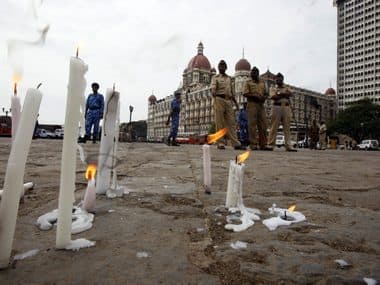 [/caption] Some 37 percent of the respondents felt that diplomacy and dialogue with Pakistan were not enough to pressure Pakistan on the issue of terrorism, and that stronger action was warranted. Only 29 percent felt that the government was right to pursue the diplomacy and dialogue route. Predictably, many more male respondents (41 percent) felt that stronger methods were warranted. Curiously, respondents in Central and Western India were far more in favour of twisting Pakistan’s arms forcefully in order to get it to act on terror. Respondents in the North were marginally less strident (30 percent favour diplomacy and dialogue; 36 percent favour stronger action); in fact, respondents from Punjab, a border state, were overwhelmingly in favour of dialoge (33 percent) than stronger action (19 percent). Respondents from the South were noticeably in favour (36 percent) of diplomacy and dialogue than stronger action (32 per cent). 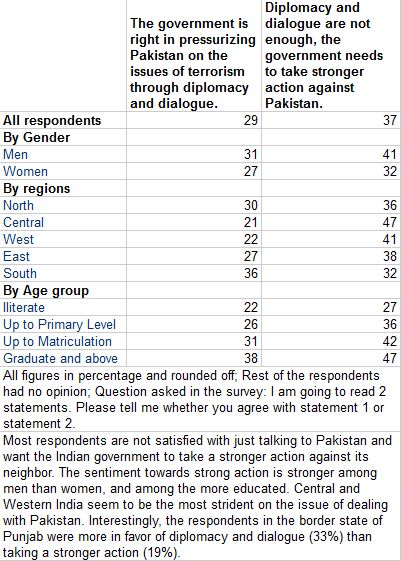 Curiously, the higher the education level among the respondents, the more strident their demand for stronger action against Pakistan. While the precise nature of the “stronger action” the respondents favoured isn’t clear, they presumably favour outright war or some limited airstrikes on terror camps operating in Pakistan-occupied Kashmir. If so, that’s a flawed strategy. Any unilateral anti-terror operation – of the sorts that the US did when it sneaked in and killed Osama bin Laden – would be counterproductive. Consider this: after the US operation to kill Osama bin Laden, the military-ISI-jihadi complicity with terror stands exposed before the world, and more importantly, before Pakistan’s civil society, which has thus far been blind to the obvious connections. Pakistani commentators, fed up with the daily dose of terror on their own soil, are pushing back against the military and the ISI, who are now on the defensive. Some of these commentators are actively calling for a change in the way the Pakistani nation perceives India: not as a threat, as the military and the ISI project it, but as a neighbour worth cultivating. That’s the kind of internal “people’s revolution” that can rein in the ISI and the military to act against terror groups. Any military action of the sorts that the survey respondents evidently favour would have the effect of consolidating support for the military and the ISI at a time when they are on the defensive. In that sense, it would be vastly counterproductive. In fact, there’s a case to argue that while India should exert the full force of its coercive diplomacy against the Pakistani state and maintain an eternal vigilance against cross-border terror, we should unleash a charm offensive at the people-to-people level. We should actively cultivate Pakistani sportspersons, performing artists and civil society members, give them visas liberally, and get them to become stakeholders in India’s economic and cultural ascent. They should become our Brand Ambassadors who project back home in Pakistan a liberal, secular, open-hearted image of an India that is worth courting. Do Pakistani cricketers want to play in our IPL? Don’t shut them out, as we’ve done in the past. Let them come and compete as equals and be chosen on their merits. Do Pakistani actresses want to act in Bollywood? Sure, let them - if there’s a director willing to hire them for their talent or dashing good looks. We have nothing to lose and everything to gain from deploying smart diplomacy that projects our soft power and works to change hearts and minds in Pakistan and convinces them that the unidimensional image that its military leaders project of India – as a military threat from which only they can protect their people – is an eternal, self-serving lie. That’s the only “stronger action” that India should take against Pakistan.
Many survey respondents favour not just dialogue and diplomacy with Pakistan but “stronger action” for its support of terror. But in fact, a counter-intuitive ‘smart diplomacy’ option could work better.
Advertisement
End of Article

 "Israel targets top Hamas leaders in Doha; Qatar, Iran condemn strike as violation of sovereignty")
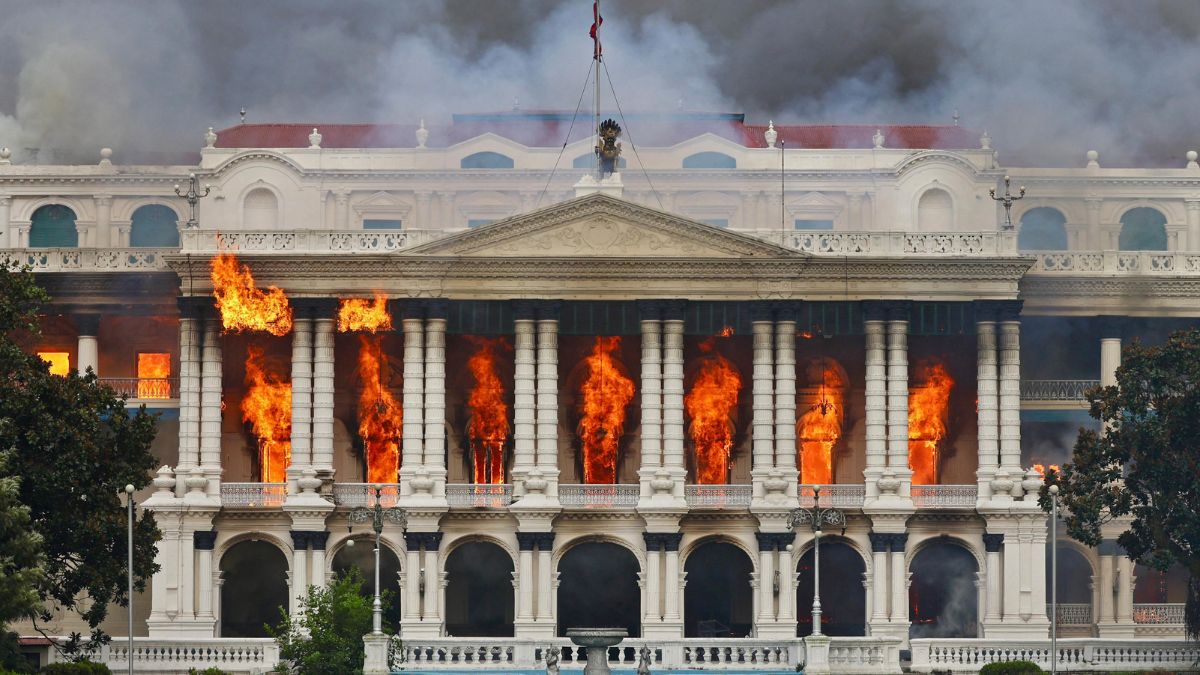 "Nepal: Oli to continue until new PM is sworn in, nation on edge as all branches of govt torched")
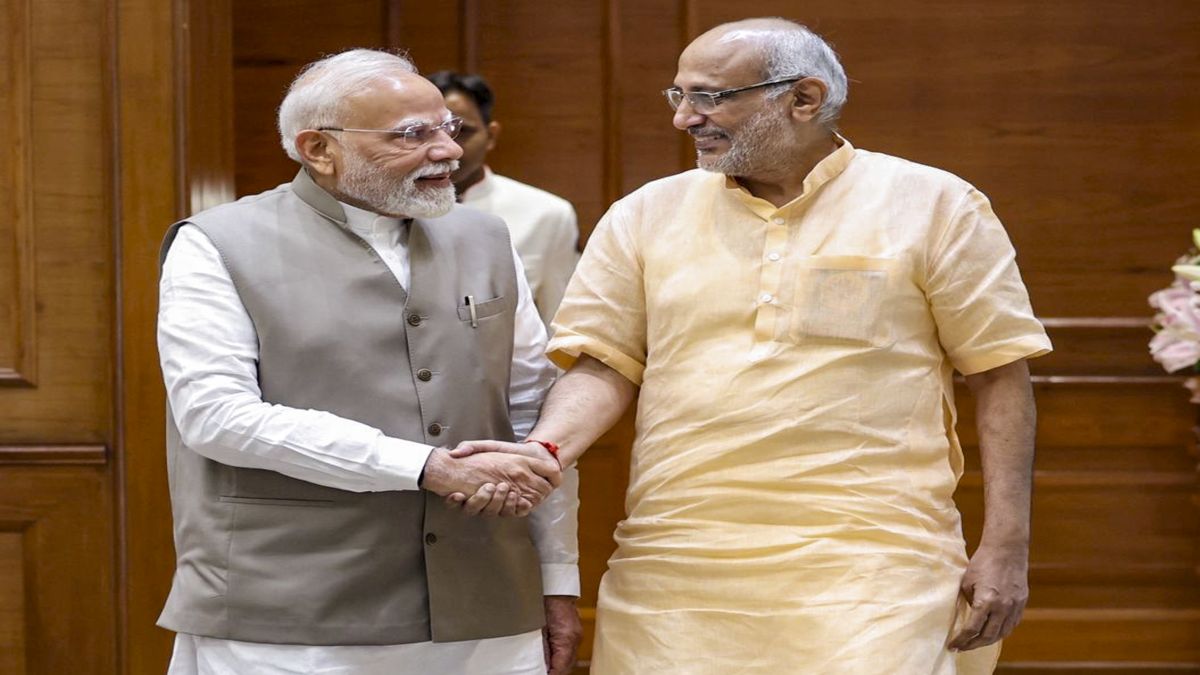 "Who is CP Radhakrishnan, India's next vice-president?")
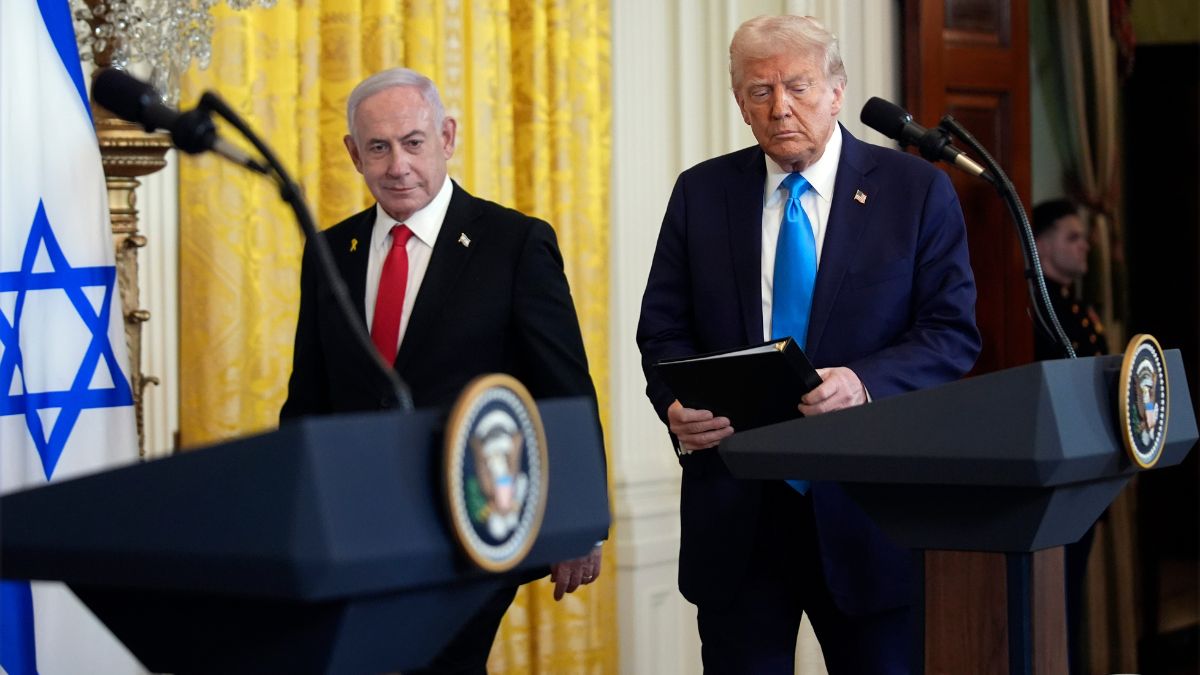 "Israel informed US ahead of strikes on Hamas leaders in Doha, says White House")
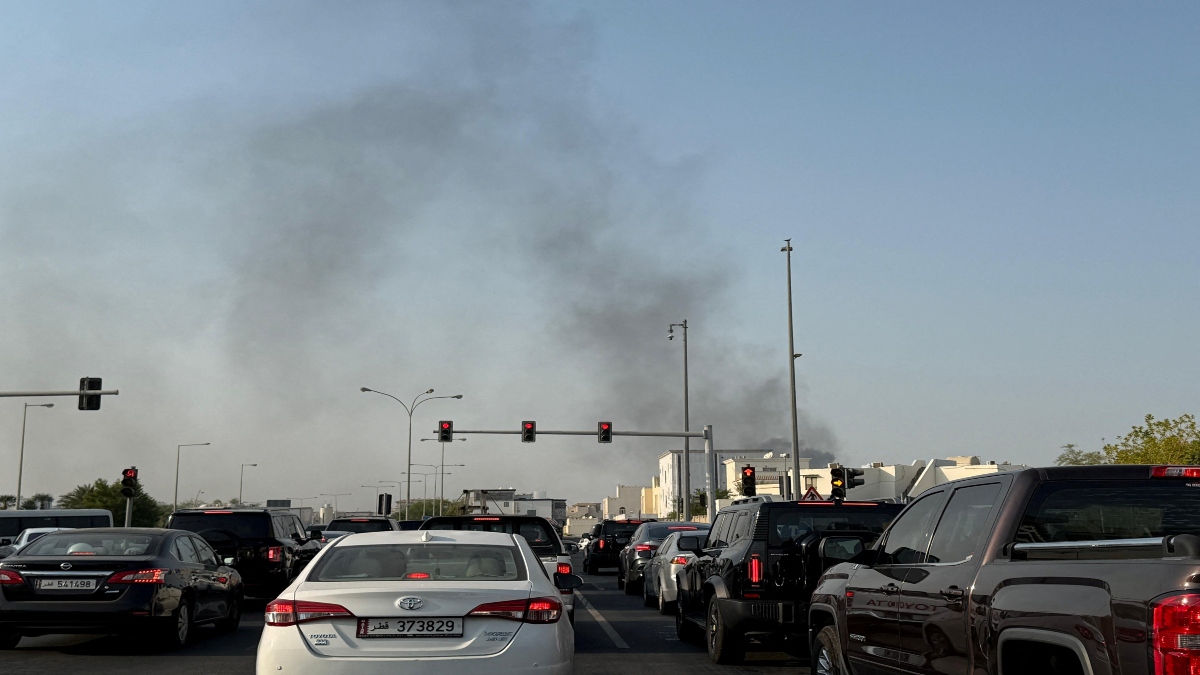 "Israel targets top Hamas leaders in Doha; Qatar, Iran condemn strike as violation of sovereignty")
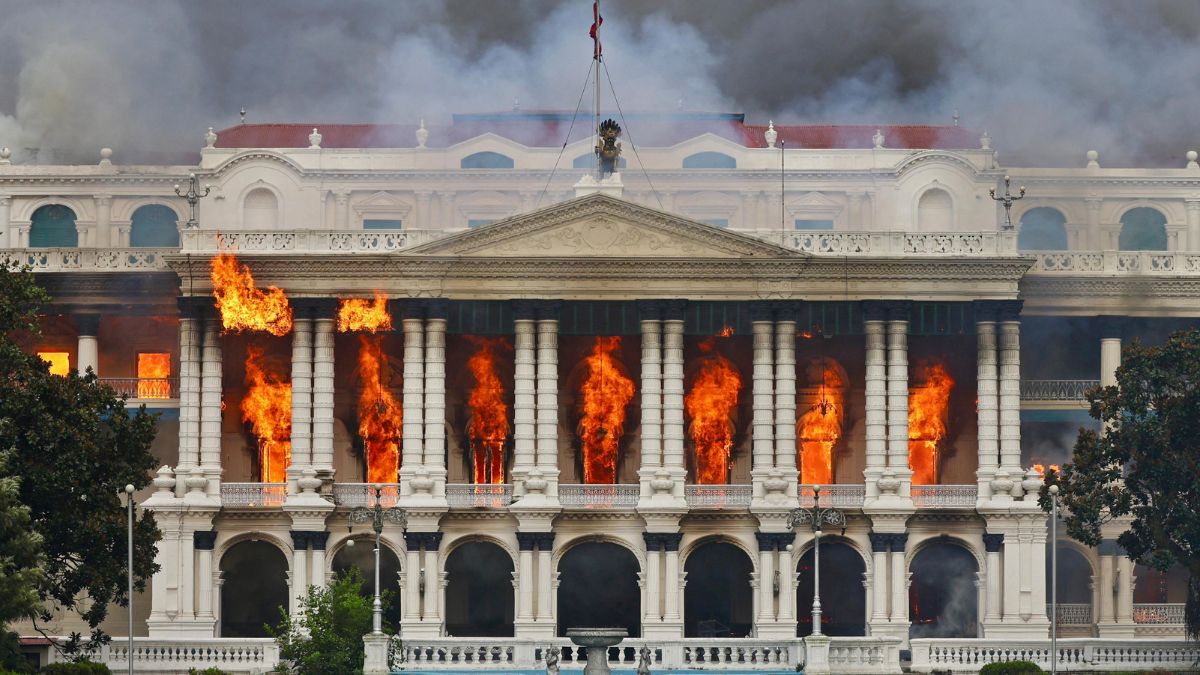 "Nepal: Oli to continue until new PM is sworn in, nation on edge as all branches of govt torched")
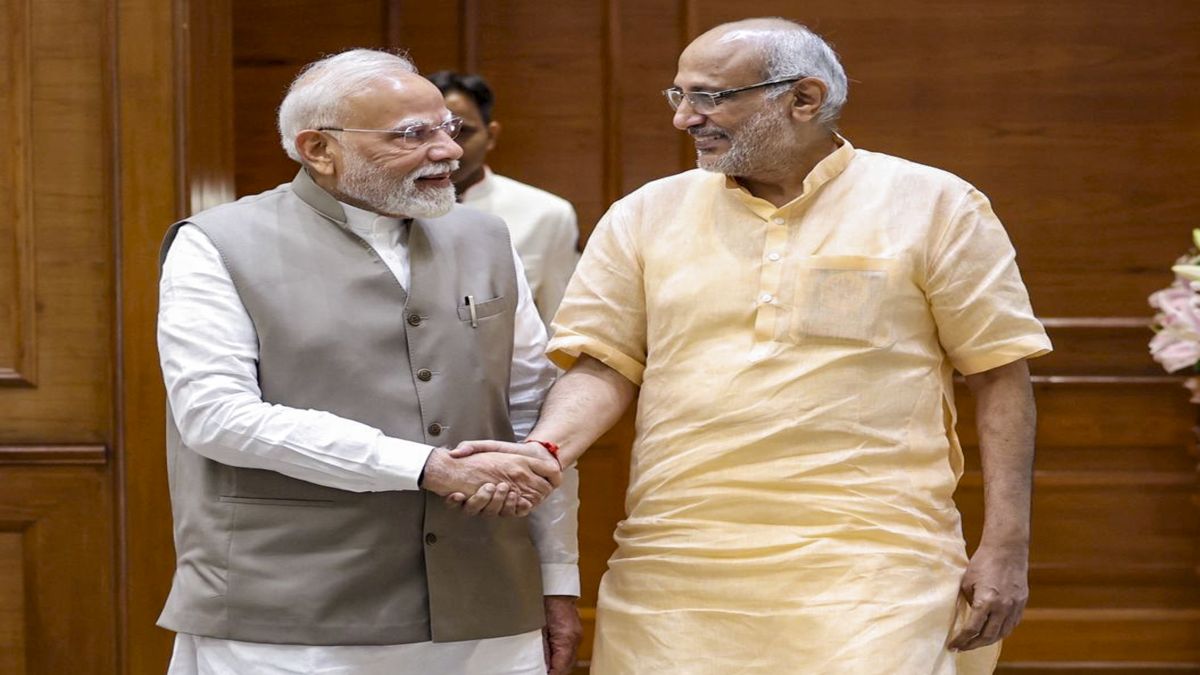 "Who is CP Radhakrishnan, India's next vice-president?")
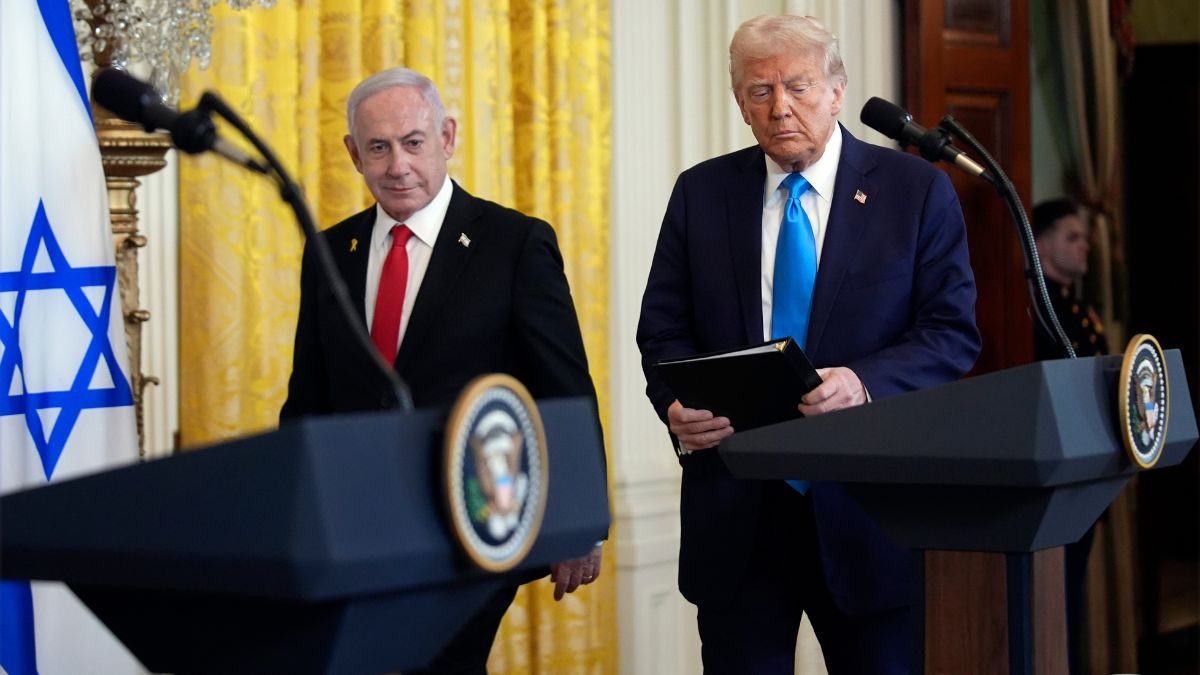 "Israel informed US ahead of strikes on Hamas leaders in Doha, says White House")



](https://images.firstpost.com/wp-content/uploads/2011/08/INDIA_ATTACKS_6-nyt.jpg)
](https://images.firstpost.com/wp-content/uploads/2011/08/DealingwithPakistanonTerrorism.jpg)