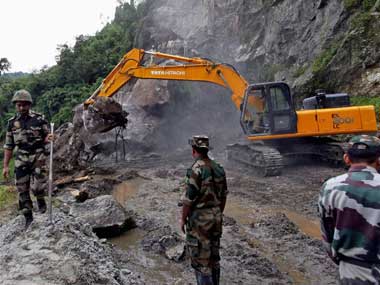
By Bahar Dutt For years officials from the National Hydro Power Corporation have assured us that the mega dams being constructed right from the stretch from Sikkim upto Arunachal Pradesh are safe from earthquakes. The North east is slated to be the Power House of the country according to a vision document of this government and over 100 dams are being constructed all along the Himalayas. This, despite the fact that the EIA (environment impact assessment) report for each major dam notes that the construction is being undertaken in a zone of high seismic activity. In a public hearing, (that is conducted to assuage the demands and fears of local people), at the site of Asia’s tallest dam in Dibang Valley, Arunachal Pradesh, when people raised the issue of earthquakes, an NHPC official just stood up and stated, “We are bringing development to your region be happy with that, why should you worry about earthquakes, when the last one happened only 30 years ago.”[caption id=“attachment_90118” align=“alignleft” width=“380” caption=“Army troops repair a road damaged in Sunday’s earthquake at Mangan in North Sikkim on Tuesday. Ashok Bhaumik/PTI”]
 [/caption] Take a look at the “development” that NHPC is bringing to Sikkim. The dams being built on the Teesta are of the “run-of-the-river” type, that require diverting river water through tunnels bypassing long stretches of the natural course, before the water is dropped back into the river at a downstream location after passing through a powerhouse. A cascade of projects along these rivers will mean most of the river would essentially end up flowing in tunnels, destroying the riverine ecology. Almost twenty six dams are to be constructed all along the river Teesta, starting in North Sikkim the site that has suffered the most damage from the earthquake. Sadly the same NHPC, which had assured local people of safety from the dams, suffered the maximum damage, lost as many as 40 workers at one site and at another spot the earthquake has induced cracks in the dam causing water to flow out creating further panic. Media reports based largely out of Delhi too have shown their ignorance of the region. In one news report after another , its been said that the infrastructure in the region is “poor” and the “condition of the roads poor and ravaged with landslides”. Yet few are aware that it was the creation of the big infrastructure such as dams, that actually worsened the problem for the people of Sikkim. One reason why rescue teams could not reach the disaster sites on time were the landslides all along the way. In the last five years since the first clearance was given for construction of the mega dam on the river Teesta over 1,000 workers and engineers have clear felled forests, and blasted the rocks to create tunnels all along the river that has triggered hundreds of landslides, mudslides leading the walls of peoples homes to crack. This is a fact acknowledged by NHPC itself, in its recent report, where it mentions that the creation of a tunnel for Teesta III has caused increased landslides along this stretch of National Highway 31. The constant blasting of the mountainside for the tunnels made the residents close to the Teesta V 510 MW hydropower project, more vulnerable to the earthquakes when their homes cracked open as a result of the dam construction. It was the CAG report of 2009 that first rung alarm bells on the Teesta Dam. For example, in a section on Disaster Management Plans, it noted that the projects “entailed extensive excavation, blasting, construction of mammoth water reservoirs, power houses and allied activities…[that puts] tremendous stress on the fragile environment of the State which could bring about unanticipated disasters and calamities…[threatening] tremendous loss of life and property besides long term damage to environment”. By contrast take a look at neighbouring Bhutan . Sunday’s 6.8 earthquake had its epicentre at Mangan, and Bhutan is barely 150km from Mangan — escaped major losses, thanks to its large forest cover. There was one death and four people injured but its homes and roads were mostly intact unlike in Sikkim , where landslides devoured vast chunks of roads, and the death toll touched 112 by Thursday afternoon. There has been a loss of forest cover in Sikkim in recent years because of the ongoing construction of a series of hydel projects on the Teesta and its tributaries, making it more vulnerable to quakes. In Sikkim, most deaths were caused by mudlsides that wiped out the ground beneath houses and blocked key roads, including the NH-31, in several areas. But in a naturally green Bhutan , forests helped hold the soil together in the hill slopes, preventing such mudslides. NHPC has maintained a hush silence about the damage to their life and property, while its being purported that the loss maybe far greater. This public sector agency needs to be more open about what went wrong, and perhaps a more honest and rigorous assessment of safety tests in place for mega dams coming up on the loose soils of the Himalayan region. The people of Sikkim who have been agitating for the last five years against the construction of the dams, on safety, cultural and environmental grounds, may probably feel vindicated for raising these concerns. Earthquakes can be natural calamities, but how severe the damage to peoples life and property is “man-made”. If our take home message from the Sikkim earthquake is that the area needs more development, it would be a huge oversight. If the government goes ahead with its plans to construct dams in seismic zones, its only reiterating the point- people be damned. Dams are more important than human lives. Bahar Dutt is a conservation biologist and has travelled across the North east reporting on the issue of dams for CNN-IBN.
Post Sikkim quake, mega dams in the Himalayas need re-think
FP Archives
• September 22, 2011, 20:03:19 IST
The damage in Sikkim due to the earthquake would have been far less had the state was not stripped of its green cover due to the
Advertisement
 "Post Sikkim quake, mega dams in the Himalayas need re-think")