 "Is Shashi Tharoor’s breakup with Congress inevitable?")
 "‘Naxalism will end in India by March 2026’: Amit Shah at CRPF Raising Day parade")
Union Budget Special Coverage tomorrow | Parliament Latest Updates: Lok Sabha has passed The Aadhaar And Other Laws (Amendment) Bill, 2019. All amendments moved by MPs were negatived. Hitting out at MPs for referring to the Supreme Court judgment to oppose the Aadhaar Amendment Bill, Law Minister Ravi Shankar Prasad said, “Don’t turn this House into a court. We are here to make laws and we also have the power to undo judgment. Please, I would urge don’t minimise your power. The people of the country have given you power to frame laws.” AIMIM leader Asaduddin Owaisi lashed out at the Centre over the Aadhaar Amendment Bill. He called the Bill ‘a classic example of halala’, which prompted laughter in the Lok Sabha. “The Supreme Court had ended marriage between state and private parties on use of Aadhaar, now this Bill is halala, Supreme Court called it a vice, government making it a virtue,” he said. In Lok Sabha, Congress leader Manish Tewari claimed that a salient part of Supreme Court judgment on right to be forgotten has been missed by the government in the Aadhaar Amendment Bill. The new bill additionally allows ‘offline verification’ of an individual’s identity, without authentication, through modes specified by the Unique Identification Authority of India (UIDAI) by regulations. Speaker Om Birla said he will give an opportunity to everyone but wanted first-time woman lawmakers to get a chance and added that Prime Minister Narendra Modi and Congress leader Sonia Gandhi will also share his wish. The Economic Survey lays a strong emphasis on job creation. It further looks at private investment as the “key driver” to generate jobs. Chief Economic Advisor K Subramanian, whose team is responsible for making the Economic Survey, said, “Looking beyond the economics of equilibrium, Survey makes case for investment-driven “virtuous cycle” to sustain growth at 8%. Investment will be the “key driver” of simultaneous growth in demand, jobs, exports and productivity.” Finance Minister Nirmala Sitharaman tabled the Economic Survey 2019 in Lok Sabha. The economic survey has predicated 7 percent GDP growth in FY20 on stable macro economic conditions. It is notable here that India needs to grow at 8 percent per annum to become a $5 trillion economy by FY25. Finance Minister Nirmala Sitharaman tables Economic Survey in the Rajya Sabha. The economic survey has predicated 7 percent GDP growth in FY20 on stable macro economic conditions. Narendra Modi-led BJP government is set to present its first Economic Survey and Union Budget after re-election in the recently concluded 2019 Lok Sabha elections. The Economic Survey is expected to be presented on Thursday, a day ahead of the Union Budget, which is an outlook of developments in the economy Minister of Communications, Electronics & IT Ravi Shankar Prasad on Thursday is to introduce a bill to further amend the Aadhaar (Targeted Delivery of Financial and Other Subsidies, Benefits and Services) Act, 2016 and further to amend the Indian Telegraph Act, 1885 and the Prevention of Money-laundering Act, 2002, which is to be taken into consideration. Prasad will also introduce a motion for the bill to be passed. The new bill additionally allows ‘offline verification’ of an individual’s identity, without authentication, through modes specified by the Unique Identification Authority of India (UIDAI) by regulations. Under the previous act, usage of Aadhaar number for establishing the identity of an individual, by the State or a body corporate under any law, is permitted. The new bill removes this provision. An entity may be allowed to perform authentication through Aadhaar, if the UIDAI is satisfied that it is: compliant with certain standards of privacy and security, or permitted by law, or seeks authentication for a purpose specified by the Central government in the interest of the State. Furthermore, Narendra Modi-led BJP government is set to present its first Economic Survey and Union Budget after re-election in the recently concluded 2019 Lok Sabha elections. The Economic Survey is expected to be presented on Thursday, a day ahead of the Union Budget, which is an outlook of developments in the economy. The purpose of tabling the Economic Survey in Parliament is to summarise the performance of major development programmes, reveal prospects of the economy of India in the short to medium term and also highlight the policy initiatives of the Central government. The Economic Survey consists of detailed statistical data that covers macro and sectoral aspects of the Indian economy. The Economic Survey is to be presented to both Houses of Parliament: Lok Sabha and Rajya Sabha during the Budget Session. It is expected to be presented at 12:00 pm. Some of the key issues that are expected to feature in the economic survey are pointers on the slowdown in economic growth, agricultural distress, banking woes and a sharp fall in demand and investments. Subramanian is also expected to offer solutions that can help the government work towards resolving the issues and boost economic growth. He is likely to discuss the slowdown in GDP growth at length.
Parliament Updates: Lok Sabha passes Aadhaar Amendment Bill; House adjourned till Friday
Union Budget Special Coverage tomorrow | Lok Sabha has passed The Aadhaar And Other Laws (Amendment) Bill, 2019. All amendments moved by MPs were negatived.
)
Rajya Sabha passes Indian Medical Council (Amendment) Bill, 2019
Both the Houses have been adjourned for till Friday, 5 July.
Lok Sabha passes Aadhaar Amendment Bill
All amendments moved by MPs negatived. Lok Sabha has passed The Aadhaar And Other Laws (Amendment) Bill, 2019.
House has power to undo SC judgment, says Ravi Shankar Prasad
Law Minister Ravi Shankar Prasad said, “Adhir Ranjan Chowdhury, it would’ve been great if Congress would’ve brought legislation on Aadhaar. We’ve been trying to bring it since Atal ji’s time.”
Hitting out at MPs for referring to the Supreme Court judgment to oppose the Aadhaar Amendment Bill, he said, “Don’t turn this House into a court. We are here to make laws and we also have the power to undo judgment. Please, I would urge don’t minimise your power. The people of the country have given you power to frame laws.”
RLD MP backs Aadhaar Bill
RLP leader Hanuman Beniwal, RLP claimed there was no scope for security-breach under the Aadhaar Bill. Supporting the Bill, he said that the direct dissemination of subsidies is made possible by Aadhaar. He also mentioned the penalty of Rs 1 crore in case of violation and added that Aadhaar will bring down corruption.
Owaisi calls Aadhaar Amendment Bill ‘classic example of halala’
AIMIM leader Asaduddin Owaisi lashed out at the Centre over the Aadhaar Amendment Bill. He callled the Bill ‘a classic example of halala’, which prompted laughter in the Lok Sabha. “The Supreme Court had ended marriage between state and private parties on use of Aadhaar, now this Bill is halala, Supreme Court called it a vice, government making it a virtue,” he said.
He further claimed the Bill also shows ill effects of electoral bonds. “I don’t know why this government has so much love for private entities… Why are you demeaning this House by bringing this Bill,” he asked.
Concluding his speech, he pointed at seven clauses in the Bill which were apparently in violation of the Supreme Court judgment on Aadhaar. “You are doing a crime over here,” he said.
Shiv Sena MP backs Aadhaar Amendment Bill
Backing the new Aadhaar Amendment Bill, Shiv Sena MP Shrikant Eknath Shinde said the Bill frees the individual of any compulsion to furnish Aadhaar to any company. He urged the government to look into data misuse, adding that privacy concerns should be looked into by getting mobile companies to delete previously procured information.
Manish Tewari says Aadhaar Amendment Bill overlooks ‘right to be forgotten’
In Lok Sabha, Congress leader Manish Tewari said, “The amendment Bill provides a good opportunity to revisit the founding principle of the entitre aadhaar. When Aadhaar was introduced, he rationale was there were millions who were bereft of any identity and they were unable to access services like ration card, pan card. This was the aim of the programme. When in 2016 the government brought the bill, it seemed that the aim of the government was to reduce the identity of an individual to a single number.
“The question is does this Bill give effects to judgments that Supreme Court has given? The one aspect that this bill overlooks is the right to be forgotten.”
Supriya Sule says BJP is claiming bills introduced under UPA regime to be theirs
The NCP leader, while discussing the Aadhaar bill in Lok Sabha, said that it is a shame that people’s data is allowed to benefit private sectors. “Most of the bills that the current government claims to be theirs were created under Manmohan Singh government she said. Sule further claimed that 65 crore people connected their mobile phone numbers to Aadhaar as they had “no other option”.
DMK opposes Aadhar (Amendment) Bill**, says it is against ‘right to privacy’**
DMK’s B Ravikumar said that the Aadhaar and Other Laws (Amendment) Bill, 2019 will give private companies access to people’s data, which is in contravention of the Supreme Court verdict. He said that monetisation of data, as mentioned in the Bill, is against the fundamental right to privacy and asked for it to be sent to a Parliamentary Standing Committee.
Aadhaar Bill defeats purpose of original idea of scheme, says Mahua Moitra
“The entire idea of Aadhaar was to come up with a unique 12-digit number; the Amendment Bill’s idea to create an alternative virtual identity is only a way to bypass the SC’s judgement striking down Clause 45,” Mahua Moitra claimed.
“If the ecosystem fails after one procures their most personal information to a private agency, the means of recourse are not specified in the Bill. It is shrouded in mystery,” she stated. “All private agencies are using this means to get private data, turning on its head the original idea of Aadhaar being a means for the poor to get subsidies,” Moitra claimed.
Aadhaar Bill classic case of cart before the horse, says Mahua Moitra
Mahua Moitra opposed the Aadhaar Bill stating that the government has pegged important clauses on largely opaque regulations, some of which don’t even exist. “In more than 11 places in the Bill, it is said “as per regulations”. What are these regulations. Why aren’t they clearly stated and explained to the citizen.”
“I’m giving up my bio-metric data, my most personal data to a pvt agency. If Aadhaar ecosystem fails you’re saying that there are viable means to recourse but I don’t know what they are. They haven’t been specified.”
‘‘Aadhaar udhaar hai,’ Congress’ Adhir Ranjan Chowdhury slams BJP for repackaging UPA-era schemes
“You have borrowed the Aadhar from us,” Chowdhury claims. The Direct Benefit Programme was also borrowed. “You way is not befitting for a democratic government. It is political plagiarism,” he alleged. “When we constituted the Aadhar, it did not breach anybody’s Fundamental Rights. Privacy was being breached,” he says.
Adhir Ranjan Chowdhury vehemently opposes govt taking Ordinance route
“Our Constitution has provision for the invocation of Ordinances but in the same way, it gives directions on when and why and how an Ordinance can be promulgated. It can be promulgated under extraordinary circumstances or emergencies that warrant its promulgation,” Chowdhury said. He told the Law Minister that four Ordinances are being brought every 10 Bills, which is an unprecedented route in history.
Lok Sabha discusses bill to further amend the Aadhaar (Targeted Delivery of Financial and Other Subsidies, Benefits and Services) Act, 2016
Minister of Communications, Electronics & IT Ravi Shankar Prasad on Thursday introduced a bill to further amend the Aadhaar (Targeted Delivery of Financial and Other Subsidies, Benefits and Services) Act, 2016.
The new bill additionally allows ‘offline verification’ of an individual’s identity, without authentication, through modes specified by the Unique Identification Authority of India (UIDAI) by regulations.
Hema Malini raises issue of attacks on doctors
BJP MP from Mathura, Hema Malini raised the issue of attacks on doctors. She said, “My concern is about the vicious attacks on doctors in various hospitals across the country. On 17 June, around 8 Lakh doctors held on all India strike. For saving the life of a patient the doctor goes through a very stressful condition.They’re our superhero and a national asset. We trust God and place equal trust on doctors. There should be a very strict law to protect medical community. Government should make rules to blacklist those who assault doctors, they should be debarred from facilities,including hospitals.”
Lok Sabha’s youngest member speaks in House
Chandrani Murmu, the youngest MP in the 17th Lok Sabha raised a matter of urgent public importance in Zero Hour. She asked the Centre to setup a steel plant in her constituency(Odisha).
Lok Sabha Speaker Om Birla allows first-time women MPs to speak in Zero Hour
Speaker Om Birla said he will give an opportunity to everyone but wanted first-time woman lawmakers to get a chance and added that Prime Minister Narendra Modi and Congress leader Sonia Gandhi will also share his wish.
Economic Survey 2019 bats for increasing retirement age for govt employees
“Given the life expectancy of both males and females in India is rising, increasing the retirement age for both could be considered. This will be a key to the viability of pension systems and would also help increase female labour force participation in older age groups. Since an increase in the retirement age is inevitable, it may be worthwhile signaling this change well in advance—perhaps a decade before the anticipated shift—so that the work force can be prepared for it.This will also help plan in advance for pensions and other retirement provisions.”
State of Economy at a glance: Economic Survey 2019
Economic Survey holds dedicated chapter on Swachch Bharat
The Economic Survey of India 2019 contained a dedicated chapter on Modi government’s pet scheme, Swachch Bharat. It states: “As a result of the efforts of the Government, as on date, 98.9 per cent of India has been covered under SBM. Since October 2014, over 9.5 crore toilets have been built all over the country (till 14.06.2019). The total number of household toilets constructed from 2014 till 2018 shows a rapid progress over the last few years starting from less than 50 lakh household toilets per year and reaching up to over 3 crore toilets per year”
Economic Survey 2019 projects 283.4 million tons of food grains production for 2018-19.
Jobs creation takes centrestage in Economic Survey
The Economic Survey lays a strong emphasis on job creation. It further looks at private investment as the “key driver” to generate jobs. Chief Economic Advisor K Subramanian, whose team is responsible for making the Economic Survey, said, “Looking beyond the economics of equilibrium, Survey makes case for investment-driven “virtuous cycle” to sustain growth at 8%. Investment will be the “key driver” of simultaneous growth in demand, jobs, exports and productivity.”
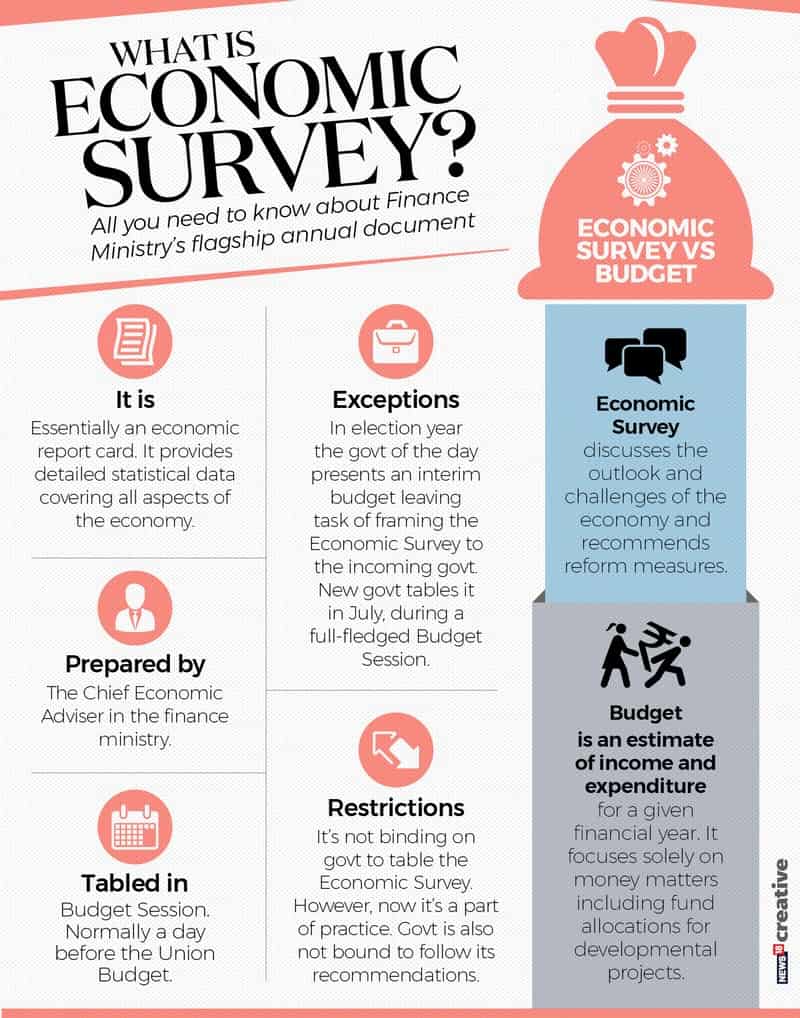
What is the Economic Survey?
The annual Economic Survey is usually presented a day before the presentation of the annual budget. It serves as the official report of the economy. Some of the key issues that are expected to feature in the economic survey are pointers on the slowdown in economic growth, agricultural distress, banking woes and a sharp fall in demand and investments. Chief Economic Advisor KV Subramanian will lay on the table of both Houses this year’s Economic Survey.
Nirmala Sitharaman tables Economic Survey 2019 in Lok Sabha
Finance Minister Nirmala Sitharaman tabled the Economic Survey 2019 in Lok Sabha.
Increased uncertainty over trade tension may hit exports, says Economic Survey
Economic Survey 2019 says lower global growth and increased uncertainty over trade tension may hit exports, reported Reuters quoting sources
Economic Survey says stressed NBFC’s partlyresponsible for low growth in FY18
Stress in the Non Banking Financial Company (NBFC) sector was also a reason for FY19 growth slowdown. However, now positive signs in investment activity seem to be taking hold.
Economic Survey predicts 7% GDP Growth
The economic survey has predicated 7 percent GDP growth in FY20 on stable macro economic conditions. It is notable here that India needs to grow at 8 percent per annum to become a $5 trillion economy by FY25.
Govt tables Economic Survey in Parliament, survey pegs fiscal deficit at 5.8% in FY19 against 6.4% in FY18
Finance Minister Nirmala Sitharaman tables Economic Survey in the Rajya Sabha. The survey pegs the fiscal deficit around 5.8 percent in FY19 against 6.4 percent in FY18.
What to Expect in Economic Survey
CNBC-TV18 sources have indicated that the survey will lay out a strategy for 8 percent average growth in the next five years. The survey is also likely to stress on better savings, investments and growth through changes in changes in the Insolvency and Bankruptcy Code.
What is the Economic Survey?
The annual Economic Survey is usually presented a day before the presentation of the annual budget. It serves as the official report of the economy. Some of the key issues that are expected to feature in the economic survey are pointers on the slowdown in economic growth, agricultural distress, banking woes and a sharp fall in demand and investments. Chief Economic Advisor KV Subramanian will lay on the table of both Houses this year’s Economic Survey.
Union Budget 2019: From tax cuts to lowering of AFT pricing, Corporate India presents its wish list to Nirmala Sitharaman
Ahead of the upcoming Union Budget, companies in the financial sector are seeking measures like increased funding for startups and incentive-based credit facilities to help the manufacturing sector.
Increase in facilities for seed and growth equity funding for startups and micro, small and medium enterprises (MSMEs), provision of simplified and incentive-based credit facilities to help the manufacturing sector grow should be among the top priorities for policy makers, said Nilyanka Bhushan, Managing Partner and Co-founder, Sigma Ventures.
According to Kumar Abhishek, CEO and Co-founder, Amazon backed ToneTag, while the Startup India scheme has definitely provided multiple benefits to startups in the form of easy licence clearance, tax cuts, and minimum regulatory interference, there is still scope for many more reformative policies. Credit inclusion for MSMEs is a critical imperative to enable growth and job creation in India, said Alok Mittal, CEO and Co-founder of Indifi Technologies said.
Rajya Sabha to take up Indian Medical Council (Amendment) Bill today
Health Minister Harsh Vardan will move The Indian Medical Council (Amendment) Bill, 2019, for consideration and passing in Rajya Sabha today. D Raja, Binoy Visham and Elamaram Kareem will move a resolution seeking the House’s disapproval of the Indian Medical Council (Amendment) Second Ordinance, 2019 (No.5 of 2019) promulgated by the President of India on 21 February.
Economic Survey 2019: When and where to watch
Chief Economic Adviser KV Subramanian will table the Economic Survey in Parliament on July 4 in the afternoon session around 12 pm. The tabling of the economic survey and discussion on it, if any, will be broadcast live on Rajya Sabha TV’s YouTube channel and on the official live streaming website of Lok Sabha TV .
You can also follow live updates here.
Chief Economic Advisor KV Subramanian to table the first Economic Survey, ahead of Union Budget
Narendra Modi-led BJP government is set to present its first Economic Survey and Union Budget after re-election in the recently concluded 2019 Lok Sabha elections. The Economic Survey is expected to be presented on Thursday, a day ahead of the Union Budget, which is an outlook of developments in the economy.