

 "Kashmir's opera of optics: Who will break self-sustaining cycle of violence, protests?")
The ongoing drama in Srinagar resembles a low-grade TV serial where two adversaries take turns to throw a fit, spurn each other publicly, then, when one of them relents, melodramatically announce ‘‘Go, I won’t talk to you" and retreat to their sulking chambers. The antics of the prima donnas of this drama appear more tragi-comic because everybody knows that ultimately they will have to set aside their hubris, public posturing, come out of their sulking chambers and talk to each other to resolve the Kashmir crisis before it is too late. But, then, like every melodramatic soap opera, the drama will go on till the inevitable finale. And, unfortunately, Kashmir will pay a heavy price for this opera of optics. For the past two months, Kashmir has been burning because of unprecedented protests and violence that has claimed more than 75 lives and left hundreds injured and maimed. Several areas have been under a curfew for weeks, markets and offices have been shut for almost two months.
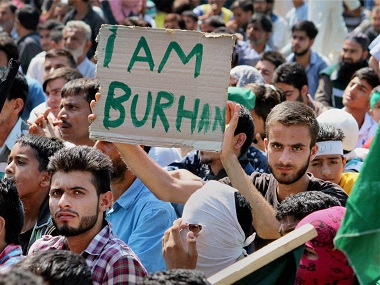
Public intellectuals like Ashis Nandy fear Kashmir has turned into Palestine for India. [caption id=“attachment_2991840” align=“alignleft” width=“380”] A youth displays a placard during a protest rally against the visit of the all-party delegation and civilian killings, at Palpora in Srinagar on Monday. PTI[/caption] But, protests and agitations are means for drawing the attention of the government towards problems, both perceived and real, of a people. They are never the ultimate objective. When people call for a hartal, their final aim is to make their demands heard, discussed and accepted not to carry on protesting till the end of time. At some point, talks aimed at a solution have to begun. Unless of course, everyone has resigned to the idea that guns and bombs will solve the Kashmir problem. So, it is difficult to understand what Kashmir’s Hurriyat Conference — an amalgamation of separatist leaders — plans to achieve by shutting the doors on members of the all-party delegation who broke away from the official delegation to try and speak to them. Five parliamentarians part of the 28-member delegation split into two groups on Sunday and tried to meet Hurriyat chairman SAS Geelani and other separatist leader Yasin Malik, Shabir Shah, Abdul Ghani Bhat and Mirwaiz Umar Farooq. When he heard of the approaching parliamentarians, Geelani asked his supporters to close the gates of his Hyderpora residence and not to open them for anyone. Some separatist leaders were slightly more courteous — they offered tea to their guests
but refused to discuss Kashmir. It is evident there is a bit of a Catch-22 playing out in Kashmir. Protesters won’t relent till talks begin; traders and other prominent civil society members won’t talk till the Indian government approaches the Hurriyat; the Hurriyat won’t let New Delhi approach its leaders till India speaks to Pakistan; and India has clearly stated that it won’t discuss Kashmir with Pakistan. Finding itself caught in a vicious circle, it is evident that the Indian government is trying to break the pattern by reaching out to all stakeholders. It is unlikely that the four MPs — CPM general secretary Sitaram Yechury, CPI leader D Raja, JD(U) leader Sharad Yadav and RJD’s Jay Prakash Narayan — who went to meet Geelani at his residence did so without some sort of understanding with the government. But, the ploy that worked under similar circumstances during the 2010 agitation, did not succeed this time,
bringing India and Kashmir back to a political cul-de-sac. Much of the Hurriyat’s current intransigence is understandable. This year’s agitation in Kashmir has evoked a huge response, in turn, putting a lot of public pressure on its leaders to take it to its logical conclusion. Since similar agitations in 2008 and 2010 failed to yield the desired results for Kashmiris, their expectations from the 2016 uprising are huge. Naturally, Hurriyat leaders can’t afford to rush to the negotiating table and then return empty-handed. They will first play hard-to-get and then even harder to appease, in case they agree to talks. Anything less and there is growing suspicion that their own followers would not forgive them. India, on its part, has queered the pitch by mishandling the situation. When violence broke in Kashmir after Wani’s death, it was evident that the aftermath would be difficult to control. Even when it was evident to those watching events in the Valley unfold, the
Indian government misread the situation and the psyche of Kashmiris . Instead of immediately cooling down tempers, reaching out to people, the state adopted a queer silence and left security forces to deal with a situation that warranted a political intervention. The results of this flawed approach are visible. Unfortunately, now that the Indian government is ready to speak to Kashmiris, civil society and its leaders have either turned numb or retreated into their sulking chambers. In the end, like with all agitations, talks are inevitable. After playing to the galleries, separatist leaders and the government will have no option but to start a dialogue. This is imperative also because the agitation may be reaching a tipping point of sorts, a stage where events could spin out of everybody’s control. As Nandy argues, “What was originally a manageable pinprick of a movement supported by local dissenters — with instigators and financiers in Pakistan trying to control it from there — is transforming itself into a full-fledged independence struggle before our eyes. This struggle now will get decentralised and it is unlikely to come under anybody’s control, not even of Pakistan.” So, somebody will have to take the lead and give peace a chance before it is too late and Kashmir gets caught into a self-sustaining cycle of violence and protests. Since Union Home Minister Rajnath Singh has failed thrice in his mission, there is growing suspicion that separatists are raising the stakes in the game by being intractable. They perhaps want Prime Minister Narendra Modi to himself step up for discussions to indicate the government is serious about a political solution. Only an invitation, people in the Valley speculate, to New Delhi will make Hurriyat leaders come out of their sulking chambers and end this opera of optics.
The ongoing drama in Srinagar resembles a low-grade TV serial where two adversaries take turns to throw a fit, spurn each other publicly, then, when one of them relents, melodramatically announce ‘‘Go, I won’t talk to you" and retreat to their sulking chambers
Advertisement
End of Article

 "Charlie Kirk, shot dead in Utah, once said gun deaths are 'worth it' to save Second Amendment")
 "From governance to tourism, how Gen-Z protests have damaged Nepal")
 "Did Russia deliberately send drones into Poland’s airspace?")
 "Netanyahu ‘killed any hope’ for Israeli hostages: Qatar PM after Doha strike")
 "Charlie Kirk, shot dead in Utah, once said gun deaths are 'worth it' to save Second Amendment")
 "From governance to tourism, how Gen-Z protests have damaged Nepal")
 "Did Russia deliberately send drones into Poland’s airspace?")
 "Netanyahu ‘killed any hope’ for Israeli hostages: Qatar PM after Doha strike")



