Let’s not read too much into the NDA’s confusion over the presidential candidate. It shows cracks in the formation but does not give us an idea of how deep and irreparable these are. From the developments so far it is clear that none of the NDA partners, including the BJP, is too keen on challenging the candidature of Pranab Mukherjee. The man who could be President has been around in politics for too long and has warm personal equations with too many players in the political spectrum going back decades. In that sense, he becomes much more than a Congress or UPA candidate. Without the Congress backing him, he would still be a strong candidate, the first personal choice of most of his party’s opponents. In a secret ballot scenario it is possible that there would be large scale cross-voting in his favour. It would be embarrassing for the NDA. That explains the lack of urgency in the BJP and its allies over the presidential polls. Had it been someone else, say Hamid Ansari or Meira Kumar, the situation would have been much easier for them. They could have just gone ahead and put up a fight no matter what the consequence – giving a rival candidate a walkover does not send out the correct message to people. It would also have allowed us to have clearer picture of the dynamics within the NDA. [caption id=“attachment_348808” align=“alignleft” width=“380” caption=“Let’s not read too much into the NDA’s confusion over the presidential candidate. PTI”]
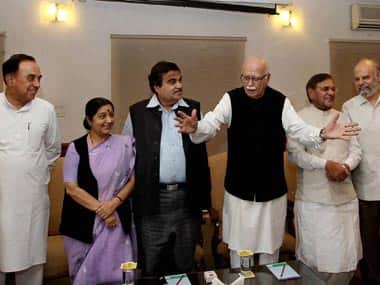 [/caption] However, the developments make two things clear: one, the big parties like the BJP and the Congress cannot take their leadership position in the alliance for granted; two, coalition politics has shifted to a more complex territory than before. Both promise a period of potential political instability, and the consequent economic instability, for the country. Between the Congress and the BJP the former is in a more comfortable position since it has 206 members in Lok Sabha of its own. With that kind of numbers, it could ignore a Mamata Banerjee. Things could change easily when the number comes down to 150 or thereabouts. The BJP with its low numbers is in no position to bulldoze its way in the alliance. If the JD(U) continues to play Congress’ Mamata for it, it can do little about it. The smaller parties are smart enough to realise the predicament of the national ones and it’s no accident that they have been trying to forming small coalitions within the bigger ones to push a common agenda. In an ideal situation, smaller parties demanding equal participation in the coalition would be a good sign – it means more inclusive decision-making and deepening of the democratic process within the political system. However, the trend so far suggests that we are not headed towards a more mature polity; we are headed towards a more confused one where individual egos, narrow agendas and political expediency could play a dominant role. The Mamata Banerjee episode gives us a clear indication how the politics of near future would shape up. To put it simply, it would be chaotic. Fragmentation of the polity and emergence of regional satraps was inevitable in Indian politics. It was even considered a healthy trend, in tune with the true federal spirit that guides great nations. However, an ideal federation is where federal interests keep in mind the national interest and converge with it at some abstract level. That does not appear to be the case in the country so far. The federating entities have shown the tendency to turn inward rather than looking outward, worked out small political goals for themselves and have been busy working towards those. This is not a positive trend but there’s no escaping it. Sooner rather than latter, the bigger parties would need to come up with a response to the challenge. They cannot go on making compromises for ever, making survival the singular focus of their political existence and living in a state of discomfort and insecurity all the time. This solution might look preposterous at the moment but it could work for both for the BJP and the Congress. They could come together at least on some issues to ward off the bullying tactic of the allies. Barring the Hindutva issue, there are more areas of convergence between the parties than issues of divergence. They can work in tandem in the areas of convergence. Before that both should realise that Indian polity has lost its bi-polarity and there are too many free particles in the political space to leave them on tenterhooks all the time. Moreover, with allies piling pressure they have little elbow room to take free or bold policy decisions. They can also take advantage of the fact that the smaller parties need them as much as the other way round. They could be blackmailed too. By keeping open the possibility of reaching out to the main rival, they can keep allies in place. The issue of Pranab Mukherjee in the context of the presidential opens a small window of possibility in that direction. Hope both parties look at that direction.
Idea for the future: A Congress-BJP coalition at the Centre
Akshaya Mishra
• June 19, 2012, 15:09:28 IST
National parties cannot make survival the singular focus of their political existence. They need to tame their allies.
Advertisement
 "Idea for the future: A Congress-BJP coalition at the Centre")
End of Article