

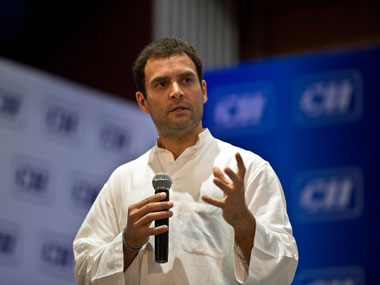
 "How Rahul's trying to play corporate boss to Congress")
While critics usually credit Rahul Gandhi with little beyond making the Congress poll campaign aesthetically pleasing, the heir apparent of the party seems to have taken some radical measures to tighten the loose ends in his party organisation. First, he launched Khidkee to try to bring some sort of discipline in the way several factions of the Congress interacted with one another. While the idea was not a bad one, the social networking site for the Congress was soon overrun by groups calling themselves ‘Rahul’s Sycophants’ and ‘Digvijaya Singh’s fans’. Evidently, the idea of an informed interaction between Congress workers and people curious to know how the party works came a cropper. Despite lengthy social media training sessions led by the likes of Manish Tewari and Rahul himself, Khidkee’s users evidently learnt nothing. [caption id=“attachment_1122509” align=“alignleft” width=“380”] 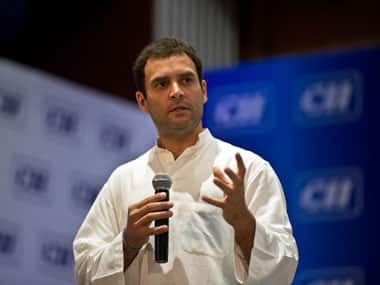 Rahul Gandhi. AFP.[/caption] Following Khidkee, Rahul’s next attempt at bringing order at the grassroots level in the party was the idea of candidates filling out a five-page application form . According to reports, the attempt was designed to give nepotism a miss and select poll candidates based on potential. The five-page application form was reportedly drafted in a way to ensure that every candidate has a deep understanding of his constituency and can make an intelligent estimation of the party’s performance there. And now, it is being reported that Gandhi junior has set another pre-condition for nominating a candidate - an assurance that he will win. DNA reports:
Rahul Gandhi’s diktat has left senior Congress leaders terrified. With Assembly elections in five states round-the-corner, the Congress vice-president has demanded an assurance from these leaders that their chosen candidates will win the election. If they don’t, the leaders will be held responsible and face the music.
The problem with Rahul’s measures, though, stems from the fact that he is trying to bring in corporate discipline to a system that has been most comfortable with jungle herding principles. Like it was evident from Khidkee itself, the Congress, like most other political parties, doesn’t have too many people to moderate or administrate a new system put in place. Like the DNA article points out, the old are too comfortable to change their ways and would preferably find ways to bypass a new diktat, and the younger crop of supporters is yet to combine intelligent polity with discipline in their way of functioning. So, while Khidkee was created with a lofty intention, the lack of one person or a group of people watching over the site turned it into a rather lame fan networking platform. Again, while the application form idea was interesting in intent, the party failed to specify who will be doing the evaluation of the candidates and their application forms. Also, given that speech writers are no big secrets in Indian politics, how difficult will it be, one wonders, to get others to fill up an application form. Unfortunately, the political bible of India has way too many cheats. However, Gandhi’s latest micro-managerial turn, whereby he has asked the party candidates to vouch for their appeal has the potential to enforcing the kind of changes that the Congress wants to bring about. Working in the way a sales target does, if candidates are made accountable to the party for their poll fortune, one would expect that they’ll clean up their acts, pay close attention to their constituencies and find ways to reach out to the voters - something that can be done through intensive campaigning and visible work in the said constituencies. But India is no stranger to gimmicky vote-grabbing techniques - lambasting the Opposition and making lofty promises. India is also no stranger to strong arm techniques of vote-pulling - one just hopes Rahul’s diktat doesn’t unleash a terror-vote campaign. One has to credit Rahul Gandhi for at least trying to breathe in some fresh air into a mothballed party. But his measures suffer the Food Bill syndrome - they’re lofty in intentions and impractical in practice.

 "Russian drones over Poland: Trump’s tepid reaction a wake-up call for Nato?")
 "As Russia pushes east, Ukraine faces mounting pressure to defend its heartland")
 "Why Mossad was not on board with Israel’s strike on Hamas in Qatar")
 "Turkey: Erdogan's police arrest opposition mayor Hasan Mutlu, dozens officials in corruption probe")
 "Russian drones over Poland: Trump’s tepid reaction a wake-up call for Nato?")
 "As Russia pushes east, Ukraine faces mounting pressure to defend its heartland")
 "Why Mossad was not on board with Israel’s strike on Hamas in Qatar")
 "Turkey: Erdogan's police arrest opposition mayor Hasan Mutlu, dozens officials in corruption probe")



](https://images.firstpost.com/wp-content/uploads/2013/09/rahul-corporateAFP.jpg)