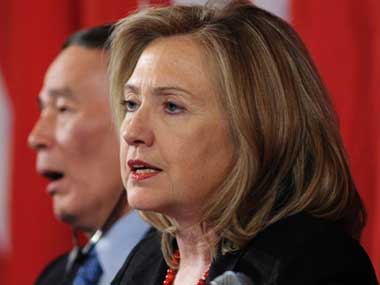
US Secretary of State Hillary Clinton’s four-day visit, beginning hours from now, is likely to be framed by the serial blasts in Mumbai on Wednesday and, consequently, dominated by New Delhi’s concerns on terrorism. However, strategic and security issues relating to Afghanistan-Pakistan and the wider region, which have a close connection with the terrorism issue, are also likely to figure prominently in the India-US Strategic Dialogue. The American decision to start a dialogue with the “good Taliban” as part of a “reintegration” of the Taliban, and the phased withdrawal of US troops from Afghanistan which is now under way, will also be discussed, according to Vishnu Prakash, spokesperson of the external affairs ministry. [caption id=“attachment_23466” align=“alignright” width=“380” caption=“Hillary Clinton’s visit will address the “unfinished business” in US-India relations, rather than stake out new strategic initiatives. AFP”]
 [/caption] Although no new strategic initiatives are likely to emerge from Clinton’s visit, the US views the Strategic Dialogue as an important event in the ongoing deepening of the bilateral strategic partnership, Ashley J. Tellis, senior associate at the Carnegie Endowment for International Peace, told Firstpost. “Both sides have a very full agenda and both recognise that there is much unfinished business. They will therefore emphasise stock-taking and consolidation: assessing how much progress has been made and focussing on successfully consummating initiatives announced during earlier visits,” he added. Not delivered on promise The dates for Clinton’s visit had been finalised much in advance and well before last week’s blasts in Mumbai. Her visit is an important one for India-US bilateral relations, which have somehow not delivered on the promise generated by the efforts of George W. Bush and Manmohan Singh to elevate ties to a strategic level following the civilian nuclear energy cooperation agreement between the two countries. Since then Manmohan Singh has made a visit to Washington, and in turn hosted US President Barack Obama in November last year. On the surface of India-US dynamics, everything looks great. The two sides maintain an even diplomatic keel, and there is no doubt in the minds of Indian officials that President Obama is sincere in his efforts to forge closer ties with India. Regional strategic equations and security considerations also accentuate the congruence of interests for India and the US. Washington’s relations with Islamabad are perhaps at their lowest point in the last 50 years, and China remains the biggest long-term foreign policy challenge for the US. And for a US economy that is desperately in need for steroids, India offers a big market. Taken together, there’s no reason why the India-US partnership should not be rocking. But that’s not exactly the case. Lisa Curtis, Senior Research Fellow at Heritage Foundation, points to a few sources of concern that will crop up at this dialogue. “On Afghanistan, there is some anxiety in India about what the US is planning to do and some questions about the decision to withdraw 30,000 troops over the next nine months…. There is concern in India that the US is getting ready to cut and run and will allow Pakistan to re-install its Taliban proxies. Secretary Clinton will need to address these Indian concerns.” India will also have some questions about recent efforts at the Nuclear Suppliers Group to tighten restrictions on NSG meembers exporting enrichment and reprocessing technologies to states that aren’t signatories to the Nuclear Non-Proliferation Treaty (NPT), adds Curtis. The NSG effort “does raise many questions about the assurances that the US gave India” through the civilian nuclear agreement, she added. The US, in turn, will “want to understand the Indian government’s next steps on the nuclear liability legislation that was passed last August, which essentially shuts US companies out of the civil nuclear industry in India.” The personal and the political According to others, Clinton’s own personality may be part of the reason why India-US relations have not blossomed to its full potential. Some of it springs from her ideological convictions - and others from personal preferences. She has a strong view on nuclear non-proliferation, which sometimes doesn’t accommodate India’s perspective on the NPT, for instance. Also, on a personal front, she has something of a soft corner for Pakistan, which influences the way India is perceived in the subcontinent. So even though New Delhi is expected to raise the issue of terror and Islamabad’s failure to deliver on the arrest and trial of 26/11 Mumbai attack masterminds, India will be keen not to give Clinton the impression that Delhi’s foreign policy remains Pakistan-centric. So, without compromising on terror-related issues, the Indian side will look to take forward the bilateral relationship and engage comprehensively with Clinton and her 25-member strong delegation. India has lined up a formidable team to engage with the Americans. Apart from External Affairs Minister S.M.Krishna, the Indian side will be represented by Montek Singh Ahluwalia, Deputy Chairman of the Planning Commission; Sam Pitroda, Advisor to the Prime Minister; Foreign Secretary Nirupama Rao; Foreign Secretary-Designate Ranjan Mathai; and other Ministerial Secretaries. From the US side, Clinton will be accompanied by James Clapper, Director of National Intelligence; John Holdren, Assistant to President on Science and Technology; Daniel Poneman, Deputy Energy Secretary; Jane Lute, Deputy Secretary in the Department of Homeland Security; as well as a number of other senior officials from various departments. Clinton and Krishna will address a joint press conference on Tuesday after their bilateral discussions. She will also have meetings with Prime Minister Manmohan Singh, Finance Minister Pranab Mukherjee, and the Leader of the Opposition Sushma Swaraj; she will also call upon UPA Chairperson Sonia Gandhi. During their bilateral discussions, the two sides will concentrate on building on the ministerial-level strategic dialogue initiated in 2009 with emphasis on five areas of mutual interest : strategic cooperation, energy and climate change, education and development, economy, trade and agriculture, science and technology, health and innovation. This comprehensive dialogue architecture covers 18 sectors of bilateral engagement. Indians are keen to dispel the impression that the bilateral relationship with US is anything but robust. External affairs ministry officials point to the fairly sustained and senior level of bilateral engagement to make their point and list the Indian Finance Minister, Commerce and Industries Minister, National Security Advisor, and Foreign Secretary as the senior dignitaries who have been to the US in recent months. Trade as the driver It’s been a two-way street and the American Commerce Secretary Gary Locke, Homeland Security Secretary Janet Napolitano, Special Representative for Afghanistan and Pakistan Marc Grossman, are amongst the top US officials to have visited India in the same period. While cooperation in the area of defence has grown manifold in recent years with regular military exercises, defence modernisation, technology transfer agreements and reciprocal visits of Service Chiefs being is now a regular feature in the bilateral engagement, trade and commerce form the real bedrock of India-US partnership. The US is now India’s biggest trading partner and –according to MEA officials– if goods and services were taken into account, bilateral trade has scaled to $50 billion. It’s this story of trade and commerce that will finally shape the contours of the India-US bilateral engagement. And on this score, India offers enormous opportunities for US industries. Given the intuitive sense with which the American capital chases profits, this bilateral engagement can only become stronger in the foreseeable future. (With inputs from Venky Vembu)
Hillary's visit has lots going for it, but where's the spark?
Sanjeev Srivastava
• July 18, 2011, 23:13:55 IST
A full agenda awaits Hillary Clinton as she arrives to advance strategic relations with India. Yet, the bilateral relationship hasn’t quite delivered on its earlier promise.
Advertisement
 "Hillary's visit has lots going for it, but where's the spark?")
End of Article