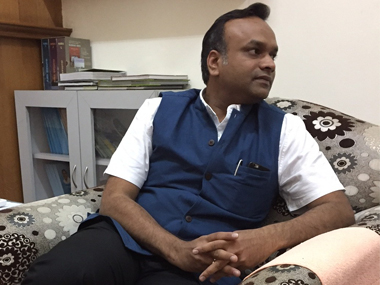
At the age of 39, Priyank Kharge, minister for IT/BT and tourism in the Karnataka government is a man in a hurry. He has ambitious plans for his ministry and wants to leave a mark before the Assembly elections in two years. The first time MLA from Chittapur is the son of veteran Congressman, M Mallikarjun Kharge and was inducted into the Siddaramaiah Cabinet as a Minister of State in the recent Cabinet reshuffle. Within a month of being sworn in, he got cracking on his job and launched a booster kit for start-ups and a week later, unveiled grandiose plans for tourism in Karnataka. Priyank Kharge is a diploma holder in computer science and entered politics as an activist of the National Student Union of India. He was also the vice-president of the Karnataka unit of the Youth Congress for a term. The well-spoken, young scion speaks to Firstpost on Brand Bengaluru and how he would never let the identity of Bengaluru die; about ‘Exploring and Experiencing Karnataka’ like never before; about the legacy that he wants to leave behind him and how he’s not here to play 20:20, but to play Test cricket. He is grounded on aiming for low hanging fruits and setting a timeline on what is achievable in two years. He even smartly turns around the question on whether he sees Congress winning the elections in 2018. ‘Of course I don’t doubt that, do you?’ Excerpts from the interview: You’re the youngest minister to be sworn into the Karnataka Cabinet and within a month you have made major announcements for IT, BT and tourism. You seem to be a man in a hurry. Priyank Kharge: Feels good to be the youngest minister in the Cabinet, but also that’s a lot of responsibility. I’m hopeful that the energy and the youth inside me can be directed to constructive things that will help the state and my department. With the elections coming in two years, how much do you hope to achieve? Kharge: Like you said I’m a man in a hurry. I have such a short time to perform and I hope to change the way things are perceived in both the departments - that this ministry did revolutionary things. I want to lay a strong foundation in the IT and BT department and the tourism department. So it could be policies, it could be reforms or it could be schemes. It could be a massive facelift for the department, the idea is to leave a mark behind. You came up with the announcement of a booster kit for startups. What was commendable was that you were able to get a lot of corporates to partner with you in that journey. Yet, Bengaluru has woeful infrastructure. The Indian Institute of Science (IISc) even came out with a study, which said that Bengaluru would be dead in five years. Your comments. Kharge: Every city has its problems. I’m not trying to escape from my responsibilities here but urban infrastructure is a problem in any of the major cities – it’s a problem in the big Apple, a problem in London, a problem in Paris. We have to pull up our socks and we are already doing that. The government has provided Rs 8,000 crores to BBMP (Bruhat Bangalore Mahanagara Palike) to revive it like never before. The CM has also given a special trust to the BBMP by appointing its own minister to tackle these problems more quickly. It needs attention and we’re giving it the much needed attention and definitely we will not allow Bengaluru or the identity of Bengaluru to die. It’s been here for five hundred years and I’m sure we’ll pull it off for the next five hundred years. [caption id=“attachment_2944356” align=“alignleft” width=“380”] Karnataka tourism minister Priyank Kharge. Image courtesy: Janaki Murali[/caption] Coming back to how we managed to pull in a lot of corporates for the start-up booster kit, the idea of the government was on how can we help and facilitate the eco system. There are 4900 startups in Bengaluru alone, imagine what it would do for the economy if I can help at least 20 percent of them become entrepreneurs. So, we spoke to Nasscom and the corporates. I spoke to a lot of them myself and everybody was on board because it helps them as well. Earlier startups had to knock on the doors of Nasscom, organisations, the government and had to be incubated with us to get benefits. Now, I have opened up the entire system so people from Bidar to Chamarajnagar – from anywhere in the state, can register with us and avail of a lot of benefits- like easy going rate on data plan, cloud, subsidised licences, mentorship, legal and accounting. Plus, I have opened their doors to funding. I am sitting on Rs 400 crores annually and Rs 2000 crores is what we plan to raise in the next four years. I think that is something that nobody’s doing. Tier II cities like Goa, Guwahati, Dharamshala and Cochin are attracting start-ups now. Even Nasscom is developing tier II cities. Are you planning to develop tier II cities to reduce the congestion in Bengaluru? Kharge: Developing tier II cities is important and we have a major thrust in that area. We have Keonic centres all over the state, in all regions- we have one in Kalburgi, in Hubbali, Shimoga and Mangalore, where we have set up incubation centres already. But going one level lower, what we have also done is come up with the New Age Incubation Network (NAIN). Through NAIN, we fund up to nine to ten labs for projects which are being developed in rural engineering colleges. The results are fantastic - some of the best projects are coming from the most backward regions of the state. We funded close to 14/15 universities last year and we intend to take it to a lot more colleges. Speaking about tourism, you have just announced the science circuit… Kharge: I have not only announced a science circuit, but the Bengaluru Tourism Advisory Committee (BTAC), the Hyderabad-Karnataka Tourism Advisory Committee (HKTAC), the coastal circuit and the Cauvery circuit. Among the smallest of the circuits is the science circuit. What I have done is broken the state into regions. What’s the most important thing about tourism is information. We need to know the history, geography, art and culture, language, food and USP of a destination and create a blueprint for the entire state. What we want to do is create these destinations with all information for domestic and foreign travelers so that they can ‘Explore Karnataka better and Experience Karnataka better.’ And nobody has tried branding a city in India. You’re talking about Brand Bengaluru. Kharge: Yes, in Brand Bengaluru, comes the science circuit, heritage circuit, the legend trails, eco circuit, wildlife circuits, art and culture circuits, gastro and pubs circuit. All these combined makes the Brand Bengaluru. It’s all there, but nobody has bothered connecting the dots. I am merely doing that, I’m not doing anything new. Are you thinking of privatisation, you know there have been protests over privatisation of the Venkatappa art gallery from artists… Kharge: When we devised the tourism policy, the idea was to take help from the private sector to develop destinations, for example take Jog falls, we could probably open it up and do a joint venture with hotels, so that they build infrastructure. Like, how we have done with Metropole or KRS in Brindavan gardens Mysuru. We have not given the properties to Royal Orchid. It’s our property being managed by them on a sharing basis. But each case has to be treated differently. We have to do a dipstick on public sentiment and then take a conscious call on whether we want PPP in this particular vertical or go solo. These are all grandiose plans, but tourism is an unchartered territory. In Karnataka, there’s so much to see, but nothing much has been done about it, so how much can you really achieve in two years? Kharge: Isn’t that what makes it exciting and challenging in the first place? If I can set up a blueprint it would be good. I’m looking for short term advice from the committees for three months, maximum four, in the fifth month we sit down and take stock of what to do and what not to do; which are the low hanging fruits and achievable. We put a timeline on what is achievable. I agree it’s a challenge and unchartered but we have to start somewhere. In corporates young people are always asked where they see themselves in five years from now and ten years from now. I am going to change that question slightly, where do you see yourself two years from now, seven years from now and twelve years from now, going with the election cycle? Kharge: In corporates if you don’t like what they’re giving you, you can always jump the ship but that does not happen in politics. This is more of a commitment to the cause and to an ideology. So it’s very difficult to say where you see yourself. The point is we are here for the long run, we’re not here to play 20:20, we’re here to play Test cricket. So irrespective of what the results are or the consequences are, the idea is to serve the public. Two years from now I see myself doing the same thing, so too at seven and twelve as well. I have a big legacy behind me. People have been very kind to me and to our family. Irrespective of your position in the party, irrespective of your position in the government, whether you are in opposition, whether you win an election or lose an election, you have to be there because they have supported you for so long. So this is a permanent job for me. When the reshuffle happened and there was rebellion in the party, the KPCC president, Dinesh Gundu Rao, said that the party needed young blood. What’s your opinion, will this help you win the elections in two years? Kharge: You always need youngsters in the party, but they also need direction. I think we have a healthy mix of both - the young and the experienced. Now, with Mr Dinesh becoming the working president of the party, we have infused the youth factor too. Do you see Congress winning two years later? Kharge: Of course I don’t doubt that, do you?
Brand Bengaluru top priority, says Priyank Kharge, Karnataka tourism minister
Janaki Murali
• August 9, 2016, 12:36:01 IST
At the age of 39, Priyank Kharge, minister for IT/BT and tourism in the Karnataka government is a man in a hurry. He has ambitious plans for his ministry and wants to leave a mark before the Assembly elections in two years.
Advertisement
 "Brand Bengaluru top priority, says Priyank Kharge, Karnataka tourism minister")
End of Article