

 "Zelenskyy has to swallow either Trump’s bitter or Europe’s bitterer peace pill")
For all of US President Donald Trump’s obnoxious narcissism, his self-patting deal-making skills and the obsession with the Nobel Peace Prize, his leaked 28-point peace plan is the only way to get out of the Ukrainian quagmire.
In return, all the American President seeks is a deluge of praises and compliments and the coveted Nobel Peace Prize at Ukraine’s cost—the tag of the smartest dealmaker comes along.
The plan is undoubtedly a capitulation to Russia and sells out Ukraine, which has never been Trump’s concern.
Connecting the dots reveals how Trump agreed to Vladimir Putin’s maximalist demands.
The plan was based on a Russian document submitted to the US in mid-October. Subsequently, US secretary of state and acting NSA Marco Rubio called Russian foreign minister Sergei Lavrov to discuss the document.
During the same time, Steve Witkoff, Trump’s special envoy for the Middle East and peace missions, called Yuri Ushakov, Putin’s top aide, to coach him on how the Russian president should speak to Trump before Volodymyr Zelenskyy’s upcoming US visit on October 17.
Leaked transcripts of the October 14 call between Witkoff and Ushakov, reported by Bloomberg News, show the two discussing a 20-point peace plan.
Witkoff wanted Putin to start the call with Trump by congratulating him on the Gaza peace deal.
“Here’s what I think would be amazing,” Witkoff told Ushakov. “Maybe, he [Putin] says to President Trump: you know, Steve and Yuri discussed a very similar 20-point plan to peace and that could be something that we think might move the needle a little bit. We’re open to those sorts of things,” Witkoff said.
Ushakov agreed that Putin would call Trump and say, he’s “a real peace man.”
On October 16, a day before Zelenskyy’s visit, Putin and Trump spoke. Unsurprisingly, Trump, after meeting Zelenskyy, indirectly said that Ukraine should cede territories demanded by Russia.
In the last week of October, Kirill Dmitriev, the head of one of Russia’s sovereign wealth funds, discussed the plan with Trump’s son-in-law Jared Kushner and Witkoff in Miami.
On October 29, Ushakov called Dmitriev, as reported by Bloomberg, saying, “I’ll informally pass it along, making it clear that it’s all informal. And let them do their own thing. But, I don’t think they’ll take exactly our version, but, at least, it’ll be as close to it as possible.”
A day after the plan was leaked, Trump said that Zelenskyy “will have to like it, and if he doesn’t like it, then you know, they should just keep fighting”.
The US plan is a veritable copy of the Russian document. However, there’s no other option to end the war—there never was.
The Joe Biden administration and the EU merely prolonged the war, now in its fourth year, in the name of protecting Ukraine’s sovereignty with no sincerity in ending it militarily or diplomatically.
Now, the Trump administration wants to force down a bitter pill down Ukraine’s throat.
It was never America’s or Europe’s war—yet the West intervened in Ukraine.
If the West were sincere about stopping the Russian aggression and protecting Ukraine’s sovereignty, Nato and the US would have confronted Russia directly.
If the West were serious about ending the war, it wouldn’t have sabotaged the March-April 2022 Istanbul negotiations between Russia and Ukraine.
US, EU Restrictions Handicapped Ukraine
More than $360 billion in military, financial and humanitarian aid has been sent to Ukraine since the Russian invasion in February 2022, per the German think tank, the Kiel Institute for the World Economy.
Around 41 nations have provided military, humanitarian and financial assistance to Ukraine. The US has contributed $134 billion, including $75 billion in military aid. The EU has poured in €187.3 billion, including €60 billion in military assistance.
The result is zilch.
What’s most striking is that even the intervention was half-hearted with restrictions imposed on ways Ukraine could fight.
Zelenskyy had asked for F-16s in the war’s first year itself. The US allowed Nato members, like the Netherlands, Norway, Denmark and Belgium, to supply the Falcons to Ukraine as late as July 2024.
Even the F-16s came with a rider: Ukraine couldn’t use them to hit targets inside Russia, making them less effective.
Then came the lethal long-range American MGM-140 Army Tactical (ballistic) Missile System and the Franco-British Storm Shadow/SCALP-EG air-launched cruise missile. Again, Ukraine was prohibited from striking ammunition storage sites, airfields and command centres deep inside Russia. The restriction was removed only in November 2024.
The restrictions resulted from the Western fear of a Russian backlash and Nato members getting sucked into the conflict, severely handicapping Ukraine’s ability to hit targets far inside Russia.
Where do Russia and Ukraine Stand
Russia occupies 18.4 per cent, or around 114,500 sq km, of Ukraine, including Crimea and a huge part of the east and southeast.
Putin’s troops control almost 88 per cent, or 46,570 sq km, of Donbas (the whole of Luhansk and 75 per cent of Donetsk), in the east. In the southeast, Russia occupies around 74 per cent, or 41,176 sq km, of Zaporizhzhia and Kherson regions.
Putin claims the four Ukrainian regions in the east and southeast as part of Russia despite not controlling them entirely—and he wants Ukraine to give them up.
Russia also occupies around 400 sq km in the Kharkiv and Sumy regions.
Russian troops are advancing slowly in the east and southeast despite heavy losses. For example, towards Kupyansk, in the east of Kharkiv. Moscow is trying to create a buffer zone inside Ukraine’s northern borders by advancing near Vovchansk and Lyptsi. According to the latest Russian claim, Ukraine has lost the towns of Vovchansk (Kharkiv) and Pokrovsk (Donetsk).
Putin turned the conflict into a grinding war of attrition after realising in the first year that defeating Ukraine wasn’t possible. Weeks turned into months and months into years as the Russian onslaught continued.
Now, a confident Putin is at his strongest point in the war—he either dictates to Trump, who willingly obeys, or rejects his overtures.
Since Trump’s plan was leaked, he and his administration have been desperately trying to give the failed meetings and talks in Geneva, Abu Dhabi and Washington, D.C., a positive spin.
However, Putin publicly redeclared his maximalist goals a few days before meeting Witkoff and Kusher in Moscow.
Exposing the hollowness of Trump’s positive spin on the peace process while not dismissing his plan, Putin told reporters in Bishkek, Kyrgyzstan, if Ukraine doesn’t withdraw from the territories it occupies, “we will achieve this through military means”.
On December 3, the Russian leader once again proved that he would write the script for the peace process.
The much-anticipated five-hour meeting between Putin, Ushakov and Dimitriev and Witkoff and Kushner after a week of diplomatic spectacle was a flop.
Ushakov termed the talks “very useful, constructive and highly substantive” but said that a “compromise option was not found”. “Some of the American proposals look more or less acceptable though they need to be discussed. But other points do not suit us.”
The two sticking points of Ukraine ceding territory in Donbas and ending its Nato ambitions clouded the meeting.
Ushakov clearly said that without Ukraine ceding the whole of Donbas, “we do not see a solution to the crisis”.
On one hand, the US and Europe have disastrously failed to deter Putin despite supplying the best weapons and military equipment to Ukraine and slapping 19 rounds of sanctions on Russia, including sanctioning its oil giants Rosneft and Lukoil.
On the other hand, the US and Europe never backed Zelenskyy 100 per cent, leaving Ukraine to fight Russia alone—with or without their support. It was a foregone conclusion that Ukraine wouldn’t be able to defeat Russia despite the massive Western military assistance.
The illusion of Ukraine defeating Russia was not only created by the US and Europe, but also by the Western media, which went into overdrive every time Ukraine tasted short successes or caused significant damage to Russian military assets.
The damage to the Kerch Bridge, the sinking of Russia’s Black Sea Fleet, the capture of Kursk, the destruction of Russian strategic bombers under Operation Spider Web or the strike on two shadow fleet vessels in the Black Sea are sporadic Ukrainian success stories, not big enough to change the war’s course.
Russia continues to strike Ukrainian infrastructure, but has failed to defeat Ukraine. The same logic applies to Ukrainian attacks, which have failed to prevent the daily Russian drone and missile volleys.
Ukraine’s plight was destined to get worse in the long run as Russia continued to slowly bleed its troops despite incurring heavy losses.
Ukraine’s Army is under-supplied, thousands of troops are either absent without leave or have been declared deserters, the messy mobilisation drive is low and Kyiv’s drone advantage has been eroded by Moscow’s innovation.
Besides, Zelenskyy has been battling corruption, which is at an all-time high.
The latest blow to Ukraine’s image was the resignation of Zelenskyy’s top aide and chief of staff, Andriy Yermak, after a probe into a kickback scandal involving the critical energy infrastructure. Yermak led the Ukrainian delegation during the recent talks with US officials in Geneva.
A Gallup survey in July showed that 85 per cent of Ukrainians believe that corruption is widespread throughout the government, a figure in line with the average from 2007 to 2024 (84 per cent).
Zelenskyy’s rating has also slipped since 2022, when it was at its peak at 84 per cent. The same survey showed that his rating has fallen to 67 per cent, more than 60 per cent in 2024 but much less than 81 per cent in 2023.
Moreover, only 25 per cent of Ukrainians believe that Zelenskyy should remain in office after the war ends, according to a Kyiv International Institute of Sociology survey done in September-October, despite 60 per cent trusting him.
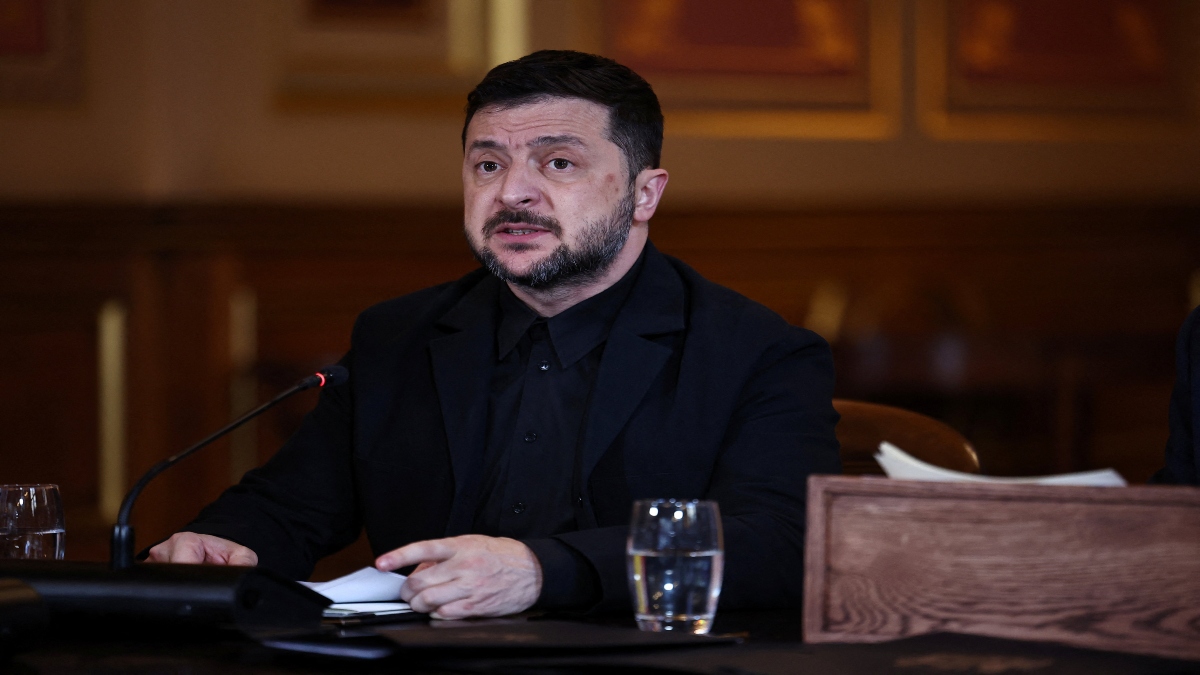
Zelenskyy’s dilemma is that either he accepts Trump’s plan and goes down as a leader who sold out his country or prolongs the war in the false hope of stopping Russia one day and loses American support.
“Now, the pressure on Ukraine is one of the heaviest,” a sombre Zelenskyy told the nation in a 10-minute speech outside the presidential palace. “We did not betray Ukraine then [in 2022], and we will not do so now,” he said.
Ukraine a Pawn in US-Europe Game
The US and Europe sabotaged peace efforts before and after Russia invaded Ukraine.
On February 22, 2022, two days before the war, Russia contacted Zelenskyy to discuss restoring Ukraine’s neutrality.
On the third day of the war, Russia and Ukraine agreed to discuss Russian withdrawal in exchange for Ukraine’s neutrality.
On February 25, a day after the invasion, the US state department’s then-spokesperson Ned Price told reporters that Russia was “suggesting that diplomacy take place at the barrel of a gun or as Moscow’s rockets, mortars and artillery target the Ukrainian people. This is not real diplomacy”.
Russia and Ukraine formally negotiated five times in the war’s first year—the first one in Belarus on February 28, 2022, four days after the invasion.
The fifth and final round of Ukraine-Russia negotiations was held in Istanbul on March 29.
According to the Istanbul Communique, Ukraine was ready to become a permanently neutral state under international legal guarantees to implement a non-aligned and nuclear-free status.
Possible guarantor states included Britain, China, Russia, the US, France, Turkey, Germany, Canada, Italy, Poland and Israel, which would respect and observe Ukraine’s independence and sovereignty and refrain from the threat or use of force against it.
Ukraine wouldn’t join any military alliances [Nato] and deploy foreign military bases and contingents, and conduct international military exercises with the consent of the guarantor states.
The guarantor states confirmed their intention to promote Ukraine’s membership in the EU.
International security guarantees for Ukraine didn’t apply to Crimea, Sevastopol and certain areas of Donbas.
According to Israel, Zelenskyy and Putin wanted a ceasefire and Russia was ready to make “huge concessions” if Ukraine restored its neutrality. Turkey also said that Ukraine and Russia were ready to end the conflict.
However, both Israel and Turkey later said that the US and the UK scuttled the peace efforts to prolong the war.
Ukraine’s then-deputy foreign minister Oleksandr Chalyi claimed that Putin “tried everything” to reach a peace agreement .
Surprisingly, as the Istanbul talks were on, then-British PM Boris Johnson landed in Kyiv on April 9 without an announcement.
The media highlighted the famous pictures/videos of Johnson and Zelenskyy walking through the roads of Kyiv—the moment was seen as British support for Ukraine.
However, Johnson had a sinister mission.
According to an article in the respected news portal Ukrainska Pravda outlet in May, “There is much more to this visit and Johnson’s words than a simple reluctance to engage in deals with Russia.”
Johnson had two messages, per the Ukrainska Pravda.
Putin is a war criminal; he should be pressured, not negotiated with.
If you are ready to sign any guarantee agreements with him [Putin], then we are not.
Around one-and-a-half years later, David Arakhamia, a member of Zelenskyy’s negotiating team in Istanbul, said in an interview: “When we returned from Istanbul, Boris Johnson came to Kyiv and said that we would not sign anything with them at all and let’s just fight.”
Initially, Zelenskyy also publicly said that the West wanted a long war. “There are those in the West who don’t mind a long war because it would mean exhausting Russia even if this means the demise of Ukraine and comes at the cost of Ukrainian lives,” he told The Economist in an interview on March 27, 2022.
However, in February this year, Zelenskyy rejected the claim that Johnson scuppered the peace dialogue.
It was never about Ukraine’s sovereignty or neutrality—it was about the West’s strategic rivalry with Russia by using Ukraine as a proxy.
Now, Trump is forcing a bitter pill down Zelenskyy’s throat. Most parts of his peace plan resemble the Istanbul Communique.
The plan is now better for Russia and worse for Ukraine from several angles.
First, Russia’s main demand that Ukraine never join Nato remains but comes with an official guarantee. Ukraine will enshrine in its Constitution that it will not join the bloc, and the alliance will agree to include in its statutes a provision that Ukraine will not be admitted in the future. The Istanbul draft mentioned no such guarantees.
Second, Russia now wants Western recognition of Crimea, Luhansk and Donetsk (including the 25 per cent under Ukraine’s control) as de facto Russian territories; to freeze the front lines in Kherson and Zaporizhzhia and establish a demilitarised zone after Ukrainian forces withdraw from the parts they control.
In the Istanbul Communique, Putin didn’t demand Western recognition of territories under Russian control and excluded only Crimea and certain Donbas territories from security guarantees.
Third, Trump’s plan offers only “reliable” but conditional and ambiguous American guarantees. On the other hand, the Istanbul Communique offered a rather stronger security guarantee by “closing the airspace over Ukraine” and providing necessary weapons.
Fourth, Ukraine must hold elections 100 days after a deal’s signature, a Russian tactic to remove Zelenskyy and probably install a pro-Kremlin figure. Hasty elections executed poorly in a war-ravaged nation without electoral reforms and proper campaigning will only result in more chaos.
Fifth, $100 billion in frozen Russian assets will be invested in US-led efforts to rebuild and invest in Ukraine. The US will receive 50 per cent of the profit from this venture. Europe will add $100 billion to increase the amount of investment available for Ukraine’s reconstruction. The remaining frozen Russian funds will be invested in a separate US-Russian investment vehicle that will implement joint projects in specific areas.
Here’s the flip side. Ukraine’s most devastated parts are under Russian occupation. Basically, Russia will get back its frozen money to rebuild the flattened areas.
Sixth, Russia will be invited to rejoin the G8 and reintegrated into the global economy. The lifting of sanctions will be discussed and agreed upon in stages and on a case-by-case basis. The US will enter into a long-term economic cooperation agreement for mutual development in the areas of energy, natural resources, infrastructure, artificial intelligence, data centres, rare earth metal extraction projects in the Arctic and other mutually beneficial corporate opportunities.
Trump’s one point favours Ukraine compared to the Istanbul draft: 600,000 vs 85,000 cap on the military’s size.
While Trump plays the global peacemaker at Ukraine’s expense, Europe, like in 2022, continues with its disruptive agenda in his peace plan.
Europe, especially France, has increasingly portrayed the war as “Us vs Russia”—the fearmongering is about how Putin could next attack a European nation.
In July, General Thierry Burkhard, the then-French Chief of the Defence Staff, said that France was Russia’s “main enemy in Europe”. After two days, Emmanuel Macron warned that Europe’s liberty faced the greatest threat since WW2.
Macron’s views on Trump’s peace plan are nothing but a spoiler. “We want peace, but we don’t want peace that is effectively a capitulation,” he told RTL radio last month.
In his De Gaullean delusion, Macron has made erratic statements, offering to provide a nuclear umbrella to Europe, complicating the situation and triggering Putin’s anger.
France’s 290 nuclear warheads pale in comparison to Russia’s stockpile of 5,580 nukes (retired, stockpile and strategic). France doesn’t even have a nuclear triad—air-, sea- and land-based nukes—after deactivating its land-based ballistic missiles in 1996.
Since the war started, Putin has threatened to use tactical nukes several times—but if he wanted to use one, he would have used one by now.
Nuclear weapons are only meant to deter an adversary. Russia would never attack a Nato member, especially with a nuke, because it would trigger the bloc’s Article V, which states that an attack against one ally is considered an attack against all allies.
Other leaders joined Macron.
Polish PM Donald Tusk said that a peace plan needs to “strengthen, not weaken, our security”.
European Commission president Ursula von der Leyen said that Ukraine’s “borders cannot be changed by force” and “there cannot be limitations on Ukraine’s armed forces that would leave the country vulnerable to a future attack and thereby also undermining European security”. “They [Ukraine] have chosen a European destiny.”
Tusk’s and Von der Leyen’s statements highlight how these disruptive leaders conflate the security of Europe and Ukraine.
In a statement bordering on insanity, Kaja Kallas, the EU high representative for foreign affairs and security policy, said that the EU has a two-point plan: first, weaken Russia; second, support Ukraine.
In the latest sabotaging bid, Macron has been joined by British PM Keir Starmer and German Chancellor Friedrich, who convinced Zelenskyy to reject key parts of Trump’s peace plan for their unattainable goal of weakening Russia at Ukraine’s cost.
After these leaders persuaded Zelenskyy, Ukrainian and American negotiators reduced the 28-point plan to 19 points.
Regarding Ukraine not joining Nato, Putin’s biggest demand, these European leaders, except for lip service, have never acted to allow Ukraine into the bloc for they know it’s not possible.
Still, Europe uses Russia’s main demand as a hurdle to hijack any peace plan.
The European counterproposal deleted the point of no further Nato expansion in Trump’s plan.
“Ukraine joining Nato depends on the consensus of NATO members, which does not exist,” Europe said.
The counterproposal shows two things. First, Europe is aware of the lack of consensus regarding Ukraine’s Nato aspiration. Second, it deliberately left the possibility for a theoretical future Ukrainian accession open.
Regarding the cap on Ukrainian military, Europe raised it to 800,000 “in peacetime”.
From Johnson sabotaging the 2022 peace plan to Macron throwing a spanner in the latest peace efforts, Europe has been using Ukraine as a pawn to create a Russian phobia and derail peace efforts.
In a further sign of causing panic to derail peace efforts, German foreign minister Johann Wadephul last week said, “Our intelligence services are telling us emphatically that Russia is, at least, keeping open the option of war against Nato. By 2029 at the latest,”
A few hours before meeting Witkoff and Kushner, Putin reiterated his stance. “We’re not going to war with Europe—I’ve said this a hundred times already.”
At the same time, he also gave a warning. “But if Europe suddenly wants to fight us and starts the war, we’re ready right now,” Putin told reporters. If Europe suddenly wants to start a war with us and does start one, then a situation could very quickly arise where we will have no one to negotiate with.”
The Russian President highlighted Europe’s war-mongering. “They themselves refused peace negotiations and are interfering with President Trump.”
Zelenskyy, who realises his predicament yet continues to be manipulated by Europe, said in Ireland, “Now, more than ever, there is a chance to end this war.”
Zelenskyy faces a brutal truth—either he swallows Trump’s bitter pill or Europe’s bitterer.
(The writer is a freelance journalist with more than two decades of experience and comments primarily on foreign affairs. He tweets as @FightTheBigots. Views expressed in the above piece are personal and solely those of the writer. They do not necessarily reflect Firstpost’s views.)

 "Thailand launches airstrikes on Cambodia in a setback to Trump's ceasefire deal")
 "'Not hawkish or dovish': 5 key things for Asia in Trump's new national security policy")
 "'With China, it's always we verify': Trump's top aide on trade deal with Beijing")
 "Why the Goa nightclub fire, which killed 25, was so difficult to contain")
 "Thailand launches airstrikes on Cambodia in a setback to Trump's ceasefire deal")
 "'Not hawkish or dovish': 5 key things for Asia in Trump's new national security policy")
 "'With China, it's always we verify': Trump's top aide on trade deal with Beijing")
 "Why the Goa nightclub fire, which killed 25, was so difficult to contain")



