

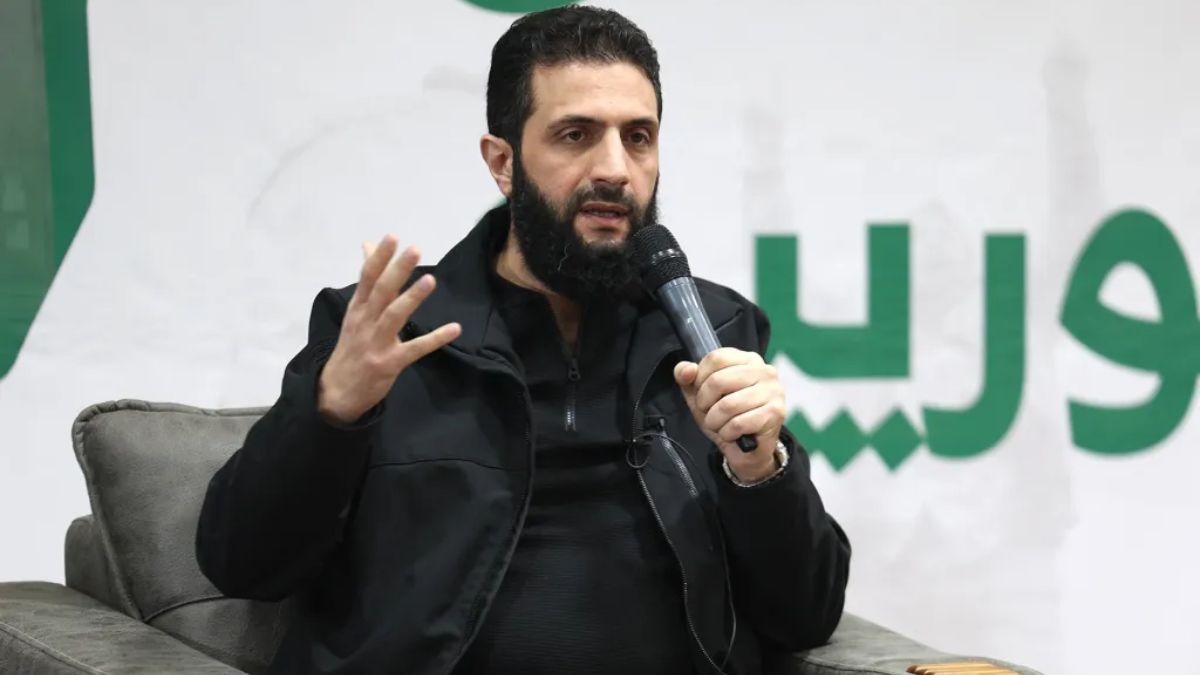
 "With territory rapidly being chipped away, can HTS and Jolani prevent fragmentation of Syria")
The Syrian surprise is the latest episode of the war in Gaza which has now spread its tentacles all across the region and the repercussions of which threaten to alter the landscape of the region forever. It all started on 27 November when a coordinated assault was launched by a combination of terror groups from the north and northwest in Syria. The attack was led by the Sunni terror group Hayat Tahrir Al-Sham (HTS) and was supported by the Syrian National Army (SNA), also known as the Free Syrian Army, and the Syrian Democratic Forces (SDF) made up of Kurdish fighters, also known as the Peoples’ Protection Units (YPG).
It is not as if these groups came out of nowhere and suddenly launched assault. Even before the assault, all three groups had firm physical presence along the north in Syria, especially in areas of Aleppo, Idlib and the northern borders shared with Turkey and skirmishes with the Syrian forces was a routine affair. However, this time the assault was better coordinated, capturing key territory rapidly. By 29 November, Idlib and Alleppo were in rebel control and by 8 December, the rebels had reached Damascus after taking over key cities of Homs and Hama. Syrian army did not offer any resistance and President Assad quickly flew out to Russia, abandoning the country which he and his family had ruled with an iron fist for over 50 years and had withstood repeated attempts of overthrow of regime in the past 13 years, since the outbreak of ‘Arab Spring’.
The Assad chapter was over and there was a spontaneous outflow of emotion and cheer on the street, having been freed of the dictator. While there is hope of a better life in the future, there are apprehensions too. HTS leader Abu Mohammad al Jolani, who is now the de-facto ruler of Syria, has a dangerous past, as the HTS is the new avatar of Al Nusra Front, an offshoot of Islamic State (IS) which was known for its brutality and terror. The IS had vowed to create the Islamic Caliphate and enforce strict implementation of Sharia in the land across Iraq and Syria. Although Jolani is trying to project a new and more moderate image by announcing that his regime will not enforce any dress or conduct code on women, form an inclusive government for the country and grant amnesty to the soldiers who lay down their arms, past precedents of similar experience in Iraq, Libya, etc, do instill fear and apprehensions.
In midst of the Assad exit and HTS takeover in Damascus, what however escaped the attention initially, is the opportunity that many external players are exploiting to quietly chip away Syria’s territory while confusion and chaos still prevails.
Impact Shorts
More ShortsIsrael captures Golan, closes in on Damascus
One of the first to take advantage of the chaos was Israel. It immediately undertook a two pronged strategy in Syria. On one hand, it sent in its forces into the Golan to capture more territory and on the second hand, it launched over 350 airstrikes across Syria within the first 48 hours, targeting key military bases, air fields and naval vessels. It claims to have destroyed Syria’s air force fleet, air defences and the naval fleet completely, while also taking out known weapon depots and suspected chemical weapons storage depots. It also claimed to have destroyed almost 90 per cent of Syria’s known surface-to-air missiles, thus ending any threat to Israeli air force in any future engagements. Acknowledging it, Israel’s Defence Minister Israel Katz said that the operation to destroy the Syrian fleet had been a ‘great success’ and further said that the IDF was aiming to ‘destroy strategic capabilities that threaten the State of Israel’.
On the other hand, Israel, which is already occupying Golan Heights illegally, having annexed it in 1981, for the first time entered even the demilitarized buffer zone in the Golan Heights, a region established after the 1973 Middle East war. The UN immediately called it that Israel’s move into demilitarized zone a violation of the 1974 disengagement agreement between Israel and Syria. However Israeli officials stated that their incursion was a “limited and temporary” measure, and described the buffer zone operation as essential to creating a “defense zone free of weapons and terror threats in southern Syria.” However, the most important capture in this operation has to be Syria’s highest peak, the Mount Hermon summit which is the highest place in the region, giving Israel direct look into Lebanon and Syria. With reports of Israeli forces closing in areas in the South almost 25 km short of Damascus, Israeli forces would be tempted to retain what has been captured for keeps.
Two statements, both coming from PM Netanyahu’s office spell out clearly Israel’s intention, of not vacating what has been captured. First was the statement from his office that the cabinet had unanimously approved a budget of over 40-million-shekel ($11 million) to encourage demographic growth in the Golan, “out of a desire to double the population of the Golan". This was followed by Prime Minister Benjamin Netanyahu’s statement that, “strengthening the Golan is strengthening the State of Israel, and it is especially important at this time. We will continue to hold onto it, cause it to blossom, and settle in it”. With reports of Druz majority areas in the Southern Syria adjoining Golan, asking to be ‘annexed by Israel’, Israel may be further emboldened to hold onto what has been captured.
Turkey captures ‘Buffer Zone’ in the North
Turkey, which shares almost 900 km of border along the north with Syria, has borne the maximum brunt of the Syrian civil war since 2011. Influx of almost 3 ,illion refugees into Turkey escaping the civil war as well as the security threats posed to its South by the Kurdish rebels operating from Syrian posed constant threat to it. Turkey considers the Kurdish rebels to be a part of the larger Kurdish movement and an extension of the Turkey-based separatist Kurdistan Workers’ Party (KWP) which has been labelled as a terrorist group by Turkey.
Over the past few years, concerned by these threats originating from Syria, Turkey has been seeking to normalise ties with Syria however, President Assad has insisted that Turkey should first withdraw its forces from northern Syria before any talks of normalisation can proceed. It is also quite clear that Turkey played a major role in the current rebel offensive which overthrew Assad regime. The Syrian National Army (SNA), which is backed by Turkey, soon over-ran territory in the North-East including towns of Tal Rifaat and the city of Manbij which were previously under been control of by Kurdish rebels and the SDF. It has established a significant military foothold in the north, capturing areas such as the city of Afrin and parts of Aleppo and Turkey is keen to retain the captured territory along its South, as a buffer zone.
Kurdish rebels may want to break free and join Kurdistan
The Syrian Democratic Front or the SDF may have aligned with the HTS and SNA to overthrow Assad but it does not fully align with the aims and ideologies of either. It has been fighting Turkey backed SNA for years and despite some setbacks in the north, has been able to extend its influence to the South almost up-to the Euphrates river, taking the entire northeast Syria under its control. If the HTS led government is not able to align with SDF in the future, the possibility of SDF breaking free a large area in the north-east and joining hands with Kurdish forces in Iraq cannot be ruled out.
What about the Alawites
Alawites, which constitute a mere 12 per cent of the population are concentrated in a small area along the Mediterranean coast in the areas of Tartus and Latakia. With Assad family being from the Alawite clan, they have benefitted the maximum over the last decades by retaining all important positions in the government and big businesses. With Assad’s ouster and Sunni movement led by HTS taking over reins, possibility of Alawites wanting to breaking free and forming their own small autonomous enclave, possibly with Russian help, cannot be ruled out.
Iran and Russia factor
The biggest hit that has been taken due to sudden collapse of Assad regime, is by Iran and Russia. Iran, already reeling under a series of setbacks in the war in Gaza due to heavy losses to its proxies Hamas and Hezbollah, seems to have been delivered a knockout punch with Syria going out of its hands. Similarly, for Russia, loss of Syria and being forced to vacate its military bases along the Mediterranean coast is a severe blow to its military and geopolitical outreach in the region.
However, there are already reports of re-calibration in the strategy by Iran underway and inputs indicate that it has already opened channels of communication with the HTS. If true, this will not be the first time that Iran would collaborate with a Sunni non-state actor. The successful example of Iran-Hamas relationship, despite Hamas being a Sunni organisation, is a perfect example. If Iran and HTS collaborate, things could shape up very differently in Syria.
Russia to might be forced to recalibrate. Despite granting asylum to Assad, it is likely that Russia will open some kind of communication with the new regime. It has started thinning out presence from its military bases but if things work out well, it might be able to negotiate a deal for for retaining the right to operate its military bases, especially the naval base in the Tartus and the Khmeimim airbase. As these are located in areas overlapping with Alawite majority areas, it will be interesting to see how HTS deals with it, if at all.
Return of the Islamic State?
The HTS has its roots in the IS. Already there are reports of IS sensing an opportunity, mustering up its cadres in Iraq and Eastern Syria. If IS and HTS rejoin hands, the whole scenario could turn out differently. A return of IS in Syria and Iraq would not only be a threat to them but also to the entire region as such, including US Assets and bases in Southern Syria and Iraq.
Conclusion
The Syrian debacle is yet to fully unfold. A number of external players are pushing to drive home the advantage. If ‘winner takes all’ is permitted, we might just see a fragmented and unstable Syria and a growing threat of unrest and terror in the region.
Turkey and Israel may rejoice in the short term, having captured major territory as ‘buffer zone’; however, developments in the future may well prove that such encroachments became the fundamental cause for unrest and conflict. In midst of all this, the greatest challenge for the HTS and Jolani, who are trying to put up a moderate and modern mask, will be retaining the integrity of Syria.
Col Rajeev Agarwal is a military veteran and West Asia expert. During his service, he has been Director in Military Intelligence as well as Director in the Ministry of External Affairs. His X handle is @rajeev1421. Views expressed in the above piece are personal and solely those of the author. They do not necessarily reflect Firstpost’s views.

 "Russian drones over Poland: Trump’s tepid reaction a wake-up call for Nato?")
 "As Russia pushes east, Ukraine faces mounting pressure to defend its heartland")
 "Why Mossad was not on board with Israel’s strike on Hamas in Qatar")
 "Turkey: Erdogan's police arrest opposition mayor Hasan Mutlu, dozens officials in corruption probe")
 "Russian drones over Poland: Trump’s tepid reaction a wake-up call for Nato?")
 "As Russia pushes east, Ukraine faces mounting pressure to defend its heartland")
 "Why Mossad was not on board with Israel’s strike on Hamas in Qatar")
 "Turkey: Erdogan's police arrest opposition mayor Hasan Mutlu, dozens officials in corruption probe")



