

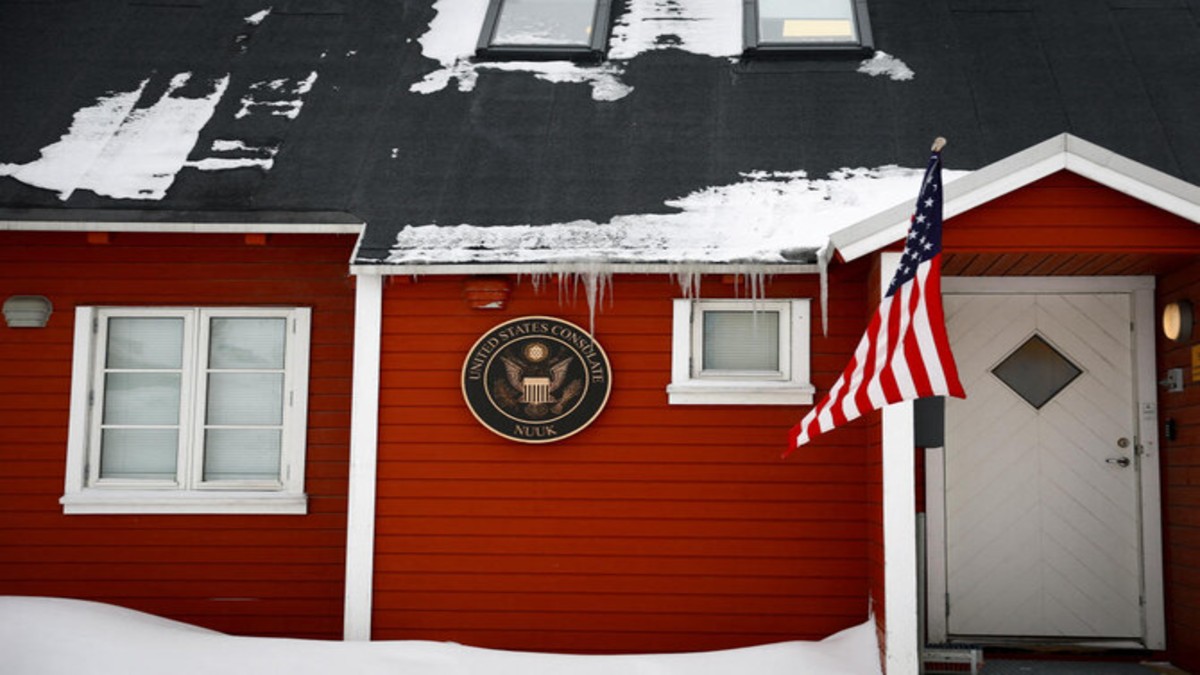
 "Why US is so obsessed with Greenland")
Those who believe US President Donald Trump is trying to annex Greenland, a self-governing, autonomous, overseas territory of the Kingdom of Denmark in the Arctic region, should think again. It’s realpolitik in an era of geodynamics.
The fact is that the US has since 1867 been trying to ‘acquire’ Greenland from Denmark. Soon after the Second World War, in 1946, it also offered Denmark $100 million in gold. Its interest in Greenland stems from the island’s highly strategic Arctic location, its untapped rich mineral resources, and potential new shipping routes.
In America’s latest move, President Trump appointed Louisiana Governor Jeff Landry as a “special envoy” to Greenland: “Jeff understands how essential is Greenland to our National Security, and will strongly advance our Country’s interests for the Safety, Security, and Survival of our allies, and indeed the World,” he wrote on X on December 22.
Few took Trump seriously—some even mocked—when, soon after returning to the White House on January 20, 2025, for a second term, Trump raised the Greenland issue, along with those like the Panama Canal, etc. But America has always been serious about Greenland, more so with its fast-changing dynamics with Russia, China, and Europe.
“We need Greenland for national security, not for minerals … If you take a look at Greenland, you look up and down the coast, you have Russian and Chinese ships all over the place. We need it for national security. We have to have it,” Trump told reporters on December 23.
Quick Reads
View AllJeffrey Martin Landry, politician, attorney, and army veteran, wrote in a post, on X: “It’s an honour to serve you in this volunteer position to make Greenland a part of the US.”
The White House said Landry will serve in a ‘voluntary’ capacity, tasked with advancing US interests in Greenland and engaging with stakeholders on the Arctic island’s future.
Greenland: Alaska II
In 1867, the US bought Alaska from Tsarist Russia for $7.2 million to end Moscow’s presence in North America and secure its access to the Pacific Ocean. Alaska, the vast, remote territory, is rich with minerals like gold. Finding it hard to defend it from rival naval power Great Britain, Russia sold it to America. Later, Hollywood made several films on this frozen treasure, including Charlie Chaplin’s iconic, The Gold Rush (1925). In 1867 itself, the US even tried to acquire Iceland—it may well be included in America’s acquisition menu, again!
For the US, Alaska meant strategic positioning in the Pacific, expanding America’s territory, and countering British power. The discovery of gold during the late 1890s validated the purchase, bringing prospectors and industries like salmon fishing.
The frozen territory was previously known as Russian America (1784-1867), the Department of Alaska (1867-1884), the District of Alaska (1884-1912) and the Territory of Alaska (1912-1958), before it finally became the 49th state of the USA (1959). Recently, it hit world headlines when Presidents Donald Trump and Vladimir Putin held summit talks on August 15, 2025, in Alaska on the Ukraine issue.
For America, Greenland, the planet’s largest non-continent island, is another Alaska. If the US acquires it, by coercion or cooperation, it would add to the US a territory 25 per cent larger than Alaska. Greenland, a former Danish colony with a population of only 56,000, has the right to declare independence under a 2009 agreement but remains heavily reliant on fishing and Danish subsidies. Apparently, Landry has been tasked to use this 2009 loophole to make it part of the US. In March 2025, Greenlanders sought independence from Denmark but opposed becoming part of the USA.
Interestingly, the US had purchased even Louisiana, which Landry heads now, from France in 1803 for $15 million. The move doubled the size of the US.
Greenland is said to hold significant untapped reserves of oil, natural gas, and rare earth minerals critical to advanced manufacturing and defence technologies. As governor, Landry has overseen the extraction of hydrocarbons in Louisiana, exported even to India.
A Danish territory since 1721, Greenland’s strategic position between Europe and North America makes it a key site for the US ballistic missile defence system, while its mineral wealth has heightened US interest in reducing reliance on Chinese exports.
The US has maintained a military presence at the Pituffik Space Base (formerly Thule Air Base) since 1943; the European Space Agency (ESA) also planned a new base in 2025. Renewed US attempts for acquisition of the island this year have prompted strong pushback from Denmark and the EU.
In May 2025, Trump said that he could not rule out a US annexation of the island. Predictably, Greenlandic and Danish authorities opposed the move and asserted their right to self-determination: “Greenland is not for sale.”
After Trump appointed Landry, Danish Foreign Minister Lars Lokke Rasmussen said, “Out of nowhere, there is now a special US presidential representative, who, according to himself, is tasked with taking over Greenland. This is, of course, completely unacceptable.”
“We have said it before. Now, we say it again. National borders and the sovereignty of states are rooted in international law,” Danish Prime Minister Mette Frederiksen and her Greenlandic counterpart, Jens-Frederik Nielsen, said in a joint statement.
Denmark has been trying to repair strained ties with Greenland and ease tensions with the Trump administration by investing in Arctic defence to address US criticisms about inadequate security.
Trump called repeatedly during his presidential transition in 2024 and the early months of his second term for US jurisdiction over Greenland and has not ruled out military force to take control of the island. In March, Vice President JD Vance even visited a remote US military base in Greenland and accused Denmark of underinvesting there. Denmark is also a Nato ally of the United States.
In August, Danish officials summoned a top US diplomat in Copenhagen following a report that at least three people with connections to President Trump had carried out covert influence operations in Greenland.
Sensing the approaching danger and mounting interest from US investors in the Danish territory, Greenland’s Parliament, in November, limited foreigners’ right to own property on the vast Arctic island. The new legislation means only people and companies from Greenland, the Faroe Islands, and Denmark will be allowed to buy property and land-use rights in Greenland.
Recently, the Danish Defence Intelligence Service said in an annual report that the US is using its economic power to “assert its will” and threaten military force against friend and foe alike.
The European Union (EU) is acutely embarrassed with this US move. Anouar El Anouni, a spokesperson for the EU’s Executive Commission, underlined the bloc’s position that “preserving the territorial integrity of the Kingdom of Denmark, its sovereignty and the inviolability of its borders is essential for the European Union”.
The Endgame
It’s only a matter of time. Not if but when.
On December 27, Landry said he plans to discuss quality of life with the people of Greenland. “What are they looking for? What opportunities have they not gotten? Why haven’t they gotten the protection that they actually deserve?”
There is a “great opportunity” for Greenland to be invited to join the United States. He noted that, with Greenland about an hour away, the US is the fastest security route for its people.
“Look, the United States has always been a welcoming party. We don’t go in there trying to conquer anybody and take over anybody’s country. We say, listen, we represent liberty. We represent economic strength. We represent protection,” Landry said.
According to media reports, political analyst Robert Collins from Dillard University said, “President Trump has already stated that he wants the island to become a US territory. So that being said, we know that that’s the President’s endgame.” Although tensions between the two allies are rising, he said, conflict is unlikely to escalate since Denmark is a Nato ally.
“The US … could invade the island and simply station troops there and say, ‘Well, it’s ours now,’ but that’s probably not realistic because that would be politically unpopular even among Trump supporters and Republicans in Congress, and so I don’t really think that’s going to happen,” Collins said.
Threatened by Russia amid the Ukraine war, Europe is unlikely to burn its fingers in Greenland, see the collapse of an already fragile Nato, and find an enemy in America that Christopher Columbus accidentally discovered in 1498, one which the continent colonised thereafter and exited completely from the Americas after the Monroe Doctrine (1823).
Greenland is geographically part of North America, just off Canada’s coast (only 16 miles away at its closest). Its nearest European neighbour, Iceland, is about 200 miles across the Denmark Strait.
Proximity decides who will own Greenland!
Period.
(The author is a senior journalist. Views expressed in the above piece are personal and solely those of the author. They do not necessarily reflect Firstpost’s views.)

 "Trump announces 25% tariff on Iran’s trading partners. How India may be affected")
 "India, US to resume BTA talks after 5 months as Gor pushes for trade deal with 'real friends'")
 "ICC sources rubbish Bangladesh sports adviser’s sensational claim of BCB being asked to drop Mustafizur")
 "Jerome Powell: The 'Fed chair with a spine' taking on Trump")
 "Trump announces 25% tariff on Iran’s trading partners. How India may be affected")
 "India, US to resume BTA talks after 5 months as Gor pushes for trade deal with 'real friends'")
 "ICC sources rubbish Bangladesh sports adviser’s sensational claim of BCB being asked to drop Mustafizur")
 "Jerome Powell: The 'Fed chair with a spine' taking on Trump")



