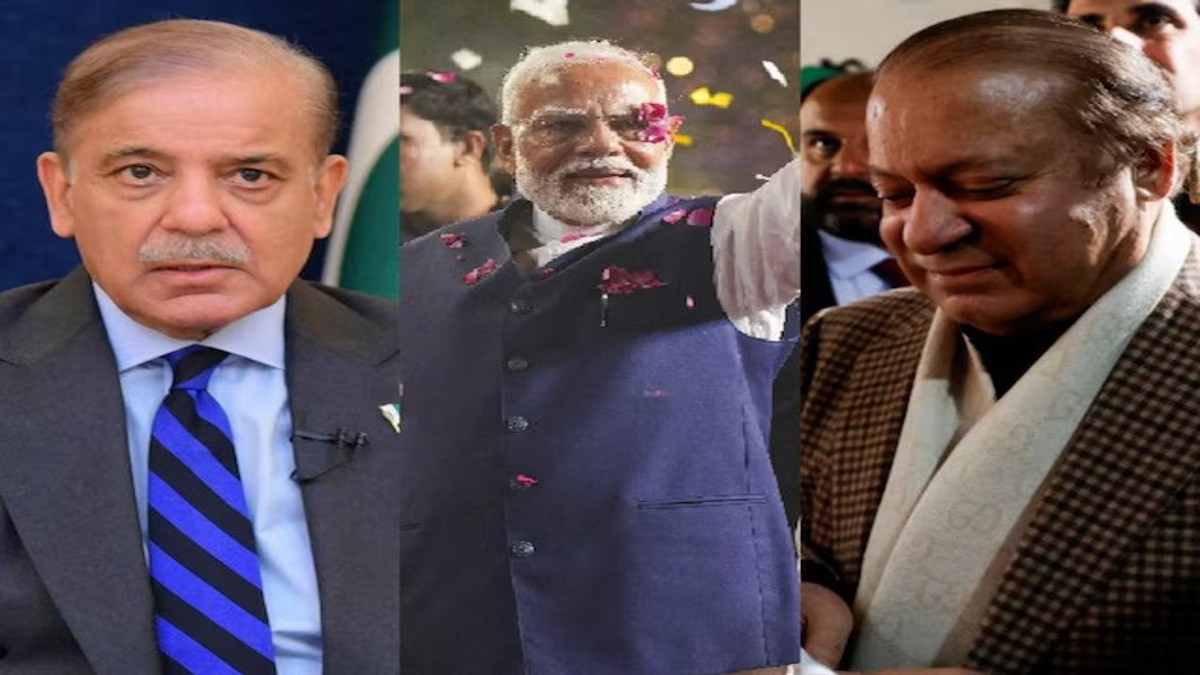
 "Pakistan Prime Minister Shehbaz Sharif and his senior brother former Prime Minister Nawaz Sharif sent congratulatory messages to PM Modi on forming the government. (Image: Reuters/PTI)")
Pakistan may be trying to engage with India. On Monday, Nawaz Sharif made a direct outreach to the Indian prime minister. He posted a message on social media congratulating PM Narendra Modi for assuming office for the third time.
In his message, Senior Sharif said: “Let us replace hate with hope and seize the opportunity to shape the destiny of the two billion people of South Asia.”
We don’t need to spell it out; Sharif is signalling that he wants to resume dialogue. Within two hours, the Indian prime minister responded, making a statement on expected lines. PM Modi said that “advancing the security” of Indians will always remain a priority.
That’s a reference to India’s long-standing position vis-à-vis Pakistan—terror and talks cannot go together.
Especially after what happened this week, Jammu and Kashmir was attacked again. Terrorists struck a bus full of pilgrims in Reasi. Nine people died in the attack. More than 30 others were injured. The attack came on the day when PM Modi and his ministers took their oath of office, and the perpetrators were once again Pakistanis. The Resistance Front, an outfit affiliated with Pakistan-based Lashkar-e-Taiba (the same group that carried out the 2008 Mumbai terror attacks), was behind this attack.
So there is no question of India reversing its policy now. PM Modi got a message from the younger brother of Nawaz Sharif and Prime Minister of Pakistan Shehbaz Sharif too. Sticking to just a one-line exchange.
So the outreaches by the Sharifs are a non-starter, as they have been at it for some time. Around two weeks ago, Nawaz Sharif made a significant remark. He spoke about the 1999 Kargil War and how Pakistan was responsible for it. Sharif called the Kargil war a mistake on Pakistan’s part, which was a major admission in itself.
Before Sharif, his daughter Maryam Nawaz too made a case for dialogue, using phrases like “don’t fight wars with neighbours” and “open the doors of friendship.”
Impact Shorts
More ShortsPM Modi has good reasons to not trust these overtures, as when he took charge in the first term, he had put his best foot forward. In 2014, he called Nawaz Sharif for his swearing in. In 2015, he made a surprise stop in Lahore on Senior Sharif’s birthday while Modi was on his way back from Afghanistan.
This was the first visit by an Indian prime minister to Pakistan in over a decade. But the optimism was short-lived, as India suffered a string of terrorist attacks in Jammu and Kashmir after that. The first was in 2016, when an Indian military base was struck in Uri. Then, again in 2019, a suicide bomber targeted Indian security forces in Pulwama.
Today, bilateral relations remain in a deep freeze. Since 2019, both countries have not posted high commissioners in each other’s capitals. They were withdrawn after India made the decision to abolish Article 370, which withdrew the special status of Jammu and Kashmir.
It has been five years. Now Pakistani leaders say they want to engage, but at the same time, Pakistan continues to provoke India.
Another example of that was seen over the weekend, when Shehbaz Sharif visited Beijing. Pakistan and China released a joint statement about Kashmir that says the two countries “oppose” any unilateral actions in Kashmir. This was a challenge to India’s sovereignty over Jammu and Kashmir, where no other country has a locus standi.
India was quick to reject this joint statement. New Delhi repeated that Jammu and Kashmir remains an inalienable part of India.
So, India’s stand remains clear—there can be no dialogue until Pakistan stops cross-border terrorism.
The views expressed in the above piece are personal and solely those of the author. They do not necessarily reflect Firstpost’s views.