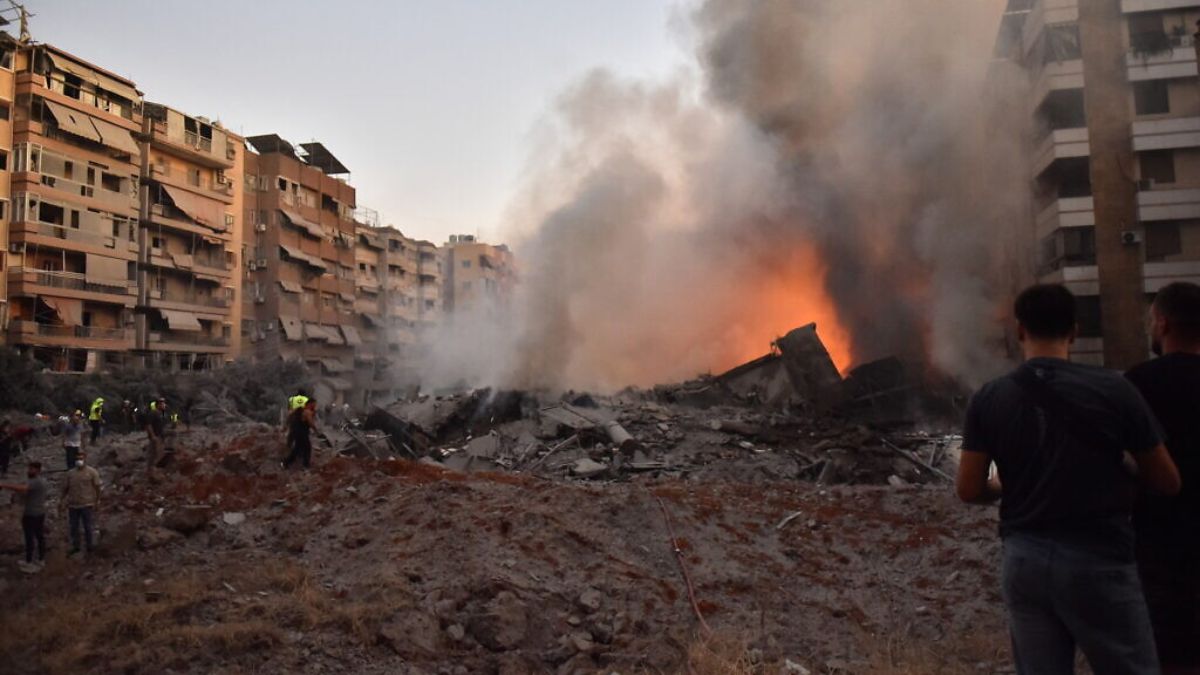
 "Why Israel’s fight with Hamas and Hezbollah cannot be allowed to spiral into a regional war")
As we remember Mahatma Gandhi on his birth anniversary on October 2, the apostle of non-violence or ahimsa of a kind the world has not seen in recent memory, violence continues to rock the world. Russia and Ukraine are at war, with no end in sight. Another conflict that has mushroomed into unabated killings, bombings, displacement of people and untold misery, is the Israel-Palestinian conflict.
This conflict, decades old, was triggered to a new phase of crisis, when Hamas, the terrorist organisation fighting for Palestinian rights, attacked Israel on October 7, 2023. In that terrorist attack, 1,189 Israelis died, including 815 civilians, and 251 Israelis were taken hostage. It was an unprecedented escalation, catching Israel off-guard. Terrorism of any kind can never be justified, and India, along with almost the entire world, condemned this wanton killing.
Israel had the right to retaliate, and it did so immediately and with unprecedented ferocity. According to UN statistics, as of May 13, Israeli bomb attacks had killed 35,000 Palestinians in Gaza, of which 7,797 were minors, 4,959 were women, and 1,926 the elderly. In addition, some 10,000 have been disabled by injuries. According to other experts, these figures are hugely underestimated. They estimate the number of deaths to be upward of 300,000. Either way, even the underplayed figures are more than the entire death count in the Russia-Ukraine war.
Israel has now targeted its bombs against Hezbollah, an Iran-backed terrorist organisation, in Lebanon. In the fresh wave of deadly bombings an estimated 1,000 people were killed, 900,000 displaced, 110,000 had already fled their homes in anticipation of Israel’s threatened attack, and more than 40,000 people have been reduced to living in refugee shelters. Famine stalks the 5 million Palestinians in Gaza, and reportedly, even body bags are now in short supply to bury the dead. Hezbollah chief Hassan Nasrallah has been killed along with most of his top leadership. And, Israel has now begun its ground invasion of Lebanon.
Most countries have asked Israel to agree to an immediate ceasefire. Addressing the UN General Assembly in New York, French President Emmanuel Macron emphatically stated that Israel cannot continue with its bombings of Gaza and the policy of killing civilians, and its new attacks on Lebanon. Both France and the US have urgently called for a 21-day ceasefire, in order to give time for negotiations, and end the unending killings. The UN Secretary General has also asked for an ‘immediate ceasefire’, adding that currently, ‘all hell is breaking loose’.
Quick Reads
View AllIndia has taken a nuanced and, in my view, balanced stand on the conflict. We condemned the terrorist attack of October 7; we have also condemned the loss of civilian lives in the ongoing conflict; we have called for restraint and de-escalation and a peaceful resolution of the conflict through dialogue and diplomacy, while reiterating our support for a two-State solution, towards establishment of a sovereign, independent and viable state of Palestine within secure and recognised boundaries, living side by side in peace with Israel. This is a reiteration of our consistent stand on the issue. We have important ties with Israel and with the Arab world, and have no option, in our national interest, but to tread a fine line in the conflict.
But I wonder if India, and the world, needs to do more, more urgently, than just repeating well-known positions. While I have no sympathy for terrorist groups like Hamas and Hezbollah, I cannot condone state terrorism either. Israel, backed to the teeth by America with the latest and most sophisticated weapons, has the ability to carry out the most devastating attacks against its enemies, while the military ability of Palestinians and their supporters is asymmetrically negligible.
There is general global consensus that Israel in its retaliation has gone too far. Public anger at Israel’s continuing maniacal attacks has led to widespread public protests in America itself. Prime Minister Benjamin Netanyahu’s scorched-earth policy of literally wiping out the enemy, with scant regard for the huge collateral damage to civilians, does not have the support of most Israelis themselves. Netanyahu runs a 7-party unstable coalition, which is by far the most ultra-right and religious government in Israel’s history. For Netanyahu, no dove himself, the support of hardliners is essential to the survival of his government. His popularity is greatly diminished, and his only hope of political survival is to continue this war.
Israel has the right to defend itself. But this right does not mean the annihilation of the rights of Palestine, on whose ancient land, British and Western colonial chicanery, led to the establishment in 1948 of a Jewish state. The genocide against Jews was committed overwhelmingly by Germany and other European countries, but it was convenient for them, in a world where only their will mattered, to create the new state of Israel in the midst of Arab territory where conflict with Arabs, who had for long peaceably lived with Jews, was inevitable. Ironically, today 15 million Palestinians are global refugees.
History is a complex phenomenon. Yet even the most biased observer will concede that Israel is less than innocent in forcibly occupying Palestinian land after the 1967 war, and in spite of repeated UN resolutions urging it to vacate Gaza and the West Bank, has refused to do so wholly. On the contrary, it has systematically increased Jewish settlements in Palestinian territories, and the current government’s manifesto aims at the illegal annexation of the West Bank.
Whatever the narrative of history, the time has come to end this war, and the immense and tragic loss of lives it has taken. India, the US, and other globally important powers must do far more to achieve that. Not the least because, with the war spilling over to Lebanon, and now involving Iran whose support for Hezbollah is verifiable, the situation threatens to spiral into a major regional war, and possibly even beyond, which would be disastrous for India, the global economy and the stability of the world.
The author is a former diplomat, an author and a politician. Views expressed in the above piece are personal and solely that of the author. They do not necessarily reflect Firstpost’s views.


 "'Indian food, our pride': $200k settlement in Palak Paneer case a moral victory against racism in the west")
 "India’s air dominance in Operation Sindoor forced Pakistan to seek ceasefire, European report says")
 "How Pakistan’s support may have led Bangladesh towards a very costly mistake")
 "India vs New Zealand Live Score 3rd T20: Kishan, Abhishek tee off after Samson bowled on first ball")
 "'Indian food, our pride': $200k settlement in Palak Paneer case a moral victory against racism in the west")
 "India’s air dominance in Operation Sindoor forced Pakistan to seek ceasefire, European report says")
 "How Pakistan’s support may have led Bangladesh towards a very costly mistake")
 "India vs New Zealand Live Score 3rd T20: Kishan, Abhishek tee off after Samson bowled on first ball")