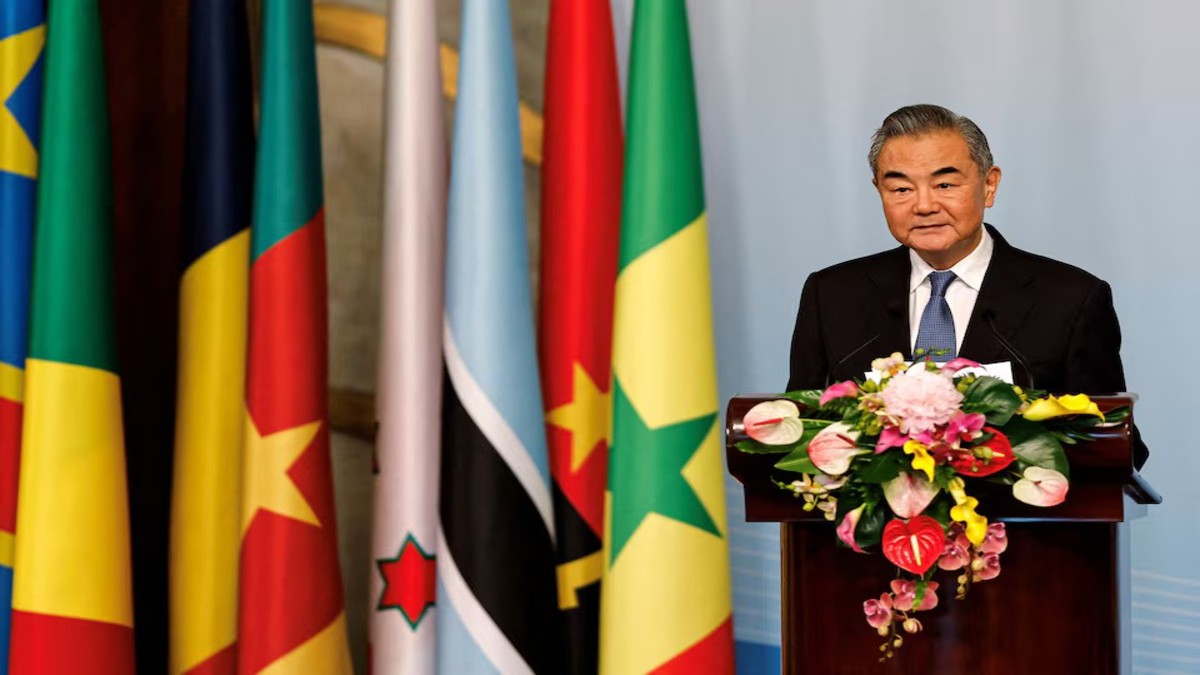
 "Wang Yi, a member of the Politburo of the Communist Party of China (CPC) Central Committee and China’s minister for foreign affairs, paid an official visit to Ethiopia, Tanzania, and Lesotho from January 7 to 11. Representational image/ Reuters")
When China’s Foreign Minister Wang Yi set out on his annual New Year visit to Africa in early January 2026, he was not merely following a diplomatic ritual. For the 36th consecutive year, Africa was the first overseas destination of China’s foreign minister, a tradition that Beijing takes pains to present as proof of constancy, solidarity, and historical gratitude.
But this year’s trip, to the African Union headquarters in Addis Ababa, followed by Ethiopia, Tanzania, and Lesotho, and notably excluding Somalia at the last moment, revealed something more subtle: a China that is recalibrating its African engagement without retreating from it.
The symbolism remains powerful. Wang Yi used the occasion of the ninth China-AU Strategic Dialogue to remind his hosts that 2026 marks the 70th anniversary of the start of China-Africa diplomatic relations. He spoke, as his predecessors have, of shared struggles against colonialism, of friendship forged in adversity, and of the Global South standing together in an uncertain world. The launch of the 2026 China-Africa Year of People-to-People Exchanges, with nearly 600 planned activities, reinforced the sense of a relationship that is meant to be societal, not merely transactional.
Yet beneath the familiar language of “sincerity, real results, amity and good faith” lay a more pragmatic message: China is adjusting its methods in Africa to reflect debt fatigue, security volatility, and intensifying great-power competition.
Africa remains China’s first diplomatic stop in the new year for three reasons that Beijing itself articulates—and that still hold. First, habit and history: China’s leadership genuinely sees the relationship as a political inheritance. Second, policy consistency: Africa is one of the few regions where China can plausibly claim that its broad orientation has not swung wildly with changing governments or crises. With China and Africa together accounting for roughly a third of the world’s population, Beijing argues that global modernisation without Africa is incomplete.
But continuity does not mean rigidity.
The most telling signal of this year’s tour was not where Wang Yi went, but where he did not. Somalia was dropped from the itinerary at a late stage. Officially, Beijing reiterated its support for Somalia’s sovereignty and territorial integrity and its opposition to Somaliland’s “collusion” with Taiwan. Substantively, however, the decision to bypass Mogadishu spoke volumes.
Quick Reads
View AllAs analysts have noted, this was a calculated assessment of political, security, and reputational risk. Somalia remains beset by governance challenges, scrutiny over aid diversion at Mogadishu port, and the persistent threat of al-Shabab. For a China that prizes predictability and optics, a high-level visit risked being overshadowed by precisely the kinds of questions Beijing prefers to avoid.
China chose caution over symbolism, supporting Somalia diplomatically from a distance while deferring personal engagement. This approach neatly illustrates China’s security doctrine in Africa: rhetorical support for sovereignty, selective counterterrorism cooperation, and avoidance of deep military entanglement. It also distinguishes Beijing from Western interventionism and from Russia’s more muscular, mercenary-driven model.
Ethiopia, by contrast, was an indispensable stop. Addis Ababa is not only a key bilateral partner but also the seat of the African Union. Wang Yi’s meetings there, with Ethiopian leaders and with AU Commission Chairperson Mahmoud Ali Youssouf, underscored China’s preference for working through continental institutions.
Ethiopia’s own economic challenges, particularly debt stress, shaped the tone of discussions. Notably absent were splashy announcements of new mega-loans. Instead, the emphasis was on aligning “high-quality” Belt and Road projects with Ethiopia’s development priorities, improving the business environment for Chinese investors, and expanding cooperation into e-commerce, renewable energy, and artificial intelligence.
This reflects a broader shift. China is not withdrawing from Africa economically; it is correcting course. Infrastructure still matters, but industrialisation, value addition, and market access now dominate the narrative. The most potent tool in this regard is not a railway or a dam, but trade policy.
African leaders repeatedly raised the issue of zero tariffs, and Wang Yi was keen to brand China’s decision to grant 100 per cent zero-tariff treatment to all tariff lines from African countries with diplomatic ties to Beijing as a “golden calling card”. In a world where Western trade regimes are becoming more conditional and protectionist, this unilateral opening gives China a powerful comparative advantage.
Tanzania illustrated how the old and the new China-Africa stories now coexist. The visit there focused heavily on reviving the historic Tazara railway, linking the port of Dar es Salaam to Zambia’s copper belt. Framed as the “Tazara Railway Prosperity Belt”, the project is intended not only as a nod to revolutionary-era solidarity but also as a strategic counterweight to Western-backed corridors such as the Lobito route.
At the same time, discussions centred on doubling Tanzanian exports to China by 2030 and embedding Tanzanian producers more deeply into Chinese supply chains. Infrastructure, in other words, is no longer the end in itself; it is meant to serve trade and industrial upgrading.
Lesotho, the final stop, carried a different symbolism. Visiting a small, landlocked country with limited geopolitical weight was a deliberate statement of inclusivity. In the wake of shifts in US trade policy and uncertainty around AGOA, Lesotho’s export-dependent textile sector has been under pressure.
Wang Yi’s pledge to accelerate zero-tariff access for Lesotho’s exports was therefore not just diplomatic courtesy but tangible economic relief. It allowed China to present itself as a stabilising partner at a moment when Western trade preferences appear less secure.
Across all three stops, China was careful to position itself as a multilateral partner rather than a domineering patron. Support for the AU’s Agenda 2063 and “Silencing the Guns” initiative, the reaffirmation of the One-China principle by African counterparts, and coordination within platforms such as Brics all reinforced this posture. China wants to be seen not as replacing Western influence, but as offering an alternative framework that emphasises sovereignty, development, and policy autonomy.
Wang Yi’s 2026 African tour was neither dramatic nor defensive. Africa-first diplomacy remains central to China’s worldview, but it is now accompanied by sharper risk assessment, a rebalancing from loans to trade and investment, and a clear effort to anchor China’s role in institutions rather than individual regimes.
The omission of Somalia, the emphasis on zero tariffs, and the focus on industrial cooperation all point to the same conclusion: China is not stepping back from Africa but is learning, adapting, and entrenching itself more carefully than before.
(The writer is a former ambassador to Germany, Indonesia, Ethiopia, Asean, and the African Union, and the author of ‘The Mango Flavour: India & Asean After 10 Years of the AEP’. The views expressed in the above piece are personal and solely those of the author. They do not necessarily reflect the views of Firstpost.)