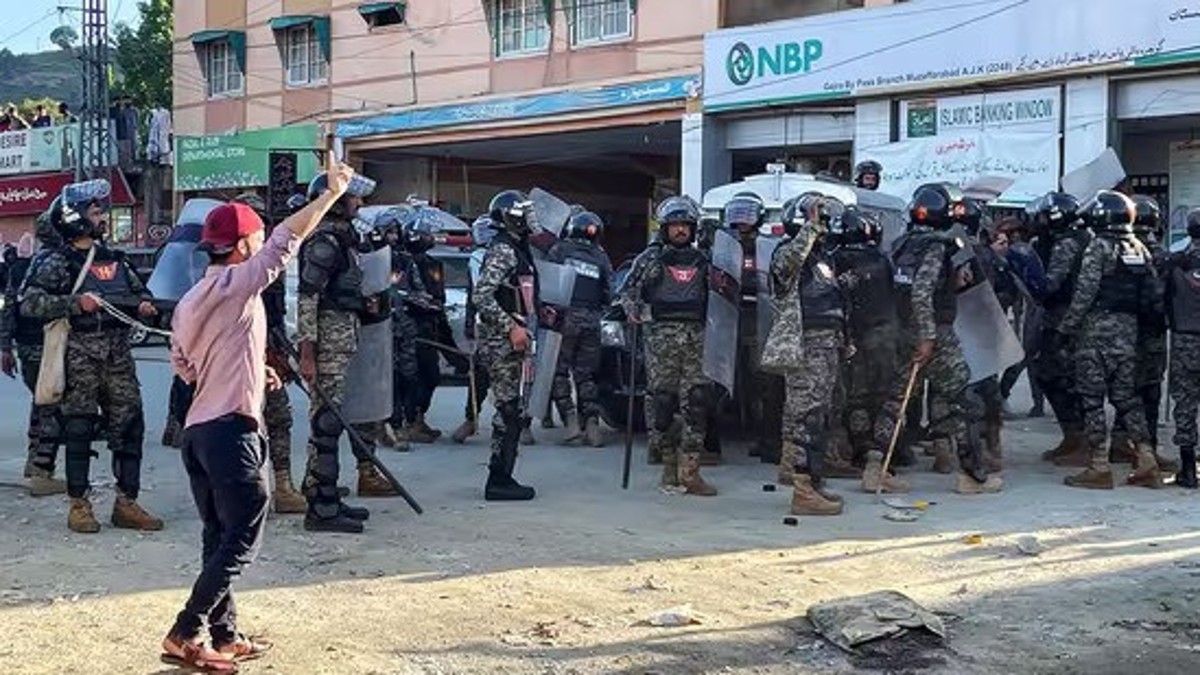
 "Pakistani rangers cordon off a street during a protest by PoK demonstrators. Image: AFP")
Pakistan is South Asia’s best example of economic mismanagement. On Monday, there were developments in Pakistan-occupied Kashmir; the region has been in turmoil for days.
The people in the region were protesting over high electricity prices and ended up clashing with the police. Over the weekend, the protests intensified, and on Monday, Pakistan gave up as Prime Minister Shehbaz Sharif approved a grant for PoK. The grant is worth 86 million dollars.
However, there is no clarity about how this money will be used. The people of PoK have to take Sharif at his word. It is doubtful if this bribe will placate the people of PoK, but it raises questions: How did perpetually broke Pakistan come up with this grant? How will it actually cobble the money together?
After all, Pakistan’s economy is in dire straits. It owes billions of dollars in loans. That’s about 42 percent of Pakistan’s GDP, and it’s not expecting high growth this year to make up for the debt.
By the end of June, their economy is expected to grow by just 1.8 percent over the 2023–24 financial year.
It’s not really a good outlook for Pakistan. High debt and poor growth. So how is it suddenly finding money for PoK? The answer may lie in another development.
Impact Shorts
More ShortsOn Sunday, Pakistan signed a defence deal with Iraq. It reportedly includes the sale of fighter jets. As many as 12 jets for about 1.8 billion dollars. It will bring some much-needed funds to Islamabad’s empty coffers. It’s one of the rare occasions where the country’s military is partially helping the economy because Pakistan is selling JF-Thunder fighter jets. It’s a collaborative effort between Pakistan and its loan shark, China.
Beijing has given billions of dollars to Islamabad; a lion’s share of Pakistan’s external debt is owed to the Chinese. So how does Pakistan pay it back? Well, there are the regular repayments, and then there are the arms purchases.
A report came out last week highlighting the different ways that Pakistan is in China’s pocket. Or rather, how China’s fingers are in Pakistan’s pocket.
Let’s look at arms imports. Between 2019 and 2023, 82 percent of Pakistan’s arms imports were from China. Up from 69 percent between 2014 and 2018.
So China’s share has gone up significantly in the last 10 years. Now, friendship is one thing, but why is Pakistan making itself completely dependent on Chinese arms? And these are not just small-ticket items. Pakistan is buying heavy weapons as well, like submarines. Last month, China launched a submarine—the first of eight hangor-class submarines it is building for Pakistan.
The total cost is between 4 and 5 billion dollars. That’s not something Pakistan can really afford. So why and how is it buying these weapons? It is because when your loan shark asks you to buy something, do you really have a choice?
It explains Pakistan’s dire economic situation. It imports defence equipment from China. Its debt keeps piling on, and it has to pay back these loans with interest. So it doesn’t have enough to spend on its own citizens, and the citizens also get squeezed by high taxes to generate money to pay back the loans.
In other words, Pakistan is spending heavily on Chinese weapons, which is crushing Pakistan’s economy. This is not hyperbole. A latest SIPRI report says in 2022, 14.5 percent of the Pakistani government’s spending was on the military. Every other country mentioned has less than 10 percent, including India and Saudi Arabia. This shows Pakistan’s misplaced priorities—how Chinese arms imports are more important to Pakistan than its own citizens.
Unless this changes—the Pakistani people get the first share of state resources—the country will never recover from its financial crisis, no matter how many jets it manages to sell.
Views expressed in the above piece are personal and solely those of the writer. They do not necessarily reflect Firstpost’s views.