

 "Two Acts: How Waqf and Places of Worship Acts have made Hindus ‘second-class citizens’ in their own country")
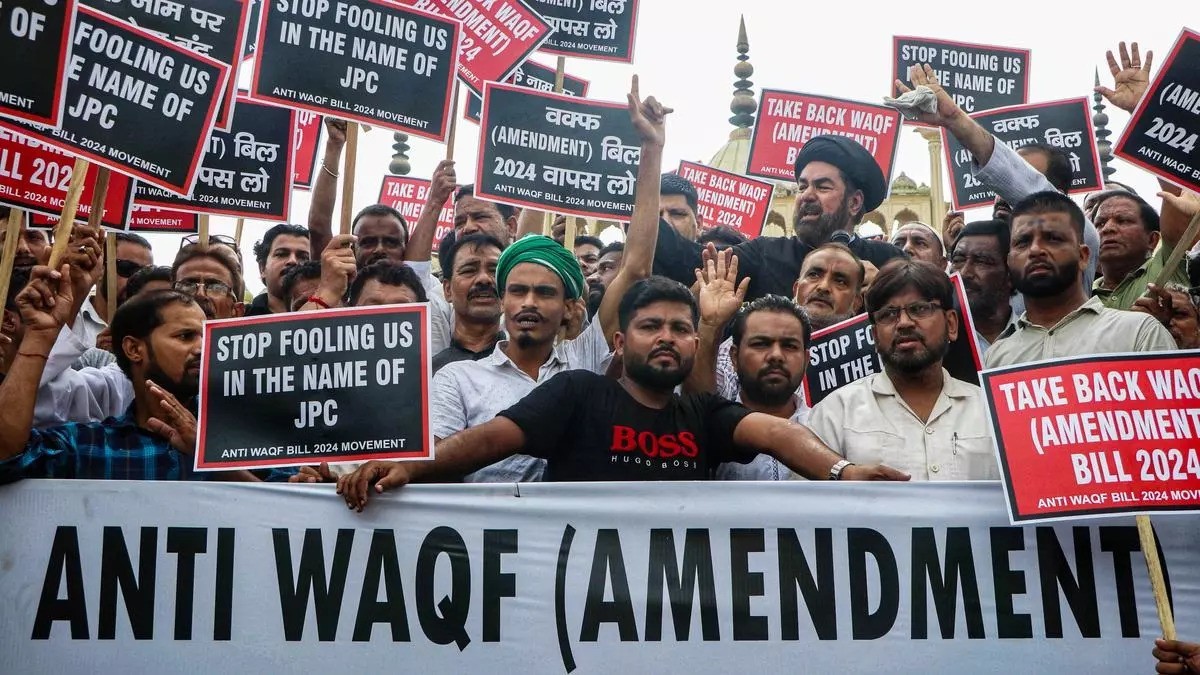
It was a show of strength. Thousands of Muslim community members gathered at the Indira Gandhi Indoor Stadium in New Delhi to protest against the proposed Waqf Amendment Bill. The Bill, introduced in Parliament in August and currently being scrutinised by a parliamentary panel, aims to reform the management and utilisation of properties currently overseen by 32 Waqf Boards functioning across the country, each overseeing such properties within their respective state or Union Territory.
Those present at the Indira Gandhi stadium saw the government’s move as an assault on their religious identity and the Constitution of India. Ironically, it’s a misleading claim on both counts. One, Waqf isn’t an integral part of Islam, with the term not even finding a mention in the Quran. Moreover, while India, which swears by a “secular” constitution, has made Waqf the centrepiece of its Muslim policy, Islamic countries such as Turkey, Egypt, Iraq, Jordan, Syria, Sudan, etc. haven’t even bothered to have a Waqf law, far less a Waqf Board.
Waqf, however, doesn’t just lack the Quran’s sanction; it also goes against the fundamental nature of the Constitution of India. A cursory look will tell us how antithetical the nature of Waqf is to the spirit of the original Constitution, which includes 22 illustrations, made under the guidance of Nandlal Bose, within its main body. The illustrations from the ancient era range from a Mohenjodaro seal to a scene of a Vedic ashram, and from Rama’s victory over Ravan to Krishna propounding Gita to Arjun and Buddha delivering a sermon. The illustrations chosen to represent the mediaeval era are far more revealing: It has a Hindu sculpture from Odisha, the image of Nataraj, and a Mahabalipuram scene depicting the penance of Bhagiratha and the descent of Holy Ganga. Among Muslim themes, only the portrait of Akbar finds a space. The other two individuals who could make it to the mediaeval-era list were Shivaji and Guru Gobind Singh. And, in the modern era, Gandhi’s Dandi March and his visit to riot-hit Noakhali, and Netaji Subhas Chandra Bose and his Indian National Army found space, indicating how revolutionaries were not yet pushed on the margins.
The ‘secularisation’ of the Constitution was thus a Nehruvian mischief that saw its beginning after the death of Sardar Vallabhbhai Patel in December 1950 and found its ascendency in the 1960s and ’70s, pushing the country towards statist socialism and soulless secularism, much against the civilisational moorings of this land. (Those who now fashionably keep a copy of the Constitution in their pocket and swear by its sanctity forget that this text has been amended more than 100 times so far.) Before Independence, there was no Waqf Board in the country, and any Waqf-related dispute would be heard in a civil court. It was the Nehru dispensation that came out with a new Waqf Act, 1954, establishing Waqf Boards for the first time in the country.
Impact Shorts
More ShortsThe 1954 Act was repealed, and a new Waqf Act was passed in 1995, giving more powers to Waqf Boards. In 2013, this Act was further amended to give unlimited powers to these bodies to snatch anyone’s property, which could not be challenged in any court of law. Section 85 of the Waqf Act states that if you cannot satisfy the Waqf Board Tribunal that it is your land, then you will be ordered to vacate the land. The decision of the tribunal will be final. No court, not even the Supreme Court, can change the decision of the Waqf Tribunal. Similarly, Section 40 gives the Board power to decide if your land is Waqf or not. In fact, in the event of the Waqf Board laying a claim on a land, it is incumbent upon its owner to prove the ownership of the land, and not the board!
Is it, therefore, any surprise that the properties of the Waqf Board, which were spread over four lakh acres of land in 2009, have more than doubled in just over a decade, making it the third-largest landowner in the country after the Army and the Railways? To add to it the vote-bank politics, and the Waqf Board becomes an unstoppable force in the country. In March 2014, for instance, just before the Lok Sabha elections, the Congress-led UPA government, realising that it would lose power in Delhi, gifted 123 prime properties in the national capital to the Delhi Waqf Board.
This brings us to the fundamental question: What’s the rationale of a religious law like the Waqf Act in a secular country like India? And if Muslims have a particular law, why is there no such legislation in favour of Hindus, Christians, and Sikhs? Why only for Muslims? In this backdrop, there’s a growing clamour for the setting up of a Sanatana Board to look into the issues of temples and temple-related properties across the country.
There is also a growing demand to do away with the Places of Worship Act, 1991, according to which the religious places in India that existed at the time of Independence will be retained as they are. In other words, Hindus in independent India would have no right to negotiate about their religious sites. It would remain the way it was betrothed to us by the British before leaving the country on August 15, 1947. This will be the case even when Hindus get fresh, clinching evidence of their religious sites being forcibly taken over and converted into mosques in the past.
At a time when official legislation gives absolute power and authority to Waqf Boards to spread their geographical boundaries, more than doubling their properties in just over a decade, it’s a double whammy for Hindus to be even denied the right to judicial recourse. This is against the basic tenet of law to deprive a person the right to appeal and get justice if he or she has been targeted or discriminated upon in the past — and more so if there’s evidence supporting it. This is nothing but institutionalised discrimination against a section of Indian citizens based on their religious identity. Time has come to do away with this state-sanctioned apartheid.
Views expressed in the above piece are personal and solely those of the author. They do not necessarily reflect Firstpost’s views.

 "Russian drones over Poland: Trump’s tepid reaction a wake-up call for Nato?")
 "As Russia pushes east, Ukraine faces mounting pressure to defend its heartland")
 "Why Mossad was not on board with Israel’s strike on Hamas in Qatar")
 "Turkey: Erdogan's police arrest opposition mayor Hasan Mutlu, dozens officials in corruption probe")
 "Russian drones over Poland: Trump’s tepid reaction a wake-up call for Nato?")
 "As Russia pushes east, Ukraine faces mounting pressure to defend its heartland")
 "Why Mossad was not on board with Israel’s strike on Hamas in Qatar")
 "Turkey: Erdogan's police arrest opposition mayor Hasan Mutlu, dozens officials in corruption probe")



