

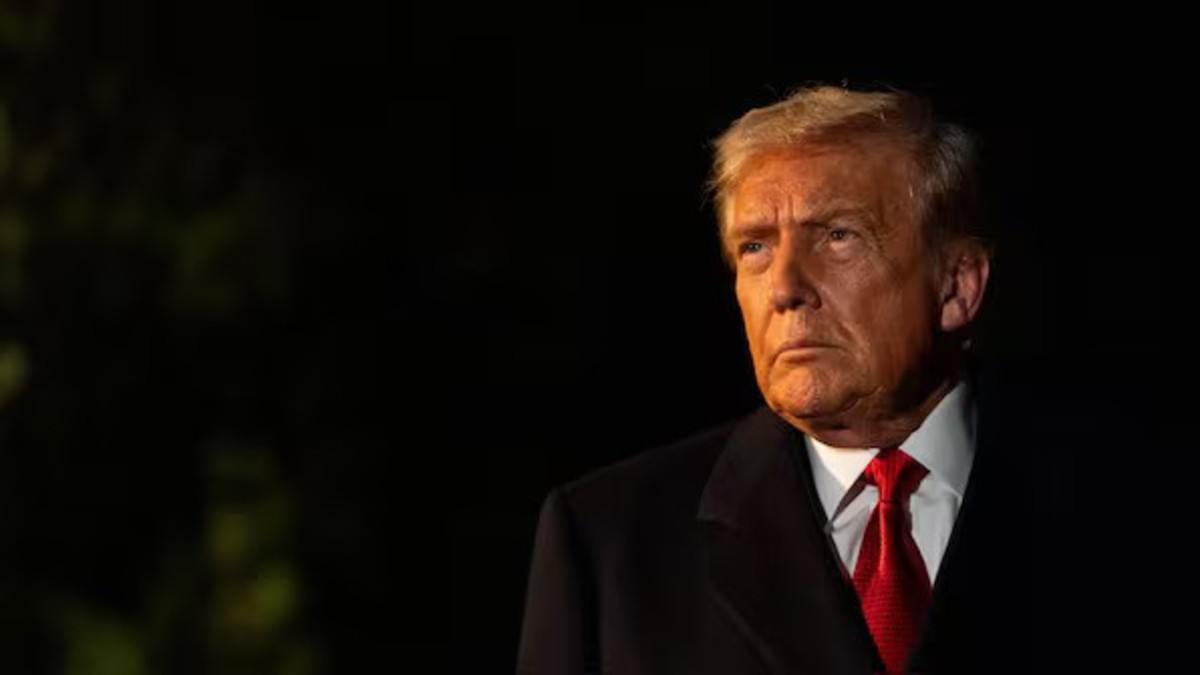
 "Trump’s new foreign policy document is bad news for India")
Pax Americana is over for Europe, admitted German chancellor Friedrich Merz. Europe finally seems to have gotten the memo. It took printed words in the Trump administration’s new National Security Strategy – where Europe has been portrayed as a decaying continent facing civilizational erasure – for Europeans to finally understand that Americans no longer see them as “reliable allies” and are unwilling to bankroll their security.
As the 2025 NSS points out, “Should present trends continue, the continent will be unrecognizable in 20 years or less. As such, it is far from obvious whether certain European countries will have economies and militaries strong enough to remain reliable allies.”
American foreign policy elite and western liberal internationalists, the likes of whom edit and write for The Economist, are struggling to come to terms with reality. Richard Haas, president emeritus of US Council on Foreign Relations, calls Trump’s NSS “the biggest redirection of US foreign policy since the end of World War II and the dawn of the Cold War 80 years ago.”
The Economist calls the MAGA foreign policy document “a dog’s breakfast”, “shorn of the enlightened values that have long anchored foreign policy” and a “naked assertion of power that owes more to the 19th century than the world that America built after the second world war.”
The liberal breast-beating for the lost world is touching. The United States has never shied away from ‘naked assertion of power’ and regime change operations in the garb of promoting freedom and inalienable individual rights. In contrast, Trump’s document promises to be “respectful of other countries’ differing religions, cultures, and governing systems.”
As Trump eviscerates America’s so-called “values-based” foreign policy that sought to cast the world in its own image and replaces liberal hegemony with single-minded pursuit of narrow commercial and geoeconomic interests, India, long resentful of the West’s interference and moral grandstanding, is enjoying a bit of schadenfreude at Europe’s expense. On these shores, America’s ideological recalibration has received a largely positive review.
Quick Reads
View AllThis optimism could be misplaced.
Trump’s hyper-transactional foreign policy, that reimagines America’s role from a global steward to a rent-seeking hegemon extracting measurable returns, does not bode well for India. It is tempting to think that a less interventionist United States will better serve India’s interests, but the “transactional realism” ushered in by Trump will bring its own set of problems.
The new American foreign policy treats all relationships – alliances, partnerships, trade ties and even security guarantees as contingent bargains, stressing on reciprocity, cost-sharing, and “fairness”. The Trumpian America pivots its engagement on immediate, quantifiable benefits that could mean financial contributions, market access, or political concessions than being guided by grand strategy. It prioritises deal-making over partnership building, and swoops where it perceives weakness.
While India may hope to fit into this transactional framework as a counterweight to China, a large consumer market and a huge importer of energy and defence equipment, the Trumpian paradigm will inevitably stretch towards extortionism. It is part of the reason why the US-India trade deal is still in limbo as Trump tries to crank up pressure, slapping the highest tariffs on Indian goods, hoping that New Delhi will eventually crack and concede.
For instance, the USTR delegation during its recent two-day visit to India, ostensibly to iron out issues in the long pending agreement, issued a bunch of unilateral demands and set extractive terms as price not just for signing the trade deal, but to do any meaningful business with America.
Calling on US IT tech giants to prioritise American markets for capex investments rather than outsourcing and creating jobs in India, the team led by deputy US trade representative Rick Switzer and chief negotiator Brendan Lynch indicated that the Trump administration plans to “leverage recent investments in AI data centres in India by American companies like Google and Microsoft because it believes that India’s AI stack – both at the front-end for end-consumers and on the backend in terms of servers and data centres – will need American participation”, reports Indian Express.
Quoting an ‘industry source,’ the report adds, “The USTR representatives said that… the US remains the dominant consumption economy, and governments around the world should understand that they should, therefore, protect the interests of American companies, because doing business with the US was inevitable.”
The US is also relentlessly pushing its GM crops, seeking access for its genetically modified soybean and corn as part of the deal but India has held firm.
Trump’s transactionalism determines that India has no choice but to agree to humiliating terms that might turn it into a colony because the US enjoys global tech monopoly. Washington is therefore pushing India to dilute its digital data protection act, let go of data localization, and relax IT rules.
This extortionist attitude introduces volatility, mistrust and discord in partnership. India isn’t alone. America’s trade deal with Indonesia is at risk. Jakarta, made to sign an agreement under duress so as not to lose access to the American consumer market, is now backtracking on several commitments.
C Raja Mohan calls this “coercive mercantilism.” He writes in Foreign Policy that Trump’s demands “on Japan and South Korea for massive new investments came with terms that can only be seen as extortionist. Equally troubling were the conditions he imposed on trade deals with Malaysia and Cambodia during the recent ASEAN summit. These arrangements have little to do with respecting sovereignty; they reflect power asymmetry and pressure. Asian states may welcome transactionalism, but they resent coercive mercantilism.”
The focus on geoeconomics over geopolitics indicates that America’s priorities in maintaining the strategic partnership with India has shifted. India is mentioned just four times in the document and has been cast away from a central role in Trump 1’s as the cornerstone of Indo-Pacific policy to a peripheral role in Trump 2.0 as a contributor Indo-Pacific security. In his second stint, Trump has shifted away from a great power competition with China (that he authored in his first term) towards a more accommodative posture, seeking a special G-2 type great power relationship with Beijing, and in this paradigm, India finds that its strategic weight has undergone a drastic erosion.
That’s why, while India has been slapped with 25% extra tariffs for ostensibly buying Russian energy, China, the biggest buyer of Russian hydrocarbons, gets a free pass because in Trump’s ‘sphere of influence’ universe, a trade pact with America’s peer superpower necessarily involves concessions which the US need not extend in India’s case.
And therein lies the biggest problem for India. In as much as the NSS reflects Trump’s world view, and there’s no guarantee of it since the document bears clear signs of competing interests among Trump’s inner coterie, the new American foreign policy orientation is a radical departure from an ideological and existential great power competition with China. The rivalry is almost entirely reimagined on economic terms, deviating wildly from the 2017 national security strategy (during Trump 1.0) that had defined China and as a revisionist power and called Beijing a “pacing threat”.
Trump is now allowing China access to Nvidia’s advanced semiconductor chips, weighing in in favour of Beijing in its fracas with America’s treaty ally, Tokyo, and the Trump White House has reportedly refused to impose sanctions on China’s spy agency MSS (Ministry of State Security) despite a massive cyber espionage attempt. Trump wants to maintain the trade truce with Beijing. He is planning a trip to Beijing in April, and nothing must derail that plan, not even concerns over America’s national security.
This recasting of China from an ideological competitor to an economic rival shifts America’s core grievance against China from its autocratic political system to its economic behaviour – trade surpluses, industrial policy, intellectual property practices, and state-backed firms. One almost gets the impression that Trump is in awe of China’s industrial capacity and manufacturing prowess.
Therefore, Trump has no problems in letting Asia be China’s sphere of influence as long as Beijing does not interfere in the Western Hemisphere. Trump is worried about China’s port investments in America’s backyard – particularly in Latin America and the Caribbean through its Belt and Road Initiative – and therefore the NSS states: “We will deny non-Hemispheric competitors the ability to position forces or other threatening capabilities, or to own or control strategically vital assets, in our Hemisphere. This ‘Trump Corollary’ to the Monroe Doctrine is a common-sense and potent restoration of American power and priorities, consistent with American security interests.”
The main focus for Trump is regional, in the Americas, where it seeks to place the US as the dominant power. Elsewhere, his approach towards China is to implicitly accept Beijing as a peer power whose conduct might be shaped through bilateral bargaining rather than multilateral pressure or ideological containment.
And even where Trump promises “military overmatch” to deter China from invading Taiwan, he makes it clear that America’s interest in protecting Taiwan stems from the fact that “one-third of global shipping passes annually through the South China Sea, this has major implications for the US economy.” The logic is commerce.
And the NSS makes it amply clear that “the American military cannot, and should not have to, do this alone. Our allies must step up and spend—and more importantly do—much more for collective defense.”
Evidently India’s role in this new security paradigm gets squeezed. The zero-sum nature of Sino-Indian competition means that any conciliation between the US and China is bad news for India. The new NSS visualizes India as one of the partners that may contribute to security in Indo-Pacific, not a pole or a pillar. And the grand bargain that Trump is hoping to strike with China disturbs the security balance in Asia.
If Washington tacitly accepts China’s primacy in parts of continental Asia in exchange for economic concessions or reduced tensions elsewhere, India could face a more assertive China along its borders without the assurance of sustained American backing. Deterrence would become less about shared strategy and more about India’s own capacity to absorb pressure.
Moreover, by framing “mass migration” as a security threat and hiking H-1B fees to $100,000, the NSS strikes at the heart of the “people-to-people” pillar that has historically served to tighten bilateral ties. The document declares open war on meritocracy. “We cannot allow meritocracy to be used as a justification to open America’s labor market to the world in the name of finding ‘global talent’ that undercuts American workers.”
This suggest that the pathways for Indian talent to reach American shores will now be closed. As labour mobility takes a hit, people-to-people ties may degrade over time. In 2017, the Trump administration distinguished between ‘bad’ (illegal) and ‘good’ (meritorious and legal) immigrants. The new NSS collapses this distinction. It argues that both undermine national sovereignty – one by breaking laws, the other by breaking the middle class.
Overall, the MAGA foreign policy treatise is an inherently hostile document to India’s interests and may widen the gap between both sides. It puts India in a corner and pushes it to adopt a more conciliatory posture towards China even though New Delhi is fully aware of the pitfalls involved.
For now, the best course of action for India might be to simply grit its teeth and wait out the Trump presidency.
(The views expressed in the above piece are personal and solely those of the author. They do not necessarily reflect Firstpost’s views.)


 "Worry for Trump: Unemployment rises to 4-year high, says US jobs report")
 "From Trump’s ‘alcoholic personality’ to Musk’s ‘avowed’ drug use: Bombshells from Susie Wiles’ interview")
 "What do Virginia Giuffre, Shafali Verma and Zohran Mamdani have in common? They are the underdogs of 2025")
 "Trump can build ballroom in White House, rules US federal judge")
 "Worry for Trump: Unemployment rises to 4-year high, says US jobs report")
 "From Trump’s ‘alcoholic personality’ to Musk’s ‘avowed’ drug use: Bombshells from Susie Wiles’ interview")
 "What do Virginia Giuffre, Shafali Verma and Zohran Mamdani have in common? They are the underdogs of 2025")
 "Trump can build ballroom in White House, rules US federal judge")



