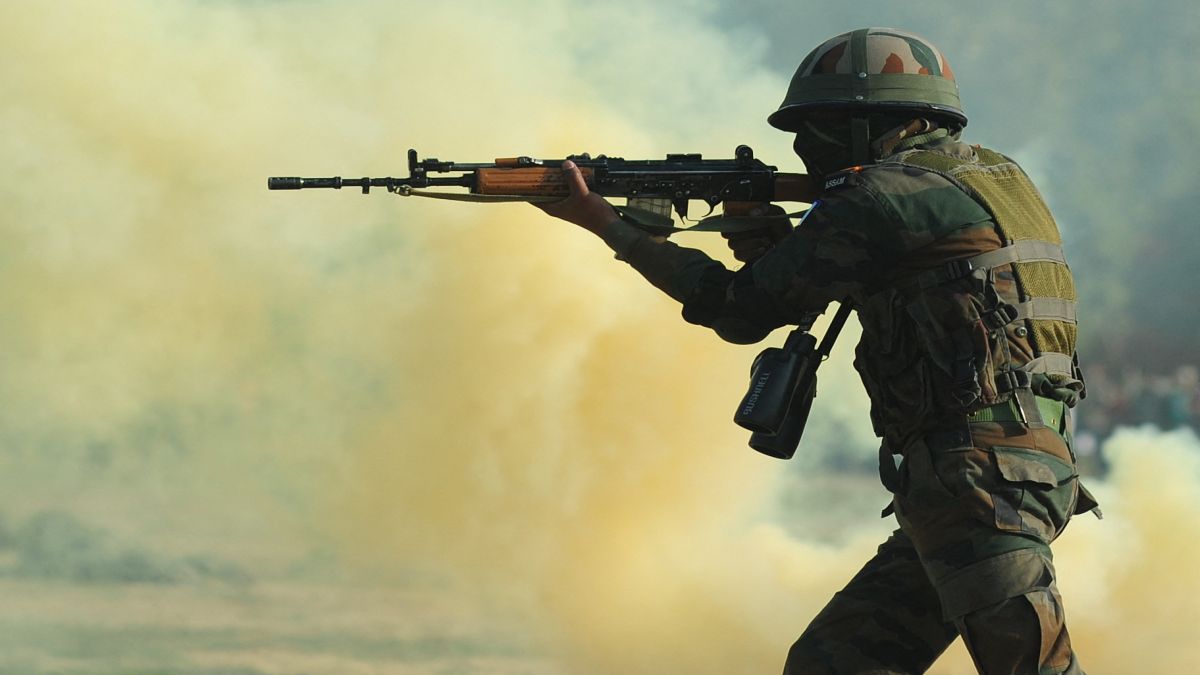
 "The Bhairav Commandos of the Indian Army will help bolster national defence. Representational image/AFP")
The armed forces are currently undergoing a series of exercises, and there are reports of restructuring within the Army. These are a fallout of studies, lessons from recent conflicts, including the Russo-Ukraine war and Operation Sindoor, as well as a possible stepping stone to the creation of theatre commands. At the same time, there are roadblocks emerging in the formation of theatre commands, with the Air Force having its concerns, including a paucity in its holdings.
Major exercises currently underway are aimed at testing joint capabilities and the integrated employment of power against our major adversaries in possible operational scenarios.
A media report mentioned that the Army’s Northern Command conducted Exercise Astra Shakti in Ladakh recently. The exercise was aimed at validating precision artillery firepower, the use of swarm drones and counter-unmanned aerial surveillance systems, alongside commando operations and synergy with the ITBP, which is deployed in a number of posts. The exercise was witnessed by the Army Commander. The intent was to validate the armed forces’ capability to respond to Chinese and Pakistani actions in the region.
Simultaneously, the armed forces are undertaking a 12-day tri-service exercise named Trishul, in Rajasthan and Gujarat, close to the border. As per an Army statement, the exercise involves “special force commandos from the Army and Navy, missile batteries, warships, battle tanks, and attack aircraft, including the Rafale and the Sukhoi Su-30, carrying out simulated offensive strikes into southern Pak to test the Indian armed forces’ readiness in a post-Sindoor scenario.” Approximately 40,000 troops are participating.
These will be followed by Exercise Poorvi Prachand Prahar in the Mechuka Sector of Arunachal Pradesh shortly. The exercises also include multi-domain operations covering cyber, space, and electronic warfare.
Impact Shorts
More ShortsExercise Trishul is reported to be a message to Pakistan considering its enhanced interest in Sir Creek, based on reports of possible oil and gas reserves in the region. Reports mention that Pakistan’s naval chief has made a few quiet visits to the region, and there are inputs of increased construction of defences by Pakistan. The exercise sends a firm message to Pakistan that any misadventure will be responded to.
India issued a NOTAM (Notice to Airmen), restricting its airspace up to a ceiling of 28,000 ft till 10 Nov around the region of the exercise. This indicates that the exercise would involve live missile and naval firing, as well as a collection of manoeuvres by the Air Force in the Arabian Sea. In panic, Pakistan also issued a similar notification covering regions close to the exercise and has placed its forces on alert.
While the intent is to convey a strong message to Pakistan, the exercise will also test coordination and cohesion among the three services, as a display of how theatre commands could operate. In addition, the exercise will tie down multiple Pak formations at a time when it is battling freedom movements in its western provinces.
The Army, on its part, is also raising Rudra Brigades, Bhairav Battalions, and Ashni Drone Platoons. Thus far, two Rudra all-arms task-oriented brigades and five Bhairav light commando battalions have been raised. These have been deployed against both northern and western adversaries. They will have both offensive and defensive tasks. Rudra Brigades would be smaller, lighter, and more effective forces compared to Integrated Battle Groups, which are already under raising.
Ashni Drone Platoons are planned for 380 infantry battalions. Each platoon will comprise strike and surveillance sections. Loitering ammunition and surveillance drones are already under procurement. Training of troops has also commenced. These new raisings have been tested in multiple exercises.
There are plans for more raisings of Rudra Brigades and Bhairav Battalions in the future. The next set of restructuring would involve existing artillery and mechanized units. Nag-2 missiles and upgraded infantry combat vehicles and tanks are also on the cards.
Artillery is already being upgraded to 155mm from the existing 105 and 130mm guns, with orders for the first set of guns already placed. Long-range rockets are also being inducted. The modern battlefield necessitates guns with the capability to “shoot and scoot”, implying fast deployment, firing multiple bursts, and moving out before being targeted by enemy counter-artillery fire or drones.
All these raisings are within the existing sanctioned manpower levels. A major factor that needs consideration is that most equipment being inducted is being manufactured locally. Dependence on imports must be minimal. Funding from the government also needs to be a continuous process. Restrictions on funds will impact restructuring, as happened with the Mountain Strike Corps.
The armed forces need to continuously evolve to meet the changing nature of warfare. Future operations will be dominated by the employment of air, missiles, drones, and rockets, alongside operations of special forces. Simultaneously, conventional wars cannot be written off, as the Russo-Ukraine war has indicated. Troops are also needed to hold defensive positions along current frontlines.
China, which remains a major threat, would continue with its actions at local levels while maintaining force readiness for major operations. To counter Chinese intrusions, there is a need to create structures that can conduct similar operations in near-similar timeframes in areas of our choosing, considered sensitive to China.
While this risks escalation, unless attempted, the response of the Chinese will never be known. Possibly, Rudra Brigades are ideal for this task.
India has simultaneously commenced the induction of the 800 km range BrahMos missile. While the Defence Minister mentioned this as a counter to Pak, in reality, it would be a major challenge for China, as most of its bases, choke points on induction routes, as well as hardened shelters in its airbases close to the LAC, would be within range. With the development of infrastructure, artillery could be deployed further forward, enabling engagement of targets in depth.
Pakistan is well aware of India’s military might. Thus far, it has survived on nuclear rattling and information warfare, while its military hierarchy remains aware of the gap in conventional force structures. Operation Sindoor was just a teaser, with no army offensive formations mobilised. Future operations may be vastly different, with Exercise Trishul being just a sample.
Simultaneously, there is a need to push for integration and jointness by creating theatre commands. Shortfalls in resources will always exist, but measures to overcome them must be found. The Operation Sindoor model of centralised control cannot be adopted for a major conflict.
Further, as the nature of operations changes with the induction of technology, force structuring should follow suit. Emphasis on indigenisation must remain, alongside continuous financial support. It is only by displaying offensive and counter-strike capabilities that the nation can achieve deterrence. Defensive capabilities are essential but will not deter an adversary who has limited aims or intends to embarrass the nation.
(The author is a former Indian Army officer, strategic analyst and columnist. Views expressed in the above piece are personal and solely those of the author. They do not necessarily reflect Firstpost’s views.)