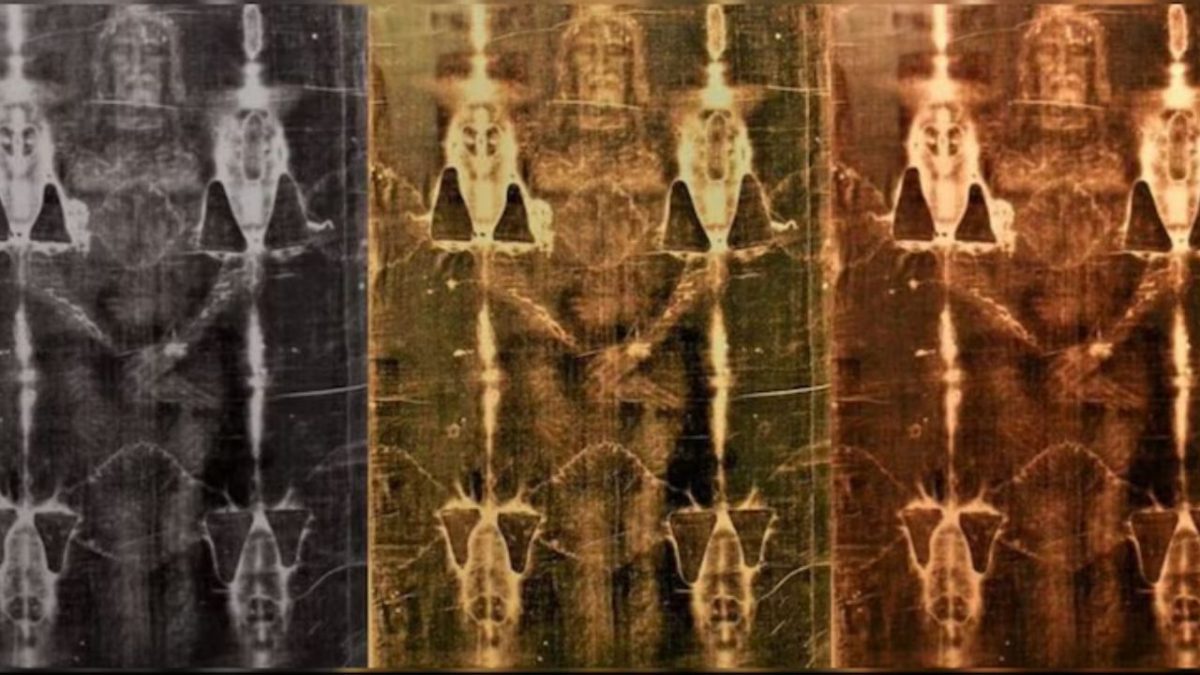
 "The discovery of Indian ancestry in biological traces on the Shroud of Turin has reignited the debate over the origins of Christendom’s most famous relic and its potential manufacture in the East.")
Nearly 2,000 years after it was used to cover his body after crucifixion, the shroud of Jesus is back in the news. This week, the Shroud of Turin, one of Christendom’s holiest relics, was brushed for DNA prints and seen to contain traces of Indian ancestry. The discovery of Indian DNA on this 4.36-metre linen cloth that bears on itself the faint mark of a face and body has caused considerable excitement in India, hitting headlines and making people — both spiritual and lay — wonder at Jesus’ India connection.
The shroud — currently at the Cathedral of St John the Baptist in Turin, Italy — has been an object of both reverence and conjecture for centuries. It was photographed for the first time by S. Pia in 1898 and has been, since then, subjected to multiple scientific tests. While a section of the Christian world deeply reveres it as an original relic, others say it is, in fact, a very clever medieval fake.
Biblical sources, though, are quite unequivocal on the matter of a shroud. The Gospels of Mark, Matthew and Luke mention that once the Roman magistrate Pilate allowed Joseph of Arimathea to take Jesus down from the cross, his followers wrapped him in “fine”, “clean linen”. After this, the body of Jesus was placed in a sepulchre and a rock was used to block the door. That linen wrap, or shroud — 4.36 metres long and 1.1 metres wide — later resurfaced in medieval France and then made its way to Turin, where it has stayed for nearly four centuries.
Throughout its historical past, it has continued to drive debate over its age and authenticity. Holger Kersten describes it in his wildly controversial but hugely popular book Jesus Lived in India. The shroud, he writes, bears an impression of a “head, face, thorax, arms, hands, legs and feet”, and its age becomes evident from its natural sepia colour, which is punctuated with faint blood stains and grey discolouration. It also bears the mark of more recent history in the form of two dark streaks that end in diamond-shaped spots — a result of a mid-16th-century fire in the chapel at Chambéry in France that nearly singed the cloth.
Quick Reads
View AllA closer inspection of the material shows two things: first, it was a rare weave and therefore possibly of considerable value; and second, although linen, it had “traces” of cotton too, which must have been imported. Kersten immediately connects the dots in his book. The fibre in this linen cloth is “twilled together in a ratio of 3:1, creating a fishbone weave”. This kind of loom work was not peculiar to Judea but was likely sourced, at some expense, from “the Roman province of Syria to which Palestine then belonged”.
While that in itself is understandable, given that the Bible does say Joseph of Arimathea was a wealthy man, what is more interesting is the shroud’s Indian connection. In 1973, textile expert Professor Gilbert Raes of the Ghent Institute of Textile Technology in Belgium was allowed to analyse a small sample of the shroud to figure out its antiquity and origins. His research showed traces of cotton fibres mixed with the linen, and his sample, called the Raes sample, later became a cornerstone of future research into the shroud. The Raes sample indicated that the shroud was probably woven on a loom which was used for both cotton and linen.
But here’s the thing: cotton was not grown anywhere in the Levant during Jesus’ time. Which means, if the cotton contaminations are correct, the shroud may have had some Indian connection. Later tests by research chemist Ray Rogers showed that the cotton was “Old World” and the cloth was 10 per cent to 20 per cent cotton and 80 per cent linen.
The trouble is, the Shroud of Turin has undergone multiple carbon-14 dating tests, and many of these claim it was far more recent than it is made out to be. A 1989 study by P.E. Damon (which was published in Nature) declared that it was likely produced between 1260 and 1390. In other words, it was most definitely a medieval fake. The samples were tested in three separate labs — at the University of Arizona, the University of Oxford, and the Swiss Federal Institute of Technology — but the findings were not above controversy. These institutes used accelerator mass spectrometry (AMS) techniques to try and carbon-date the shroud. Shroud researchers claimed that it is possible the cloth was repaired in the Middle Ages and thus its contamination may be more recent than the original weave.
Subsequent studies of the shroud show that the radiocarbon dating done earlier does not match current requirements of accuracy, and given that the object has been exposed to various contaminations — from thymol vapours in the 1980s and 1990s to a fire in 1532 — its exact dating requires further study. Researchers have also found fungi and bacteria which may have partly impacted the dating of the sample, and some researchers have even used pollen on the cloth to show that many of the plants that have left traces on it do not grow in central Europe at all. Instead, pollen from vegetation varieties like tamarisk, seablite and artemisia are more common in West Asia.
Which brings us to the current study that has thrown up yet another India angle to the shroud. Gianni Barcaccia of the University of Padova and a team of researchers examined biological material collected from the shroud. According to their study, the shroud has certainly been exposed to Indian and Mediterranean DNA, once again giving rise to the theory that the cloth could have been woven in India. One look at historical records tells us this is entirely probable. India’s cotton exports have an ancient lineage.
In his Histories, 5th-century BCE Greek historian Herodotus famously called cotton “sheep wool that grew on trees”. This “tree wool”, he noted, was what Indians used to weave all their clothes from. By the 1st century CE, Pliny the Elder wrote about the amount of Roman gold that was making its way to India to pay for cotton fabric. The Periplus of the Erythraean Sea even gives a list of different types of cotton and the Indian ports they were shipped out from, including Barygaza (or Bharuch in Gujarat) and Muziris on the Malabar coast.
There are references to cotton exports even in Sangam epics like Silappatikaram, which mentions fine cotton being manufactured and exported from rich mercantile cities like Puhar and Madurai, with cloth merchants catering to both domestic and overseas markets. Indeed, cotton and silk textiles were an important manufacturing commodity from the Sindhu-Saraswati period itself, and there are enough needles and spindle-whorls that were found in Harappa and other similar sites to support this theory.
Given that India’s trade with the Roman Empire in general, and the Levant in particular, is well recorded, and its cotton manufacturing skills equally well known, the Shroud of Turin’s India connect may not be historically far-fetched. The ancient world was far more connected than we give it credit for. The Shroud of Turin, one of history’s enduring mysteries, has just proved that point.
(Nandini Sengupta is a freelance writer and author of several books. Views expressed in the above piece are personal and solely those of the author. They do not necessarily reflect Firstpost’s views.)