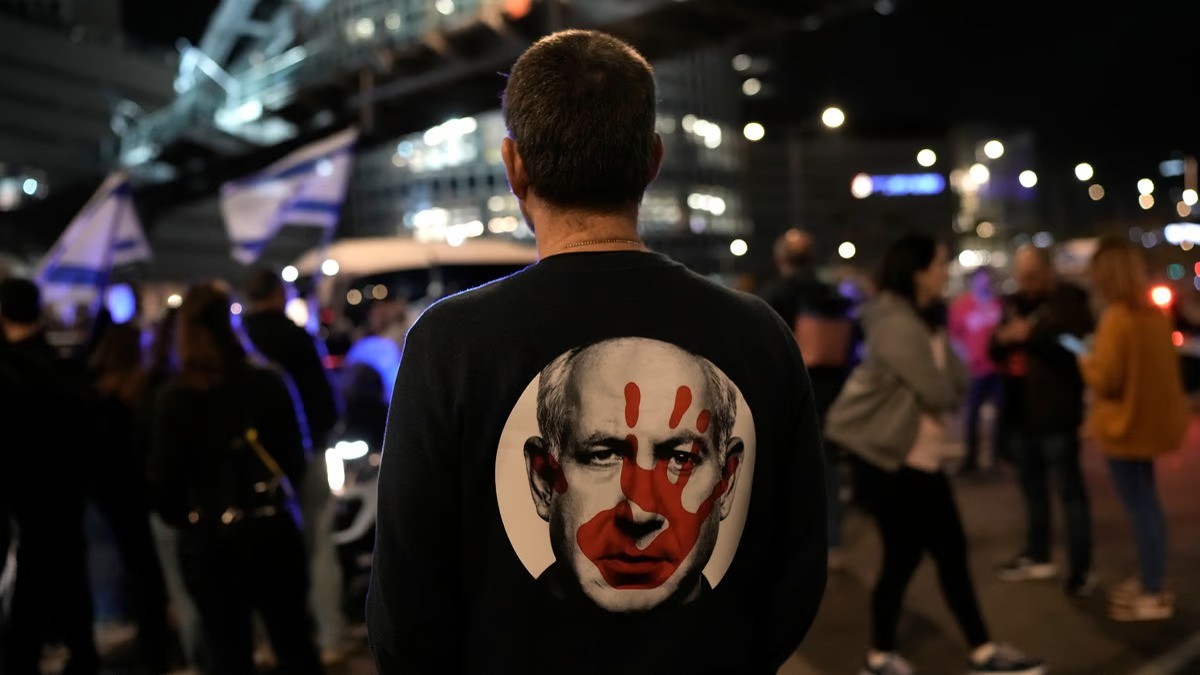
 "the pursuit of objectivity in reporting on the Israeli-Palestinian conflict is as crucial as it is challenging. Image: AP File Photo")
As daylight breaks over the scarred landscape, the air trembles with the echoes of last night’s turmoil. The sun, a silent witness, rises over a tableau of destruction a neighbourhood now rubble and ash. In this moment of calm after the storm, a single image pierces the veil of statistics and reports, an image that will soon travel beyond these borders, across oceans, and into the hearts and minds of millions.
In the frame stands a child, no older than eight, clutching a tattered doll a stark contrast to the devastation that surrounds her. Her eyes, wide and unblinking, seem to capture the entirety of the conflict in one haunting gaze. This photograph, this frozen sliver of time, is about to become the epicentre of a global reaction, as it is shared and reshaped within the narrative of the Israeli-Palestinian War.
The main players in this unfolding drama are manifold. There is the photographer, a local journalist who has witnessed the cyclical violence that marks this land. There are international media outlets, ever-thirsty for compelling visuals to bolster their news cycles. And there are the activists, human rights advocates, and policymakers, each interpreting the image through their own lens of agendas and aspirations.
The challenge, as always, lies in discerning the truth amidst the fray. How can one image encapsulate the complex tapestry of historical grievances, political manoeuvring, and human suffering that defines this war? The problem is multi-layered, as the photograph becomes a tool, a weapon, and a plea all at once.
Impact Shorts
More ShortsThe approach to understanding this image and, by extension, the role of imagery in the conflict requires a meticulous deconstruction of its elements. The photographer’s intent, the context of the moment captured, and the subsequent path of dissemination, all these factors unite to inform the narrative that emerges. The image travels from the photographer’s lens to the world stage, where it is interpreted and re-interpreted, each iteration compounding its emotional resonance.
The results are powerful and immediate. Public outcry swells, humanitarian aid is mobilised, and on the global political stage, leaders are pressed to respond. Data shows spikes in social media engagement, shifts in public opinion, and even policy changes all stemming from the dissemination of a single, compelling image.
Reflecting on this case, one cannot help but ponder the implications. What are the ethical considerations of using such images? Do they inspire empathy and action, or do they commodify suffering? It’s a delicate balance between raising awareness and respecting the dignity of those caught in the conflict.
Visual aids, like the photograph itself, serve to bring these questions into sharper focus. They act as a bridge between abstract statistics and the visceral reality of those living in the war. Through them, we see not just the physical destruction, but also the resilience and humanity of those who endure.
This instance connects back to the larger narrative of the Israeli-Palestinian conflict, a narrative where imagery is a permanent tool in shaping perceptions. The power of a single photograph or video clip can transcend borders, languages, and cultures, becoming a touchstone for solidarity or a beacon for action.
I am no stranger to the complexities of war and the impact of imagery. I’ve seen the power such images wield. But as we navigate the narratives, we must always strive to look beyond the frame, to the stories untold, and the voices unheard. Only then can we begin to grasp the full scope of the Israeli-Palestinian War and the images that define it.
International Media Bias
For decades, the world has witnessed the Israeli-Palestinian conflict unfold across the pages of newspapers and screens of televisions, with each side accusing the other of distortion and manipulation. Behind these claims lies a more pervasive and subtle influencer: international media bias. The very entities tasked with delivering news have often been accused of colouring the facts, shaping public perception, and altering the course of political discourse. This critical investigation peels back the layers of these accusations, examining the intricacies and implications of media bias in reporting on the Israeli-Palestinian conflict.
The central assertion here is that international media has, at times, exhibited bias in its coverage of the Israeli-Palestinian war, which has influenced public opinion and policy worldwide. To substantiate this claim, we must first consider the primary evidence: The patterns of coverage that suggest a tilt in perspective.
A study conducted by the Media Research Centre analysed hundreds of articles and broadcasts, revealing a tendency to frame Israeli military actions as aggressive and to describe Palestinian casualties in more personal terms. For example, descriptions of Israeli forces often included words like ‘occupy’ or ‘invade,’ while Palestinian groups were more frequently referred to as ‘militants’ or ‘fighters,’ rather than ‘terrorists.’
The language used in media reports is not merely a choice of synonyms; it shapes the narrative and, by extension, the audience’s understanding of the events. The use of emotionally charged words can elicit sympathy or condemnation, often blurring the lines between reporting and advocacy.
However, it would be intellectually dishonest not to acknowledge the counter-evidence. Proponents of the media’s approach argue that the coverage is a reflection of the reality on the ground. They point to the asymmetry of power between the two sides and suggest that the media is merely highlighting the plight of the less powerful. Furthermore, they cite instances where Israeli narratives have been supported by major news outlets, especially when reporting on rocket attacks and terrorism concerns.
In response to these counter-arguments, one must consider the journalistic responsibility to provide context. While it’s true that highlighting human suffering is crucial, so is presenting the complexity of the conflict, including the history, the politics, and the cycles of violence that perpetuate it. By failing to provide this balance, the media risks perpetuating a one-sided view.
Additional supporting evidence can be found in the disparity of airtime and column inches given to each side’s grievances and narratives. A content analysis of network news over a six-month period showed a significant discrepancy in the coverage of Palestinian and Israeli-led violence. This inconsistency suggests an underlying bias that favours one narrative over the other.
As we draw conclusions, it’s clear that while instances of bias in media reporting on the Israeli-Palestinian conflict exist, the issue is complex. The media’s role in shaping public perception and policy cannot be understated. It holds the power to influence international relations, humanitarian aid, and the very fabric of societies.
In conclusion, the validity of the claim that international media bias colours the reporting on the Israeli-Palestinian war is reinforced through the examination of language use, context omission, and the quantity of coverage. The media, as the conveyor of information, has a profound duty to deliver unbiased news. Yet, as we’ve seen, this ideal is not always achieved.
In the end, the pursuit of objectivity in reporting on the Israeli-Palestinian conflict is as crucial as it is challenging. It demands of us a commitment to scrutinise every story, to question every headline, and to recognise that in the war of narratives, the pen can be as mighty as the sword.
The article is an extract from Dr Joseph K Thomas’ book, ‘Israel-Palestine War: Give Peace a Chance’, which offers a comprehensive analysis of one of the most complex and the oldest conflicts still affecting the world. Views expressed in the above piece are personal and solely those of the author. They do not necessarily reflect Firstpost’s views.