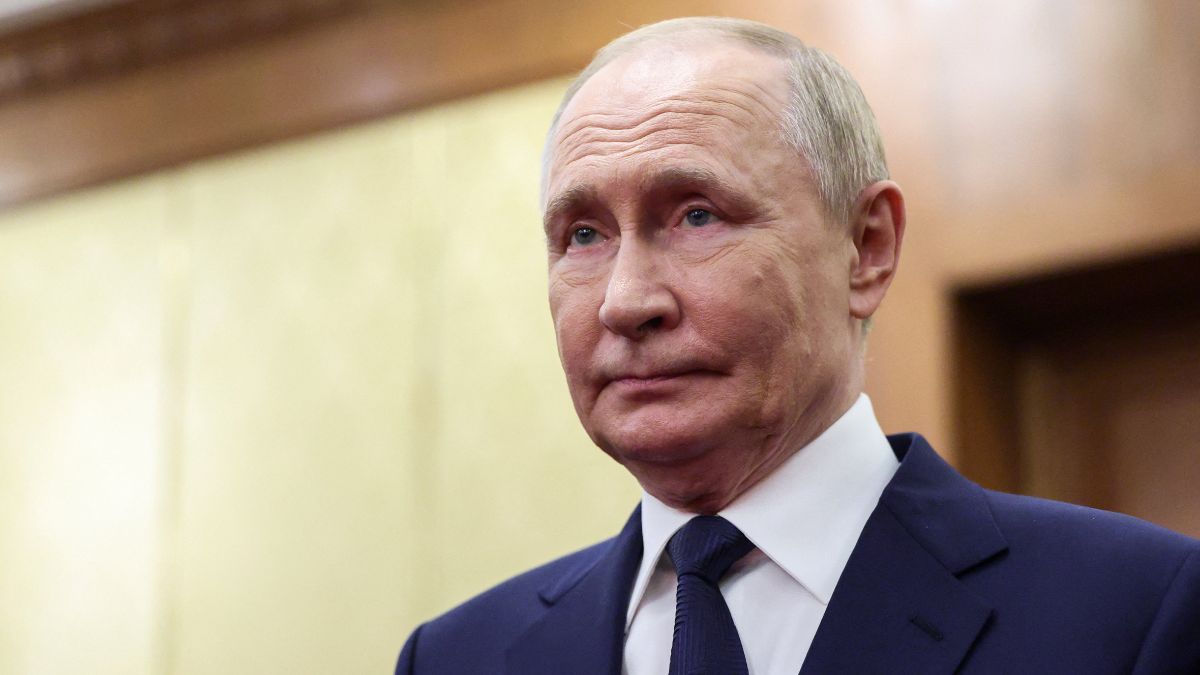
 "Russian President Vladimir Putin")
The global nuclear threat is increasing. At a time of severe tensions between Russia and the United States and a continuing war in Ukraine, Moscow tested not just a nuclear-capable missile, which is par for the course most of the time, but a nuclear-powered one, which means that it has a small nuclear-powered unit on board.
That can have big implications, especially in the case of an accident or misadventure. But what is even more interesting is the timing of the test and its attendant fallout in terms of ending the Ukraine war. Meanwhile, Europe, as it has done so many times before, seems to be engaged in expanding the war.
Completely new missile
The test of the Burevestnik—meaning a stormy petrel, a bird of the seas—took place on October 21, but was announced only on October 26 for reasons unknown. Russia’s top general, Valery Gerasimov, chief of the general staff of Russia’s armed forces, said that the missile travelled 14,000 km (8,700 miles) and was in the air for about 15 hours. It’s entirely possible, since it is travelling on nuclear power, unlike existing missiles whose ranges are limited by a complicated fuel weight versus warhead balance. It has an unlimited range.
The missile has been in development at least since 2018 and seems to have had hard luck in earlier tests, with at least 12 failures, and one in 2019, leading directly to the death of at least 5 scientists and reported radiation in the White Sea. Earlier assessments from Western sources put the final date of entry into service as at least a decade away.
In 2024, a potential site for the missile was identified 260 km north of Moscow and, extremely unusually, located right next to a nuclear storage site. The reasons for that are unclear, though it could be a deliberate move to ensure that no one attacks that base. The attendant radiation could envelop Europe and the US. But once in service, it could be a game changer, with this in theory capable of circling the earth for days and dodging missile defences.
Impact Shorts
More ShortsCritics, however, say its subsonic speed made it vulnerable to interception. The question is, however, whether it can be shot down over ‘friendly territory’, thereby risking the population to radiation.
Future of arms control
Add to all this. The only arms control treaty still in existence, the ‘New Start’, is due not just to expire next year, together with a clutch of treaties that the US walked out on; it also does not really cover this range of missile, with an ICBM defined as having an ‘intercontinental range’ of 5000 km. This could be at least twice that or more.
Whether the US is at all interested in arms control now is contested. A not unreasonable view among the arms control community is that any new treaty should bring in China. The latter rather leaves the door open to bring in others like India with a budding ICBM capability. A whole train of events could follow soon that New Delhi needs to keep an eye on.
Cautious reactions
Meanwhile, US President Donald Trump was interestingly casual about the test, observing that it was ‘inappropriate’ . He did mention that the US had a nuclear submarine “right off their shores”. But, this aligns with Trump’s stance on Ukraine, where he has said that Europe should pay for supplying US weapons, funding peacekeepers if a ceasefire happens, and covering reconstruction costs.
In other words, Washington is saying this is not its war and has, in a rather unprecedented strategy, ‘refused’ to acknowledge implied nuclear threats to it, though it is also arguing for a resumption of nuclear testing.
Nato’s Secretary General Mark Rutte, for instance, dismissed the whole thing, saying it did not see any immediate dangers despite ‘reckless and irresponsible’ statements from Moscow. This is, however, accompanied by considerable unease in Europe, with President Macron offering a ‘discussion’ on French nuclear forces—numbering about 300—as a deterrent for Europe.
Then came the Northwood Declaration of July 2025 with the UK, which stated, “Our nuclear weapons exist to deter the most extreme threats to the security of our nations and our vital interests. Our nuclear forces are independent but can be coordinated and contribute significantly to the overall security of the Alliance and to the peace and stability of the Euro-Atlantic area." It, however, again exercises caution in declaring that there is no ‘immediate’ threat.
Ironically, the UK’s deterrent—at about 225—is entirely US dependent. But it’s still a development indicating unease. France has continued to modernise its arsenal of submarines with a recent test of the M-51 SLBM with new warheads, said to be capable of evading enemy defences. Submarines form the core of the French deterrent. All in all, a nuclear arms race is developing, as SIPRI observes.
In sum, Putin may have succeeded in dividing Europe from the US, even as the European Union as a grouping slows economically on the back of high energy costs. Countries like Germany , which once powered the European Union, are now in recession. Political instability is also rampant, as much of Europe remains divided on the Russian war.
A red line
The launch of such a formidable missile by Russia is not without its own costs. It risks a pre-emptive strike and, as Trump says, is hugely vulnerable to submarine-launched missiles. But it’s the political messaging that is important here. This reflects Putin’s strong opposition to supplying Ukraine with 2,500-km-range Tomahawk missiles. Former Russian President Dmitry Medvedev and others have warned that it is impossible to distinguish between a nuclear-armed and a conventional Tomahawk, cautioning that such a move could ultimately backfire on Trump himself.
That is naturally why Ukraine wants them in the first place. Everyone wants Washington in and on the ground. Meanwhile, the sanctions on Rosneft and Lukoil—which include all their subsidiaries involved in downstream activities—have led to the latter announcing the sale of all its international assets, which lie across the world. It supplies Hungary, Slovakia and Turkey’s major refinery. How this is going to pan out is unclear, as is whether this is a threat to Europe as well.
As of now the war grinds on with Russia’s advantage. Putin’s demand to retain all of Donbas, rather than merely freezing the current battle lines, is something Ukraine’s President Volodymyr Zelenskyy is unlikely to accept. Even a ceasefire based on the existing status quo—pending future negotiations—would likely require strong pressure from Trump to materialise.
Meanwhile, politically driven Europe is still insisting that all territory—including Crimea—be returned. That’s positioning. Everyone on the stage knows that’s not going to happen. Meanwhile, Russia has offered nuclear arms control talks, which Trump says is a ‘good idea’ even as SIPRI notes that there is no indication at all that Russia is increasing its tactical nuclear stockpile as predicted by the US in 2020.
Despite the Kremlin’s determination to retake all of Donbas, now part of its constitution, and to ‘disarm’ Ukraine, it appears to have no intention of triggering a nuclear escalation. Yet, European warnings suggesting that Nato territory could be next are often overstated, and these misperceptions are among the misconceptions fueling the war and costing hundreds of lives.
As a noted expert pointed out, Russia has never attacked Europe in its entire history, nor occupied it unless by treaty. It is Nato that has expanded steadily, despite repeated (unwritten) promises not to move “an inch” from its postwar borders. The universe is about cause and effect. Time for Europe to look closely at its own causes and ponder on the final effect. If it goes out of control, it might be truly final.
Tara Kartha is Director, Research and Analysis at the Centre for Land Warfare Studies. Views expressed in the above piece are personal and solely those of the author. They do not necessarily reflect Firstpost’s views.