

 "Pro-Palestinian protests, repressions, and academia of ‘land of the free’")
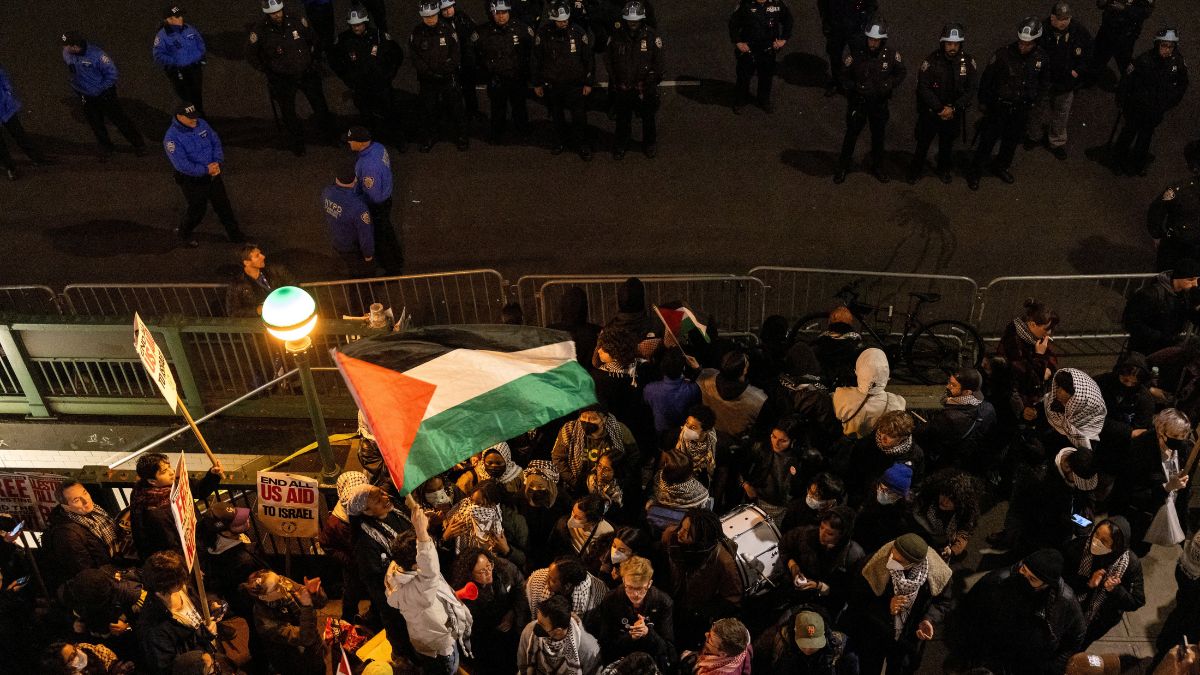
Columbia University saw the beginning of pro-Palestine student protests on April 17, 2024. These rallies were nonviolent and denounced the Israeli activities in Gaza, which were reported to have resulted in 35,000 deaths. Similar to the anti-Vietnam War protests of the 1970s, these demonstrations were a major national movement that culminated in the mass arrest of about 100 students by the New York Police Department (NYPD), who were wearing riot gear and using plastic handcuffs.
The participation of law enforcement organisations and the use of officially sanctioned violence that followed these incidents have sparked debates over the concepts of free speech and liberty in American academia. Academics like Stanford’s Douglas McAdam and Penn State’s Jonathan S Coley have extensively studied student activism in the US, providing frameworks for understanding the motivations, forms, and outcomes of these movements on college campuses.
Transition into a national movement
This wave of demonstrations has spread beyond Columbia University to a number of other universities, including Yale in New York, the University of North Carolina at Chapel Hill, Miami University in Ohio, and Temple University in Philadelphia. Furthermore, the impact of these protests goes beyond the boundaries of the school, as demonstrated by the story of Achinthya Sivalingam, an Indian national who was detained and expelled from Princeton University in the United States.
Due to Sivalingam’s involvement in a student-led pro-Palestine camping demonstration that took place inside the university’s boundaries, a disciplinary procedure was started, and this punitive measure was placed in place while it was ongoing. Scholarly jargon says that these incidents represent an important convergence of sociopolitical activism and higher education, prompting a critical examination of the constitutional liberties afforded within educational institutions and the ethical implications of their enforcement.
Impact Shorts
More ShortsHistory of student protests in the US
The substantial surge in student protests within the US can be traced back to their involvement in the anti-Vietnam War movement during the 1970s. Notably, in April 1968, students at Columbia University and its affiliated institution, Barnard College, staged a demonstration against the Vietnam War, a conflict spanning from 1954 to 1975.
These protests manifested in the occupation of five campus buildings, accompanied by the temporary detainment of a dean. The Civil Rights Movement concurrently instigated discussions and contemplations on racial dynamics and justice within predominantly white campuses, thereby impacting the collective consciousness of the student body.
Simultaneously, the lowering of the voting age from 21 to 18 in 1972 galvanised protests against the apartheid regime in South Africa. The demands articulated by student protesters mirrored those voiced in contemporary protests, emphasising the imperative for university divestment from entities supporting or benefiting from South African apartheid.
Their efforts yielded significant outcomes, with 155 universities eventually divesting. Moreover, in 1986, succumbing to pressure from demonstrators, the US government enacted a divestment policy. In parallel, the ongoing protest encampments are advocating for analogous measures, urging university administrators to divest endowments from corporations associated with Israel’s actions in Gaza, sever ties with Israeli academic institutions, and formally endorse a ceasefire.
Over subsequent decades, mass protests materialised against the Iraq War, amidst the Occupy Wall Street movement, and in response to the killing of George Floyd. However, these demonstrations predominantly unfolded off campus. Nonetheless, technological advancements facilitating real-time access to national protests have augmented student awareness of activism and cultivated a sense of responsibility among them.
Columbia University president grilled over anti-Semitism
Columbia University’s President, Minouche Shafik, encountered intensified scrutiny following a pointed rebuke from a campus oversight panel regarding her administration’s handling of a pro-Palestinian protest on the New York campus. Shafik, a British-American academic and economist, assumed the presidency of the university in July 2023, following her tenure as president and vice chancellor of the London School of Economics from 2017 to 2023. Of Egyptian descent, Shafik was summoned to testify before the House Committee on Education and the Workforce. The visit of former New York City Mayor Rudy Giuliani to Columbia University amidst the protests prompted his vehement condemnation of pro-Palestinian demonstrators.
The political landscape witnessed a familiar phenomenon wherein politicians seized upon the backlash to the protests of the 1960s, a trend observed in contemporary discourse. In the 1966 California gubernatorial race, former President Ronald Reagan criticised the incumbent governor and the president of the University of California for perceived leniency towards Berkeley protesters, despite the administration’s implementation of mass student arrests.
Noteworthy philanthropic figures associated with Columbia University, such as donor and alumnus Robert Kraft, founder of Columbia’s Foundation to Combat Antisemitism, and billionaire Len Blavatnik, suspended their donations to the university. Their actions were motivated by concerns over the perceived inadequacy of Columbia’s measures in combating campus antisemitism. Concurrently, Republican lawmakers, initially targeted for support by Shafik in her congressional testimony, called for her resignation. Notable among these voices were House Speaker Mike Johnson and several congressional members, who asserted that the university had failed to ensure the safety of Jewish students. Such accusations also limit down the presence of Jewish students themselves in the protests that are demonstrating for Palestinian rights.
What is anti-Semitism?
To begin, it is crucial to understand that Semitism is an identity delineated primarily by linguistic affiliations rather than racial categorisations. According to the narrative of Noah’s progeny recounted in the biblical book of Genesis (10), the linguistic lineage associated with Semitic languages purportedly traces back to the linguistic repertoire of Sem, one of Noah’s sons.
Although the exact etymological origins of Semitic languages are subject to scholarly debate, it is widely posited that these languages originated in the region of West Asia. Among the prominent Semitic languages are Arabic, Hebrew, and Aramaic.
The designation “Semitic” itself finds its genesis in the scholarly discourse of the late 18th century, particularly among members of the Göttingen school of history. August Ludwig von Schlözer, a prominent figure within this academic milieu, is credited with the inception of the term “Semitic” in 1781, specifically to denote languages closely affiliated with Arabic, Aramaic, and Hebrew. Subsequently, the evolution of the term “anti-Semitic” can be discerned in the intellectual exchanges between scholars, notably exemplified in the interactions between Moritz Steinschneider and Ernest Renan.
Avner Falk’s analysis reveals the trajectory of the semantic development of the term “Semitic” within the historical discourse, particularly as expounded by scholars such as Heinrich von Treitschke. This evolution is characterised by a notable conflation with Jewish identity, in stark contrast to the broader conceptualization espoused by Renan, which encompasses a spectrum of ethnic groups based primarily on linguistic affiliations. Consequently, the term “antisemitic” emerges as a corollary within this framework, denoting the manifestation of hostility or discrimination towards individuals perceived to be of Semitic descent, notably those of Jewish heritage, within both historical and contemporary contexts.
Nevertheless, the conceptualization of “anti-Semitism” as prejudice specifically directed towards individuals of Jewish descent has garnered official recognition. The European Parliament Working Group on Antisemitism, in 2010, adopted a definition aligning with this understanding. Similarly, the United States Department of State, in 2014, embraced a similar definition that eschewed the term “wrong.” This definition subsequently found incorporation into the Operational Hate Crime Guidance of the UK College of Policing. Thus, while acknowledging the inherent limitations and inaccuracies of the term “anti-Semitism,” institutional frameworks have endorsed its application in delineating discriminatory attitudes towards individuals of Jewish heritage. Yet it remains quite questionable why such discourse on Islamophobia are not having the same gravity as those accusations of anti-Semitism.
In academia, scholars have increasingly recognised the need to address Islamophobia as a form of racism and discrimination comparable to anti-Semitism. Efforts to analyse and combat Islamophobia have gained traction, with interdisciplinary research drawing on fields such as sociology, political science, cultural studies, and religious studies. However, institutional biases and systemic barriers continue to hinder the mainstreaming of Islamophobia discourse within academic circles, reflecting broader societal challenges in confronting prejudice and discrimination.
Conclusion
Efficiently executing a comprehensive boycott or import ban on all Israeli goods presents substantial logistical challenges, primarily due to the indispensable nature of certain commodities in contemporary global markets. Many Israeli products, including computer technology, medical devices, pharmaceuticals, and sophisticated heavy machinery, lack readily available substitutes or entail considerable difficulty in replacement. Despite these complexities, the prospect of divestment from Israel remains a pertinent avenue for influencing public perception regarding the ongoing conflict in Gaza and the broader Israeli occupation.
However, the efficacy of such divestment initiatives underscores deeper questions regarding the fundamental essence of universities and the preservation of academic freedoms. Central to this discourse is an interrogation of the parameters delineating state-sanctioned violence and surveillance within university settings. The intrusion of such mechanisms raises profound concerns regarding the preservation of academic autonomy and the safeguarding of democratic principles within educational institutions.
At the heart of this discourse lies an exploration of the concept of freedom of speech and expression and the correlative rights of students to engage in peaceful protests. Within the context of university campuses, traditionally regarded as bastions of intellectual inquiry and free exchange of ideas, the curtailment of student protests poses a fundamental challenge to the ethos of academic freedom. Consequently, interrogating the delineations of permissible dissent within educational settings becomes imperative in safeguarding the democratic fabric of society and upholding the principles of freedom of expression.
The author is a Research Fellow at Centre for India-West Asia Dialogue, a think tank based out of New Delhi. The views expressed in the above piece are personal and solely those of the author. They do not necessarily reflect Firstpost’s views.


 "Russian drones over Poland: Trump’s tepid reaction a wake-up call for Nato?")
 "As Russia pushes east, Ukraine faces mounting pressure to defend its heartland")
 "Why Mossad was not on board with Israel’s strike on Hamas in Qatar")
 "Turkey: Erdogan's police arrest opposition mayor Hasan Mutlu, dozens officials in corruption probe")
 "Russian drones over Poland: Trump’s tepid reaction a wake-up call for Nato?")
 "As Russia pushes east, Ukraine faces mounting pressure to defend its heartland")
 "Why Mossad was not on board with Israel’s strike on Hamas in Qatar")
 "Turkey: Erdogan's police arrest opposition mayor Hasan Mutlu, dozens officials in corruption probe")



