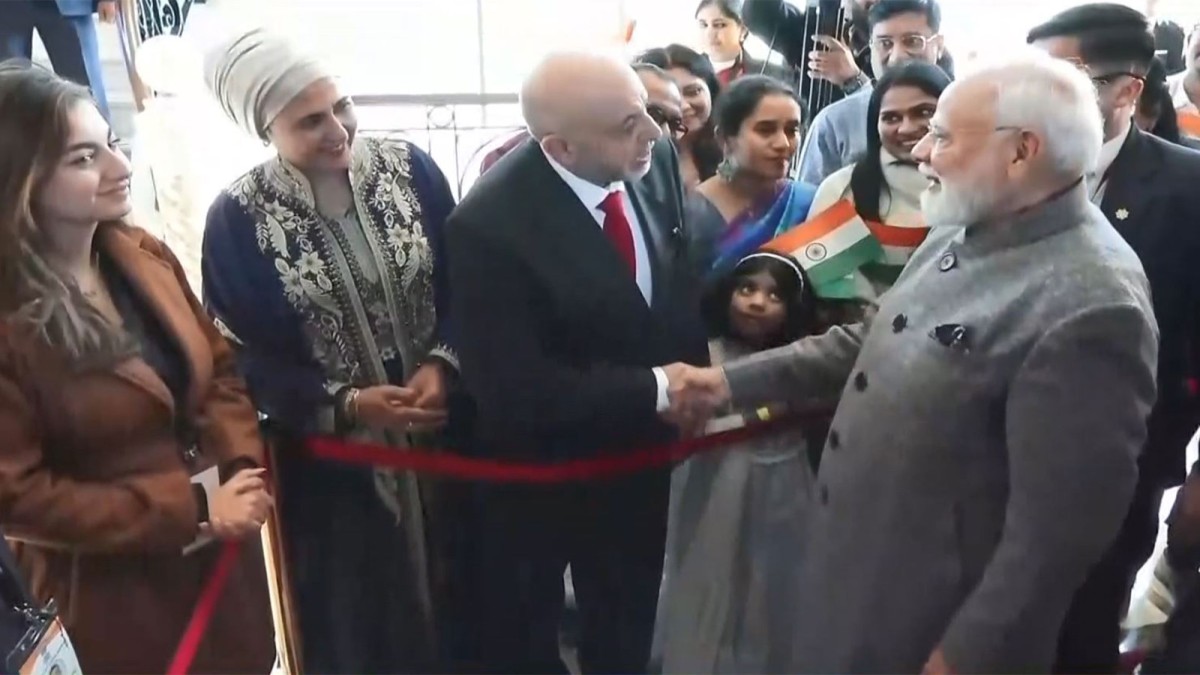
 "Prime Minister Narendra Modi is greeted by members of the Indian diaspora in Amman, Jordan, on Monday, December 15, 2025. Image: ANI")
Prime Minister Narendra Modi has landed in Jordan; the visit heralds a significant milestone in the bilateral relationship between the two countries. Although PM Modi visited Jordan in 2018, it was a brief transit stop on his onwards official visit to Ramallah, Palestine.
Jordan, although geographically small in size and population compared to other neighbouring West Asian countries, is vitally important due to its strategic location situated at the crossroads of three major continents, namely, Asia, Africa and Europe. Jordan provides a rare case of political stability in the region, where the shifting sands can cause ripples with profound ramifications.
India and Jordan have forged a close and cordial relationship which has been nurtured assiduously since India achieved independence in 1947. Subsequent governments have cemented this relationship further through important initiatives across various sectors.
Trade and Commerce
India is currently the fourth largest trading partner of Jordan, with bilateral trade being valued at $2.875 billion, with Indian exports to Jordan itself amounting to over $1.5 billion. Both sides aim at a more ambitious goal of reaching $5 billion by 2026. India’s exports to Jordan are quite diversified and growth-oriented as well as beneficial to Jordan’s economy, such as chemicals, machinery and electricals, pharmaceuticals, etc. Beyond these sectors, both India and Jordan are currently planning to expand their growing partnership to other niche areas such as AI, IT, and green energy.
Jordan has a trump card in the form of potash mining and exports. The Arab Potash Company, Jordan’s major producer of potash, can be a potential game-changer as it has immense potential for India’s economic sector. For Jordan, the export of potash is likely to pave the way in lowering the cost of critical mineral exports.
Quick Reads
View AllEducation and Culture
During King Abdallah II’s visit to India, February 27-March 1, 2018, a number of key agreements were signed between the two countries, which have since been augmented with renewed vigour. A Centre of Excellence was set up by the Centre for Development of Advanced Computing (C-Dac) in Jordan along with a dedicated unit catering to the needs of its IT graduates.
Al-Hussain Technical University in Amman has been provided necessary assistance under Indian Technical Economic Cooperation (ITEC), and as part of that, India has provided 28 designated slots. India, being a leading software superpower in the globe, has provided the state-of-the-art supercomputer Param Shavak for the promotion of critical research and a more affordable high-performance-driven computing solution for complex technical issues.
Although the number of Jordanian students studying in India is rather small, numbering about 500, this number is likely to grow as India’s ICCR has agreed to offer scholarships. India’s current NEP-2020 does offer a window of opportunity for international students, including Jordan, to take advantage of India’s first-rate educational outreach programme in various disciplines, including in Science, Technology, Engineering, and Mathematics (Stem) subjects.
In the cultural arena, India, being a viable soft power, does offer plenty of choices in the form of Indian textiles, Bollywood, cuisines, art, literature, yoga, Ayurveda, etc. The Jordan-India Friendship Society and the Jordan-India Alumni Association, among others, have been at the forefront of showcasing the cultural uniqueness of both Jordan and India. Events such as the Jerash Festival and celebrating International Yoga Day each year on June 21 are cases in point.
People-to-People Interaction
India and Jordan have an open-door policy as far as visits to respective countries are concerned. To enhance connectivity and greater mobility of nationals, Jordan has a visa-on-arrival policy for Indian tourists. On a reciprocal basis, India has similarly extended e-Transit Visa (e-TV) to Jordanian nationals for boosting tourism and for enhanced outreach. The Indian diasporic population numbering about 17,000 in Jordan, mostly comprising personnel working in 25 Indian-owned garment factories in the Qualified Industrial Zones (Qiz), also plays a pivotal role in promoting social and cultural exchanges.
Defence Cooperation
An MoU was signed between India and Jordan in 2018 which has laid groundwork for proactive cooperation in several defence sectors such as the training of military officials, piracy, counter-terrorism, cyber security, the defence industry, etc. One area in which India can offer valuable input and feedback is in the area of peacekeeping, as India has a solid track record of UN peacekeeping operations around the world, including in West Asia, Africa, and Asia.
Should, under the Gaza Peace Plan being propounded by President Trump, the services of Indian and Jordanian peacekeeping troops be required, both countries can cooperate and collaborate. It is worth noting that both India and Jordan have friendly diplomatic relations with both Israel and Palestine.
Imec Angle
India-Middle East-Europe-Economic Corridor (Imec) framework that was launched during the G20 summit in Delhi in 2023 can also be a potential boon for both Jordan and India. For Jordan, Imec provides an ideal outlet for positioning its strategic location in the corridor’s northern route by facilitating maritime transport from India to Arab Gulf countries, to be followed by land-based networks, including railways passing through Saudi Arabia, Jordan and Israel before connecting to ports in Europe.
Once Imec is being operationalised, it is likely to speed up cargo movement between India, West Asia, and Europe, thus reducing logistical expenses drastically, as well as providing energy transition through electrical grids and hydrogen pipelines. For Jordan, Imec can provide an opening for rapid growth and huge investment and in overcoming some of the economic challenges it is currently facing. If India and Jordan can join hands and cooperate, both sides can persuade other stakeholders to create uniform customs procedures, resolve technical glitches, and develop an acceptable regulatory mechanism and operational standards.
Overall, India and Jordan’s bilateral relationship is on a firm wicket, and under the leadership of both PM Modi and King Abdallah II, it is likely to witness an upward swing in the coming years.
(Mohammed Badrul Alam is Director of Research; Professor and Head, Department of Political Science, Retd; Faculty of Social Sciences, Jamia Millia Islamia University, New Delhi. Views expressed in the above piece are personal and solely those of the author. They do not necessarily reflect Firstpost’s views.)