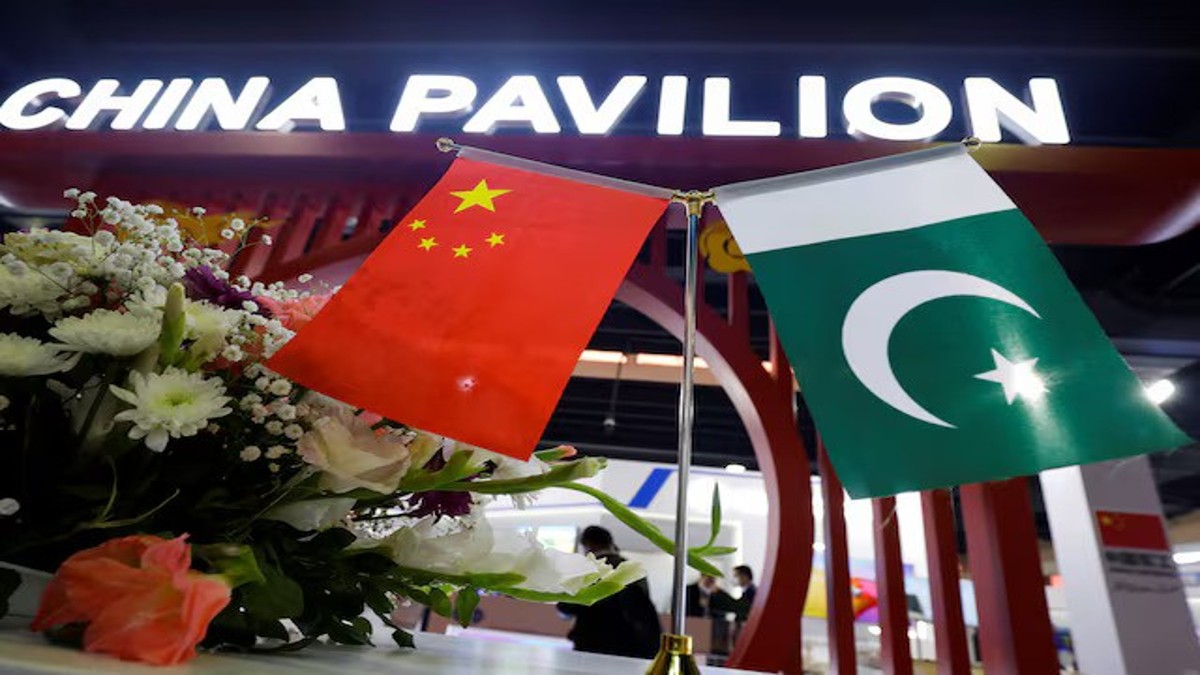
 "The Pakistani leadership is facing pressure from its friends for a secure environment for their investments, including its 'iron-brother' China. REUTERS")
On March 26, a convoy of Chinese nationals travelling from Islamabad to the Dasu Hydropower Project site in Khyber Pakhtunkhwa’s Kohistan District was attacked by Tehreek-i-Taliban Pakistan (TTP) terrorists. The Pakistani government quickly announced a compensation of $2.5 million for the families of the five Chinese nationals who had lost their lives. A joint investigation team comprising police and intelligence agencies’ personnel was then formed to probe the high-profile terrorist attack and also address Chinese concerns.
In just over two months, Pakistan’s law-enforcement agencies have completed the investigation. This is, indeed, a remarkable achievement, but it does not seem to have impressed the Chinese authorities, as there have been reports that Beijing wants a large-scale anti-terrorism operation carried out on the lines of Zarb-i-Azb against the militants.
Chinese Demand a Counter-Terrorism Operation
The reports of China’s demand for a massive counterterrorism operation are reflective of Beijing’s concerns over the escalating threats to Chinese nationals working on China Pakistan Economic Corridor-related and other projects in Pakistan. The South Asian country had earlier launched such counterterrorism operations at the behest of China.
There are reports that the Lal Masjid Operation in Islamabad in 2007 was launched after Chinese President Hu Jintao called Gen Musharraf. Prior to the operation, women students of the Jamia Hafsa madrassah had kidnapped Chinese health workers who they believed were commercial sex workers. Years later, the Lal Masjid Operation continues to haunt Pakistan and inspire global jihadi movements.
Impact Shorts
More ShortsInternational pressure, including from the Chinese, also worked in 2014 when the Pakistani military launched Operation Zarb-i-Azb in North Waziristan. While China supported the Financial Action Task Force’s recommendation that Pakistan comply with its counterterrorism financing and anti-money laundering commitments, they also argued that Pakistan be given more time to fulfil the FATF’s requirements.
However, China’s demand for a large-scale operation may not be feasible now as the Tehrik-i-Taliban Pakistan terrorist group is hiding in Afghanistan, and cross-border operations could have wider implications in the region. Further, the Baloch insurgency is also persisting between the insurgents and security forces. Insurgents recently targeted the Gwadar Port Authority Complex. The Balochistan Liberation Army (BLA), which claimed responsibility, has consistently opposed the CPEC, demanding that China abandon its operations in the region.
Pakistan’s economy is in the throes of a deep crisis, and a massive military operation would entail its own costs. At the same time, the Pakistani leadership is facing pressure from its friends for a secure environment for their investments. This is not only China, a major investor in Pakistan, but also other countries such as Saudi Arabia, which have concerns similar to Beijing’s when it comes to investing in Pakistan. Security concerns are being taken seriously.
On May 20, Saudi Crown Prince Mohammed bin Salman approved a cooperation agreement between the Presidency of State Security in Saudi Arabia and the military intelligence in Pakistan to combat terrorism and its financing.
The Pakistani leadership, however, appears confident in its assessment that the security challenges can be mitigated and wants the countries that are looking at investment in Pakistan to follow suit. However, terrorist incidents continue to shake the confidence of foreign investors.
The Afghanistani Angle
Afghanistan under the Taliban has emerged as a major security challenge for Pakistan, but terrorism and extremism have a long history of state institutions using them as tools for political and strategic purposes. The dynamics of terrorist groups are known, and preventive measures can be taken against them, but these get compounded with problems of border management.
Stable ties with Kabul are Pakistan’s strategic compulsion. But relations between the two countries have steadily deteriorated. This is contrary to expectations that the Taliban’s return to power in 2021 would help Pakistan secure its western border. Instead, there was a marked escalation in border tensions and terrorist attacks targeting Pakistan’s security forces. A surge in violent activities by the TTP from their safe havens in Afghanistan posed increasing threats to Pakistan’s security.
According to successive reports by the UN Security Council’s Analytical Support and Sanctions Monitoring Team, the “TTP benefited the most of all the foreign extremist groups in Afghanistan from the Taliban takeover". This echoed Pakistan’s assessment that Kabul’s unwillingness to act against the TTP presents a mounting threat to Pakistan’s security. Cross-border attacks escalated following the breakdown in November 2022 of the ceasefire brokered by the Afghan Taliban between Pakistani authorities and the TTP. In fact, the TTP used this to expand its reach in Pakistan.
Pakistan’s efforts to persuade Afghanistan’s Taliban rulers over the past two years to take action against the TTP have yielded little. The Taliban leaders offered assurances, asking for time, but did nothing. The spike in terrorist activities led to a significant rise in casualties among security personnel. Pakistani leaders publicly voiced concerns over “the safe havens and liberty of action available to the TTP in Afghanistan”.
In a recent press conference, Interior Minister Mohsin Naqvi held TTP responsible for the March attack on Chinese workers in Bisham. He said it had orchestrated this from Afghanistan as a “flagship project” supported by “enemy intelligence agencies”. He demanded Kabul arrest the terrorists behind the attack, prosecute them, or hand them over to Pakistan.
Despite Islamabad’s urgings, he said, the Taliban had not taken measures to prevent militants from launching attacks from their Afghan sanctuaries. This issue was also discussed by the Corps Commanders, who expressed serious concern over “continuous cross-border terrorist attacks” from Afghan soil, adding that “hostile foreign actors were using Afghanistan” to target security personnel and civilians in Pakistan.
Over the past year, Pakistan has taken actions to raise the costs for the Taliban regarding the TTP. It has conducted air strikes on the hideouts of the militant group in Afghanistan. In April, Pakistan announced they had carried out air strikes against militant sanctuaries and warned such actions would continue unless the Taliban changed course.
Pakistan then imposed certain restrictions on transit trade last October, banning a number of items that could be imported by Afghanistan via Pakistan. While the action aimed to curb smuggling, it also served to put pressure on Kabul. The Taliban responded by accusing Pakistan of politicising trade. Later. some restrictions were eased.
The third was the expulsion of around 700,000 undocumented Afghans residing in Pakistan. This has been implemented, with well over half a million Afghans repatriated to Afghanistan. The shadow of a second phase now hangs over the decision to deport around 600,000 Afghans holding citizen cards issued by Pakistan a few years ago.
The dilemma for Pakistan is that it cannot afford a rupture in relations with Afghanistan.
Conclusion
Intolerance in Pakistan is also leading to erosion of the social fabric, making conditions insecure for minorities. Intolerance has become a huge hurdle in the way of economic progress, including foreign investment. Last year, a Chinese citizen barely escaped lynching by a mob at the Dasu Hydropower Project site. On December 3, 2021, a Sri Lankan national, Priyantha Kumara Diyawadana, was lynched by a mob in Sialkot.
As per reports, the security of Chinese nationals in Pakistan was a key concern during the recent visit of Pakistani Prime Minister Shehbaz to China, where he, accompanied by General Asim Munir, held talks with President Xi Jinping.
Naghmana Hashmi, a former Pakistani Ambassador to China, said that Beijing is talking tough with Islamabad on the security of Chinese nationals to avoid a backlash from its own people.
“Their people ask questions; their journalists ask questions; here is our best friend, and we don’t have people dying anywhere except when they go to Pakistan,” Hashmi said. “Now, everybody does not understand the politics of it, so the optics of it are very bad,” the former diplomat said, reiterating Pakistani officials’ stance that adversaries want to derail CPEC.
There is no doubt that extremism and intolerance in Pakistan have thrived with state support. Decades of myopic policies have led to the radicalisation of significant portions of the population and created fissures in society. Unless there is a fundamental shift in Pakistan’s policy of supporting the divisive elements, Islamabad will find that its friends are facing a binary choice of ‘staying’ or ‘leaving’.
The author is a retired Major General of the Indian Army. Views expressed in the above piece are personal and solely those of the author. They do not necessarily reflect Firstpost’s views.